Public Safety Committee Discusses SDSU Traffic Stop Study on Nov 30, 2016
STREAMING COPY IN PREPARATION — RECORDING AVAILABLE FROM THE ORIGINAL SOURCE
Public Safety Committee Discusses SDSU Traffic Stop Study on Nov 30, 2016
The Public Safety and Livable Neighborhoods Committee held a special session on November 30, 2016, to review the full report from San Diego State University (SDSU) on traffic stop data cards. The meeting focused on findings of racial disparities in stops and post-stop outcomes, data quality issues, and recommendations for reform. The committee heard from researchers, the police chief, and extensive public testimony before voting to refer the report to the full City Council.
Public Comments & Testimony
- Non‑agenda public comment: Francine Maxwell (resident of Encanto) asked for more community representation on the police advisory board and criticized reactive use of forfeiture funds. Martha Welch raised concerns about county jails, police station hours, and lack of police academies.
- Comments on the SDSU report (pro‑action):
- Tony Young (RISE San Diego) urged policymakers to allocate resources for the issue.
- Armando King (community member) called for documenting and removing officers who racially profile; he stated the community did not need a study to confirm lived experiences.
- Norma Chavez Peterson (advocate) highlighted contradictions in the report (e.g., no disparity in stops for Latinos but disparities in searches and field interviews). She presented seven requests, including referring the report to council by February 2017 and implementing AB 953 early.
- Ignacio Luna (Lincoln High School student) said racial profiling is a clear problem at his school.
- Marvin Shaw (retired SDPD lieutenant) supported more training, accountability for stop‑card completion, and implementation of AB 953.
- Lee Hernandez (Office of Assemblymember Shirley Weber) submitted a statement supporting the report’s recommendations and urging early adoption of AB 953.
- Isabel Schechter stated that admitting the problem is the first step.
- Chris Wilson (community member) described different policing approaches in Southeastern vs. Northern divisions and called for one consistent approach.
- Dale Kelly Bankhead (San Diego & Imperial Counties Labor Council) urged leadership to implement AB 953 and develop training on racial profiling.
- Michael Dobbins (SEIU Local 221) supported racial justice and implementation of AB 953.
- Bob Pearl (Oak Park resident) encouraged white bystanders to observe and record police interactions.
- Paul Watson (victim of profiling) urged transparency and accountability.
- Willie Blair (former committee consultant) urged the committee to take the report seriously to uphold San Diego’s “America’s Finest City” title.
- Anne Marie Barron (Peace Resource Center) supported the recommendations but noted they do not go far enough; she called for a strong community review board.
- Dr. Peter Brownell (Center on Policy Initiatives) explained limitations of the “veil of darkness” methodology, arguing that the report may underestimate disparities; he submitted a Syracuse study for the record.
- Comments in opposition (or critical of the report):
- Martha Sullivan (Women Occupy San Diego) opposed the report due to alleged changes made at the mayor’s request, lack of independent review board powers, and no review of body‑camera footage.
- Richard Hilton criticized the inclusion of 2015 data, alleging deliberate adulteration.
- Eddie Price (community member) stated that the police department is the perpetrator and must own the issue.
- Rebecca Hookheld (San Diego LGBT Community Center) urged the committee to send the report to council with recommendations for SDPD to address disparities and comply with AB 953.
- Colleen Cusack (California Western School of Law) highlighted the intersection of race and poverty, citing financial incentives for impoundment and requested supervisor‑level documentation of targeted enforcement.
Discussion Items
- SDSU research presentation: Josh Chanin, Megan Welsh, and Dana Nurch presented findings from analysis of ~260,000 traffic stop cards (2014‑2015). Key findings:
- Disparities for black drivers (stops, searches, field interviews) in 2014 but not in 2015 combined data.
- Hispanic drivers were more likely to be searched and less likely to be found with contraband compared to white drivers.
- Asian/Pacific Islander drivers showed fewer disparities.
- Data quality issues: missing data increased over time; a 27,000‑citation discrepancy between stop cards and judicial records.
- Recommendations: acknowledge disparities, enhance training, improve transparency, make traffic enforcement more data‑driven, reduce number of stops, improve data collection, and strengthen accountability.
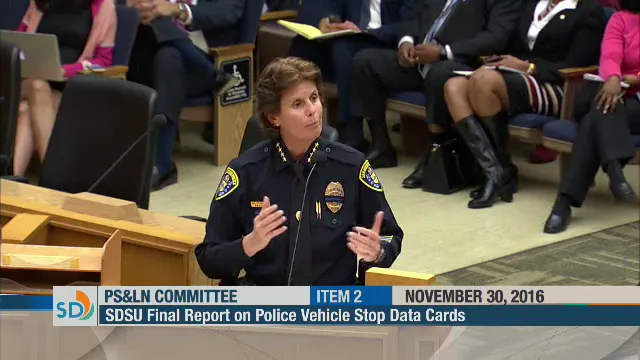
- Police Chief Shelley Zimmerman: Responded that every human has bias; SDPD has enhanced training on non‑biased policing, procedural justice, and emotional intelligence. She committed to 100% compliance with AB 953 once final regulations are known.
- Committee discussion:
- Chair Emerald asked about changes made to the report at the mayor’s request; researchers stated only minor corrections were made, not substantive changes.
- Councilmember Cole expressed disappointment that disparities persist, noting that black drivers are more likely to be stopped and searched but less likely to have contraband. She motioned to refer the report to the full council in February 2017 with several requests.
- Councilmember Gloria criticized the process (long delay, release before Thanksgiving, missing data) and stated the report did not clearly acknowledge police racial bias. He challenged the chief, who reiterated that everyone has bias. Gloria supported the motion but noted the need for budget investment.
- Councilmember Kate asked about systematizing traffic enforcement priorities and noted a lack of focus groups north of Interstate 8. He supported the motion while urging the public to advocate for funding in the budget.
Key Outcomes
- The committee unanimously approved Councilmember Cole’s motion to refer the SDSU report to the full City Council for consideration in February 2017. The motion includes the following requests:
- The police department commit to implementing AB 953 once final regulations are released early 2017.
- The department identify what systems are needed to collect data required by AB 953, including cost estimates, for budget discussions.
- The department explain how it will incorporate the report’s findings into academy and ongoing training, particularly regarding racial profiling, field interviews, and consensual searches.
- The department provide an update and timeline for reviewing policies that create intimidating interactions (e.g., multiple police vehicles at a simple stop) and develop a policy for traffic enforcement to reduce individual officer discretion.
- The mayor’s office and chief include in their report to council the specific actions they will take to implement all recommendations in the SDSU study.
- The committee also received its annual report of accomplishments (item 1) and a brief non‑agenda comment from Martha Welch. The meeting was adjourned.
Meeting Transcript
There are some people. Alrighty then welcome to the November 30th uh meeting of the Public Safety Livable Neighborhoods Committee. This is a special session uh to um uh re go back and take a look at the full report from our uh researchers at San Diego State University. Uh and October 26th, we had quite a great discussion of uh of the issues that uh that the community has concerns about, uh what the police department is doing to uh respond to those concerns and to uh build public trust and create uh what it really is that shared responsibility for public safety and quality of life in our city. And I'm I'm just gonna ask uh the speakers uh one for one favor that when we open this up to public comment, uh that we not so much dwell on uh the problem so much but the solutions. Uh as promised, the mayor's office released uh the full report from San Diego State uh uh but by Thanksgiving, as we had asked, and I want to thank the mayor's office for doing that. Thank you, Ron Via. I know that you burned the midnight oil, and uh our chief Shelly Zimmerman was probably up late too and uh uh offering suggestions and and helping to get uh a comprehensive report out. Uh I'm gonna ask that when you come up to speak, let's talk solutions because that's where we go next. Uh we've uh we've been given a very comprehensive study, took a lot of work and time on behalf of researchers who have a great deal of experience in this area. And so today ought to be the so what an opportunity to talk to council members, uh, to talk to the mayor's office, our police chief, and and let them know what what issues are of most importance to you and and how you see uh us coming to uh some kind of a resolution, a solution that brings all of us together as uh a tighter, uh more trusting community. Uh with that, um we're gonna take uh our items out of order. Our first item of uh item one, which is our annual report from this committee, which has been very busy. We'll take that after we have our our discussion of this uh police stop card study. Uh let the record reflect that all of our uh members of our uh committee are here, Mr. Gloria, Miss Cole, Mr. Kate, Mr. Herrera from the Mayor's Office, Linda Peter from the City Attorney's Office, our independent budget analyst Andrea Tevlin, thank you so much for being here, and our committee consultant Marissa Beruman. Uh with that, uh, we'd like to open the floor up to non-agenda public comment, beginning with uh Francine Maxwell. Miss Maxwell, good to see you again. And thank you for being here and uh and thank you for your voice. Thank you for all of that you do, and you know they will miss you. Uh, my name is Francine Maxwell. I'm a resident of Incano, and I wanted to ask the uh committee to think about the fact that my community has four shot spotters, and we need to have four seats on the police advisory due to them having um policy conversations that are going to enforce the data that's gonna come from the shot spotter since all four of them are in my community. Um I think that we should be at the table just a little bit more. Those faith base and those nonprofit people that are they have access to be behind the closed doors with you and the uh mayor's office, they don't they don't speak for all the constituents of the fourth council district. So we need to have more seats at the table so that the people that are going to be on the police advisory can have a true understanding of what is really happening in our community. I'm um dismayed at the fact that all four of them are in my community because um that means that the forfeiture money you wanted to be reactive with it instead of being proactive. You could have used some of the forfeiture money for victim assistance. Some of these issues are retaliatory. I completely understand all the things that are happening in my community, all the illegal firearms, but I haven't seen this city move towards a more preventative. It's so reactive that it is just astounding to me. So if we're gonna start using public dollars, let's start putting some things to help the victims because if they get help, the mindset change and we begin to change the narrative and preventive more than so much reactive. And I just wanted to come make that statement as we get ready to seat some new council people and you start to look at the broad. He had eight officers surrounding him. Four of them had their um guns drawn. So it didn't look like the part team was there for me. But that's neither here nor there. Thank you very much, Miss Maxwell. Martha Welch. Martha Welch. Welcome, Miss Welch. Thank you for being here. You'll have two minutes, ma'am. Martha Welch. You know the city used to county jails. You know that? Let's talk about the jails. Now there's a death in the uh death in the woman's. I heard it in uh in the county about the million dollars, they said about that death.
openpublica.com