Public Safety and Livable Neighborhoods Committee Meeting - March 8, 2017
STREAMING COPY IN PREPARATION — RECORDING AVAILABLE FROM THE ORIGINAL SOURCE
Public Safety and Livable Neighborhoods Committee Meeting - March 8, 2017
The Public Safety and Livable Neighborhoods Committee met on March 8, 2017, to discuss a range of public safety and neighborhood issues. The agenda included informational reports on ambulance response times, fire station coverage, the Resource Access Program, downtown public restrooms, human trafficking enforcement, and a discussion item on red light abatement. The committee approved a routine consent calendar and made two specific motions: one requesting a fiscal analysis of the fire station coverage report and another directing the city attorney to identify additional tools for red light abatement.
Consent Calendar
- The committee unanimously approved the record of action items from the February 8, 2017 meeting.
Public Comments & Testimony
- Danny Avila (speaking as a victim of racial profiling) expressed disgust with the City Council's decision on February 25/27, 2017, not to adopt recommendations from the SDPD racial profiling report. He urged the committee to take action.
- Brisa Johnson (Alliance San Diego) echoed disappointment and called on the council to adopt the recommendations to address racial profiling.
- Susan De Boer raised concerns about security at Horton Plaza Park, citing an incident where a suspicious suitcase was handled by private security instead of police. She also repeatedly called for safe, clean public restrooms with security.
- John Long (business owner at Fault Line Park) reported that public restrooms at the park are magnets for homeless encampments, drug use, and criminal activity, harming his business. He requested an amendment to the development agreement for security or delayed opening.
- Lindsay Ford (manager at Stella Public House) detailed a log of incidents including exposure, knives, human waste, threats to staff, and needles in restrooms, emphasizing safety concerns.
- Jane Wu (volunteer with Alabaster Jar Project) described a nail salon where 25 workers were trafficked, and urged action against massage parlors used for sex trafficking.
- Nancy Chi (business owner on Convoy Street) reported that massage parlors in her plaza engage in prostitution and trafficking, affecting the community.
- Alan R. (President of San Diego City Firefighters) supported the Citigate report and highlighted the unique risks San Diego firefighters face.
- Ed Harris (lifeguard representative) questioned the auto-dispatch policy and suggested it may lead to unnecessary responses, straining resources.
- Steph Gross (Chair of Human Relations Commission) expressed support for the human trafficking task force and emphasized the importance of education.
Discussion Items
Ambulance Response Times (AMR Report)
- Mike Rice (Director of Operations, AMR Rural Metro) reported that the city is currently compliant in all eight emergency zones, meeting the 90% threshold for responding within 12 minutes. Staffing improvements include 32 EMTs in paramedic school, $5,000 sign-on bonuses, and a contract compliance committee. Hospital offload delays are being addressed with a county software tool. Councilmembers Zeff, Ward, and the committee chair asked about sustainability, retention, and hospital hold times. The item was informational; no action taken.
Fire Station Coverage (Citigate Report)
- Stu Gary (Citigate Associates) presented an updated standards of response coverage study. Key findings: citywide first-unit travel time is 6 minutes (goal 5), and multi-unit response (weight of attack) exceeds 8 minutes. The report identified 10 major gaps (down from 19 in 2010 due to improved modeling) requiring new stations, with six already in the CIP. Additional recommendations include three battalion chiefs and use of fast response squads. IBA Chris Olson raised policy questions on funding and prioritization. Councilmember Ward expressed concerns about engine saturation in his district; Councilmember Bree asked about UCSD station negotiations and motioned for a fiscal impact analysis by the IBA. The chair requested the analysis be completed before budget review and suggested revisiting council policy. No formal vote on the informational item.
Resource Access Program (RAP)
- Anne Jensen (RAP Program Manager) and Deputy Chief Gina LaMantia described the community paramedic program targeting frequent 911 callers. Approximately 1,200 to 1,400 frequent users generate up to 17% of call volume; 54% are homeless. The program has achieved a 52% reduction in calls from frequent users, saving $45,000 per month. The team currently has one full-time city employee and four AMR paramedics (currently understaffed). Dr. James Dunford praised the program. Councilmembers Ward, Bree, and Zeff asked about staffing, county integration, and expansion costs. The chair requested a cost estimate for expanding the program. Informational.
Downtown Public Restrooms (Grand Jury Response)
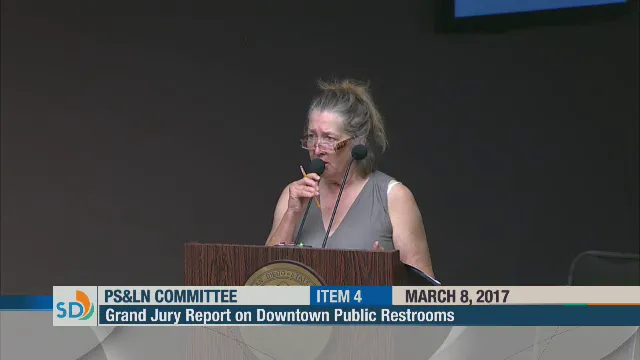
- David Graham (Deputy COO) and Daniel Kay (Civic San Diego) reported on the status of three grand jury recommendations. New restrooms have been added at Fault Line Park, Horton Plaza, and future projects. A wayfinding system with 200+ signs and 20 kiosks was installed. Challenges remain due to loss of redevelopment funds and criminal activity. Councilmember Ward argued the response is inadequate, stated the city lacks a comprehensive plan and sufficient budget, and called for improved collaboration with the Port and County. No action was taken on this informational update.
Human Trafficking Task Force
- Danny Santiago (California DOJ) presented task force statistics: in 2016, 190 leads, 50 cases, 36 arrests, 56 victims rescued (up from 29 in 2015). The task force conducted the first electronic wiretap human trafficking case in California. Training increased significantly. A critical need is housing for juvenile victims (zero beds available). Councilmembers Bree, Zap, and Ward asked about training strategies, juvenile beds, labor trafficking, and public postings (SB 1193). The chair noted adult beds are funded by NGOs. Informational.
Red Light Abatement (Discussion Item)
- Deputy City Attorney Patricia Miranda explained the process under Penal Code 11225 and general nuisance laws. Past successes include settlements at Mission Valley Travel Lodge, Howard Johnson, and La Quinta. Recent cases at massage parlors achieved voluntary compliance. Public comments described trafficking in massage parlors and the need for action. Councilmember Ward asked about time frames and legislative needs. The committee chair initiated a motion, seconded by Councilmember Zap, to direct the city attorney to identify additional municipal code provisions to strengthen abatement and prevent re-opening, with a report back in four months. The motion passed unanimously.
Key Outcomes
- Motion by Councilmember Bree: Request the Independent Budget Analyst conduct a fiscal impact analysis of the Citigate report recommendations. The chair specified that the analysis should cover the three main recommendations and be completed in time for the budget review process. The motion was seconded and approved.
- Motion by Councilmember (Zap): Direct the city attorney to identify additional municipal code provisions not covered by state law to enhance red light abatement enforcement and prevent operators from re-opening, with a report to the committee in four months. The motion was seconded and passed unanimously.
- All other items were received as informational; no further action was required.
Meeting Transcript
Good afternoon, everybody. Welcome to the March 8th meeting of the Public Safety and Livable Neighborhoods Committee. We have a quorum consisting of myself, Councilor Reward, and Vice Chair Bree and Council Member Zap is here as well, too. We have a very busy agenda, so we're gonna get right to it. First, start off with non-agenda public comments. We have Maggie O'Neill, followed by Danny Avila and then Brisa Johnson. And you all have two minutes. Thank you. Danny Avila, and then Brisa Johnson, and then Susan De Beer. Good afternoon. Um thank you for having me speak today. Um I just wanted to say thank you guys for your service. Um but I am disgusted with the city's uh council's decision on Feb uh February 25th, Monday, to not adopt any recommendations in the SDPD's racial profiling report. Uh why do we have to continue to keep coming down here expressing why racial profiling is wrong? I have been a victim of racial profiling myself. On November 10th, I was taken down by a bike that had been thrown at me by one of SDD SDPD's finest. I was arrested with three other black men solely because of the color of my skin. We need to stop this now. I have ask I asked the committee to urge the city council to take action now. People are dying all of our countries due to this problem. We will lose a great opportunity to show real leadership and be real, be a real role model for policing in other cities. Please tell this city council no more judgment based on the color of our skins. Please and thank you. Thank you. Good afternoon, committee. How are you all today? Good. Okay. My name is Brisa Johnson. I'm with Alliance San Diego local nonprofit organization here in the uh county of San Diego. Um and I'm here today just to express uh along with my um my fellow community members just some of my disappointment with the decision that was made by City Council on Monday, uh February 27th to not adopt the recommendations that were proposed in the SDPD racial profiling, not only by those that did the research, conducted the research, but also by community members that showed up that day to voice their concerns. And I truly believe that right now San Diego has a a large opportunity to use this report and its recommendations to address the disparities within our policing and specifically policing in communities of color. Um our communities have suffered from these issues of racial profiling and will continue to suffer if our city council doesn't take any action to protect its residents. And so I really wanted to come here today and speak to the Committee of Public Safety and Livable Neighborhoods to really urge the City Council to not only adopt the recommendations given by the researchers and community residents, but to ensure that we move forward with solutions that are going to address racial profiling within the city of San Diego. Thank you so much for your time. Have a great day. Thank you very much. And our last speaker, Susan Deboer. I wish I could be that eloquent and I wish I could be speaking on that topic, but I didn't know that was available. But I am speaking on something else, which is more like homeland security. Um I bring about the pact of uh security at uh Hart and Plaza Park. It was an incident that actually happened with me, and that's how I came about it. I had a suitcase and it was behind me in an event there. And actually what happened was I guess several people called about it and they didn't know who it belonged to, so it it disappeared from me. I didn't know where it was where it went to. Well, it turns out that um it ended up with security at the Horton Plaza, which are not attached to the public park. Well, instead, what they were supposed to do, they were supposed to call the police. Well, they didn't. It was a suspicious item, you know, it's was there, and it's they should have called the police, but they did not. It's was there, and it's they should have called the police, but they did not.
openpublica.com