Public Safety and Livable Neighborhoods Committee Meeting - April 26, 2017
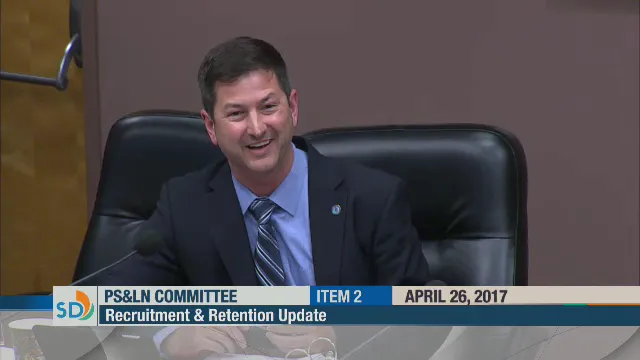
STREAMING COPY IN PREPARATION — RECORDING AVAILABLE FROM THE ORIGINAL SOURCE
Public Safety and Livable Neighborhoods Committee Meeting - April 26, 2017
The Public Safety and Livable Neighborhoods Committee met on April 26, 2017, at 10:00 AM. The committee, chaired by Councilmember Kate, with Vice Chair Bree and Councilmembers Ward and Zapf present, received reports on police recruitment and retention, the Community Review Board on Police Practices (CRB), and the Commission on Gang Prevention and Intervention. Key discussions centered on declining police applications, dispatcher staffing improvements, CRB case statistics, and gang prevention programs.
Consent Calendar
- The record of action items from April 5, 2017, was adopted unanimously.
- One consent agenda item was passed unanimously.
Public Comments & Testimony
- Tobacco Control Advocate: A speaker (not named) presented data on smoking rates, hookah lounges, and healthy retailing, expressing concern about youth access to tobacco products, especially in college areas. They noted that 80% of 77 hookah lounges are located near young adults and that only 41% of stores in San Diego County sell fresh fruits and vegetables, while over 90% sell menthol tobacco products.
- Martha Welch: Commented on police staffing, academies, and the absence of two officers per car. She stated that tents are everywhere due to a lack of police, that police stations are often closed, and that single-officer cars create safety risks.
- Brian Marvel (President, San Diego Police Officers Association): Expressed strong concern about stagnant police staffing since the 2012 five-year plan, noting that current staffing (1,832 sworn) is only 11 higher than in 2012 despite a promise to add over 300 officers. He highlighted depleted investigative units, the disbanding of the centralized auto theft unit, and overwhelmed detectives. He urged the council and mayor to provide "straight talk" and commit to real solutions.
- Evie Tossaur (Women Occupy): Spoke in favor of independent oversight for the CRB, noting that Measure G passed in November 2016 and that the board needs full independence similar to the sheriff's review group and ethics committee.
Discussion Items
1. San Diego Police Department Recruitment and Retention Update
- Presentation by Chief Zimmerman and Captain Hara:
- Sworn staffing: budgeted 2,039, actual 1,832 (207 below). Attrition rate of 13 per month; 15 officers lost to other agencies this fiscal year.
- Recruiting: 36% decrease in applicants over the last two fiscal years. Department exploring a pipeline partnership with Health Sciences High School.
- Civilian staffing: budgeted 557, actual 509 (48 below).
- Communications division: 1.4 million calls in FY2016, 615,000 of which were 911 calls. Dispatcher hiring: 44 hired since January 2016, 39 still working. Vacancies reduced to only 4.
- Performance metrics: 911 calls answered in an average of 3 seconds; 95.29% answered in 10 seconds or less (all-time record). Administrative line average wait 266 seconds, but 57% answered under 2 minutes. Overtime decreased from 1,600 hours (July 2016) to 841 hours (March 2017).
- Comm center named "CommCenter of the Year."
- IBA comment (Chris Olson): Provided a five-year historical handout of budgeted vs. filled positions.
- Committee Q&A:
- Councilmember Zapf asked about reasons for leaving (Sheriff's Department, Escondido, Dallas) and the difficulty of filling academies (only 24 of 43 slots filled for the May 22 academy). Standards are high (less than 5% of applicants accepted).
- Councilmember Ward asked about the five-year plan, reasons for not becoming an officer (felonies, drug use, DUIs), diversity (about 50% minority/female in recent academies), dispatcher improvements, and the administrative calls reduction (85,000 fewer from Jan-Mar 2017 vs. 2016). He suggested reviewing disqualification criteria for minor offenses.
- Vice Chair Bree asked about retention efforts, lost officers to other agencies due to pay, and the impact of the $4 million retention package approved last year. She also suggested looking at best practices from other departments.
- Chair Kate noted that 600 officers will be eligible to retire over the next five years and asked about the sheriff's contract (currently being renegotiated). She emphasized providing tools and support for officers.
2. Community Review Board on Police Practices (CRB) Report
- Presentation by Executive Director Charmaine Mosley and Chairman Doug Case:
- Background: CRB established via Proposition G in 1988; Measure G (November 2016) changed name, placed board under mayor/council, and added oversight of officer-involved shootings and in-custody deaths.
- Case statistics (July 2016 – March 2017): 43 cases reviewed (down from 67); 116 total allegations; IA sustained 13, exonerated 68, unfounded 33, not sustained 2.
- CRB agreed with IA on all but one allegation (courtesy/conduct). Most disagreements are resolved at the team level.
- Body-worn camera: in 33 of 43 cases cameras were on; in 7 cases they were not. Videos have improved review accuracy.
- Demographics: 23 complainants Caucasian, 14 African American, 5 Hispanic; 94 officers: 66 Caucasian, 18 Hispanic, 4 African American, 2 Filipino, 1 Asian.
- Challenges: 10 potential members awaiting appointment due to ordinance not yet implemented (expected by June). Need more diverse members, especially Latino and API.
- Public Comment: Evie Tossaur reiterated need for full independence.
- Committee response: Vice Chair Bree inquired about the ordinance timeline (in process, expected June). Chair Kate noted an API nominee from her district.
3. Commission on Gang Prevention and Intervention Annual Work Plan
- Presentation by Reverend Laster, Dr. Rodney Hood, and Commissioner Genevieve Jones Wright:
- Commission's purpose: collaboration, policy recommendations, advocacy. Focus on prevention, intervention, diversion.
- Work plan based on 2015-2020 strategic approach.
- Developmental concepts:
- Wraparound pilot program with county probation and Multicultural Health Foundation (home-based intervention for at-risk youth and families).
- Job training initiative with Workforce Partnership, targeting youth 16-24 for summer employment; service agreements signed.
- New initiatives:
- Success Agents (modeled on Orange County GRIP): 16 fourth graders at Porter Elementary, weekly tutoring and parent engagement, following through 8th grade.
- Ongoing initiatives:
- Trauma-informed principles: Over 500 individuals trained since 2015 city resolution.
- Youth development: Summer Nights program expanded to 10 sites in 2017 (5 added in 2016, 5 more in 2017). Over 6,000 participants in 2016.
- Gang tattoo removal: 150+ individuals served.
- Community Youth Court, Girls Only program (Encanto, expanding).
- Gang documentation ad hoc committee (Commissioner Jones Wright):
- Review of CalGang entries: average age 29.9, 54.4% admitted gang membership. No juveniles under 15. Decrease from 4,052 to 3,815 entries; juveniles from 50 to 27.
- Police volunteered to review 100% of files (phase three starting). One adult contested documentation (AB 2298).
- Committee Q&A:
- Councilmember Zapf asked for success stories and benchmarks for Success Agents; added that she provided CPPS funds to Connecting Hope for job training.
- Vice Chair Bree asked about setting goals for gang reduction (no formal goals, but trend is down) and collaboration with existing organizations. She also asked about parent engagement (letters to parents per AB 2298).
- Councilmember Ward asked about comparative gang statistics across California (Captain Aher stated San Diego's prevention model is unique and successful, with decreasing gang-related violent crime).
- Chair Kate thanked the commission and emphasized the value of prevention and community investment.
Key Outcomes
- SDPD Recruitment and Retention: The committee acknowledged the ongoing challenge and urged continued support. Chair Kate directed that the sexual assault evidence kit testing topic be added to a future agenda, as requested by Councilmember Gloria. The IBA will be included in that discussion.
- CRB Report: The committee received the report as information. The implementation of Measure G (ordinance) is expected by June 2017; until then, board vacancies cannot be filled.
- Commission on Gang Prevention and Intervention: The committee received the annual work plan as information. The next joint report will be on November 1, 2017.
- Next Meeting: Scheduled for Wednesday, June 7, 2017.
Meeting Transcript
Good afternoon. We are going to call today's meeting of the public safety and mobile neighborhoods committee to order. We have a forum consisting of Vice Chair Bree and Council Member Ward. First item will be non-agenda public comments. You have two minutes to speak, and I'm going to call up the names now. And you will have two minutes. Uh for the last 30 years, we have been able to reduce smoking rates from 26 percent to less than 12 percent, and that is changing, especially with youth. Despite the wins that we had and on tobacco control last year, brought 56 uh increases of 20 year old to buy tobacco products, uh closing loopholes at schools and workplaces and including the e-cigarettes as tobacco products. We are uh facing uh a lot of issues, uh, especially with access uh with minors. And um, just to give you a little uh data in early 2016, the American Longs Association and Say San Diego staff, uh we counted 77 hookah lounges when the city of San Diego. Eighty percent of these hookah lounges were located with young adults are. That is Phoebe, college area, and downtown. Uh statewide use uh hookah use has increased uh in young young adults from 41.8 percent in males and 47 percent in females. Uh this is from the California Tobacco Control Program. Uh in high school, um 26 percent ever smoke hookah, 10 percent smoke uh are current hookah smokers, and 4.6 percent smoke both cigarettes and hookah. Uh on another note, uh other grants that we're working on is on healthy retailing, and that is another point of access uh for these products. Uh we're looking for a land use solution again. Um just to give you some data on uh I participated in the 2013 and 2016 healthy stores for healthy community for healthy community. Uh this was a statewide um effort. So we found out that only 41 percent of stores in San Diego County sells fresh fruits and vegetables, but more than 90 percent sell menthol tobacco products. So I have one concluding sentence, sir. Thank you. Yeah, thank you. And I'm gonna just pause the same for the thank you. Thank you. And then Martha Welch. Good afternoon, Martha Welch. I love things in these meetings. I found out when the police go uh in front of uh um candidates go to a McMahon and they pick him out. And then they pick it out year um training, no cavities. You know, that's why I have one person in the cars, maybe also. And if we had academies, I know it would be on TV or uh radio or uh TV or newspaper, but we don't see that. Now, living in um um we have two years we have in the tent. Because I know what used to be, and I've looked that there's not up there. For two years we have it. That's why the pe the tents are all over the county because there's no police. Now I had a I called them number non um a number, and I've told to go online police performed. Okay, I did that. About two years, two weeks later, they called me, said can't do anything about it. It's cold case office, just stealing stuff. So they took couldn't do anything. They didn't give me a number to call back. And I also know when I go to sleep, I I vest I've um I'm vesting every I'm vest I'm looking everywhere what goes on in the city. So I go to the um police stations and most times they're closed. We don't have enough police, obviously. And I'm because we don't have academies, and people don't like this if you um don't go to training. How can they know the laws about searching and seizures and all that stuff? They can't they can't, you know, they have to go to school and find about the laws and everything. And also I've seen on TV if there's one police in a car, there's a lot of trouble because in 60 minutes they showed what happened when some person was by herself and it it was a bad system, but something bad happened. She kills somebody on by accident, I think.
openpublica.com