Public Safety and Livable Neighborhoods Committee Meeting - July 19, 2017
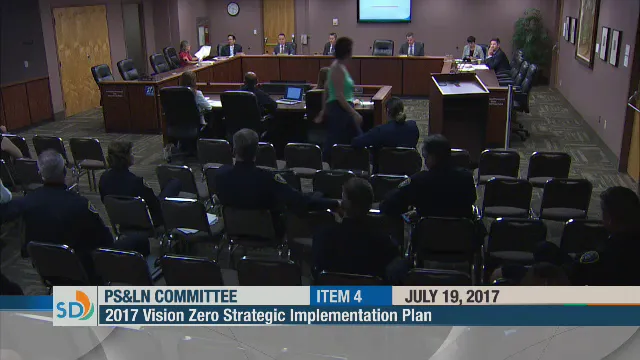
STREAMING COPY IN PREPARATION — RECORDING AVAILABLE FROM THE ORIGINAL SOURCE
Public Safety and Livable Neighborhoods Committee Meeting - July 19, 2017
The Public Safety and Livable Neighborhoods Committee met on July 19, 2017, at 10:00 AM. The committee, consisting of Chair Kate, Councilmembers Zaf and Ward (Vice Chair Bree absent), addressed several agenda items including a contract modification for the Computer-Aided Dispatch (CAD) replacement project, updates on the implementation of PERF recommendations, the police department's five-year plan, Vision Zero, and the Human Relations Commission annual report. Public comments covered EMS worker conditions, police staffing, towing contract transparency, and pedestrian safety.
Consent Calendar
- The committee unanimously adopted the record of action items from the June 28, 2017 meeting.
Public Comments & Testimony
- Daniel Smyovsky: Stated he is running for City Council District 2, calling for objectivity and bringing people together.
- Joseph Ross (speaking also for Ahmed Al-Atas): Requested modification to AB 263 to require EMS contract holders (like AMR) to match fire department policies on lights and sirens for non-emergency (Level 3) calls, arguing that current practices overuse lights and sirens, endanger workers, and reduce break time; urged committee to contact state legislators.
- Martha Welch: Expressed concern about police staffing levels, noting stations closed and patrol cars with only one officer; argued that understaffing compromises public safety and that funds are diverted to pensions.
- Sapphire Blackwood: Raised concerns about towing bid contracts (RFSQ procedures) not being reviewed in over 20 years; called for transparency, lower fees, and public access to contract award criteria.
- Jared Solar: Reported spending over $800 in towing fees and requested transparency in contract awards and a hold on new awards.
- Andrea Reyes: Spent over $1,500 on towing fees and echoed calls for transparency and a hold on contract awards.
- Luis Huerta: Spent over $400 on towing fees and requested transparency and a hold on awards.
- Beryl Foreman (El Cajon Boulevard Business Improvement Association): Urged immediate changes on El Cajon Boulevard, the second most dangerous corridor, citing deaths and near-misses; highlighted dense developments and schools along the corridor.
- Paige Colburn Hargis (Trauma Research Education Foundation): Reported that from January to September 2016, San Diego County trauma centers cared for 563 pedestrian-injury patients, with 100 in critical condition; pedestrian injuries are a leading cause and appear to be rising; offered to share data.
- Dan Fesperman (Community Health Improvement Partners): Urged prioritizing engineering as the most effective strategy; called for greater transparency on goals and data.
- Maya Rosas (Circulate San Diego): Recommend prioritizing engineering, reconvening the Vision Zero Task Force as a standalone entity meeting bi-monthly, and providing public collision data on a website.
- Kathleen Ferrier (National Vision Zero Network): Cited success in cities like New York (26% reduction in deaths) and Seattle; urged measurable goals, evaluation, and transparency; noted that many listed projects are not Vision Zero-specific.
- Andy Hanshaw (San Diego County Bicycle Coalition): Supported Vision Zero; asked for emphasis on engineering on Vision Zero corridors and pursuit of grants for protected bike lanes.
Discussion Items
-
Computer-Aided Dispatch (CAD) Replacement Project (Action Item)
- Steve Chen (SDPD Information Systems Administrator) presented an update. The legacy CAD system is being replaced via a project approved in 2013. Intergraph (Hexagon) was selected in December 2015. Out of 3,211 functionality requirements, 18 gaps were identified and resolved. The team has completed hardware/software installation, configuration workshops, and acceptance testing. Dispatcher training is underway; go-live is planned for October 2017. Additional functionality (iDispatcher) was discovered for call takers. A contract modification of approximately $461,000 was requested, including a $25,000 credit from prior change orders, plus an anticipated $110,000 for future needs; total funding remains within allocated capital project funds. Motion by Councilmember Ward, seconded, passed unanimously.
-
Police Department Response to PERF Recommendations (Information Item)
- Chief Shelley Zimmerman reported that all 40 PERF recommendations are now implemented. The final seven relate to the Early Identification Intervention System (EIS), which uses IAPRO Blue Team software to monitor employee performance. Systems include automated alerts, monthly supervisor reviews, and documented interventions. The department has contracted with PERF director to share completion reports.
- Brian Marvel (POA President) praised implementation but noted staffing shortages: 30 open sergeant positions (~10% of budgeted), 96 open detective positions (~29%), and only 1,817 actual sworn officers as of July 1, 2017 (lowest since 2000). He warned that understaffing undermines supervision and accountability, and urged immediate action.
-
Police Department Five-Year Plan Status (Information Item)
- Chief Zimmerman detailed progress since the original 2012 plan. As of FY18, the department added 70.5 budgeted sworn FTE (needs 89 more to reach 2009 levels) and 61 civilian FTE (needs 39 more). Current sworn staffing is 1,817. Facility needs include elevator modernization ($1.7M), energy management ($4.5M), traffic division replacement, backup dispatch center (up to $1.1M), police range ($7M), training facility study ($250K), SWAT/canine facility study ($250K), and EVOC site in Otay Mesa (city committed up to $5M). Equipment: 1,280 body cameras deployed; helicopter fleet study completed; Motorola portable radios need replacement (3,000 units at $5,500 each, $1.6M/year). Total projected costs: $26.4M (FY19), $15M (FY20), $9.9M (FY21).
- The IBA noted additional FY18 budget items: $3M for overtime, $4M for recruitment/retention compensation, $350K for marketing, $150K for retention study, $100K for salary survey, $200K for AB 953 implementation, and $500K for sexual assault kit testing.
- Brian Marvel reiterated the staffing crisis, noting a net loss of 12 officers over five years, attrition exceeding hiring, and 600 officers retiring within five years. He urged the committee to prioritize police funding and reopen contract negotiations.
-
Vision Zero Strategic Implementation Plan Update (Information Item)
- Alejandra Gavaldon (Mayor's Director of Infrastructure and Water Policy) introduced the update. Engineering (Linda Moradkhan): Training on complete streets, University Avenue project advanced (construction expected 2021, $5.4M grant received), transportation strategic plan consultant selected, street design manual updated with NACTO (National Association of City Transportation Officials) guidelines, citywide crash analysis grant ($250K) to identify high-crash locations, and $12M in capital projects allocated for safety. Enforcement (Captain Ramos): $219K grant from Office of Traffic Safety for pedestrian/bike safety; $100K from STEP grant for enforcement details; two details per month conducted along El Cajon Boulevard and University Avenue; fatalities year-to-date are 22 (down from 29 in same period 2016). Education (Katie Keats): Media campaign launching September 2017; Vision Zero expositions planned per council district; collaboration with school district for 'Heads Up' campaign; focus on awareness and distracted behaviors.
- Committee members discussed progress on corridors, measurable outcomes, enforcement targeting, and the need for a Vision Zero website with accessible data.
-
Human Relations Commission Annual Report (Information Item)
- Chair Steph Gross and Executive Director Joel Day presented the report. In 2016, the commission co-sponsored the All People's Breakfast, attended over 200 events, and contributed to San Diego receiving a perfect 100-point rating on the Human Rights Campaign Municipal Equality Index. The 2017-2019 work plan includes 30 tactics under five strategies: collaborate, educate, advocate, investigate, and mediate. Outcomes include higher profile, 60% increase in activities, and deeper partnerships.
- Committee members praised the report and emphasized the importance of outreach to diverse communities, including language access.
Key Outcomes
- Motion passed (unanimous): Approval of change orders (approx. $571,000 total) for the Computer-Aided Dispatch replacement project with Intergraph/Hexagon.
- Staffing concerns noted: Police department staffing at 1,817 sworn officers (lowest since 2000); 600 retirements expected in five years; POA urged immediate action to reopen contract negotiations.
- All 40 PERF recommendations implemented as confirmed by Police Chief; report to be shared with PERF director.
- Five-year plan update received; projected needs of $26.4M (FY19), $15M (FY20), $9.9M (FY21) for sworn positions, civilian positions, facilities, and equipment.
- Vision Zero update received; fatalities decreased to 22 year-to-date from 29 in 2016; media campaign launching September; committee requested measurable outcomes and public data dashboard.
- Human Relations Commission annual report received; noted increased community engagement and planned outreach to non-English-speaking communities.
- Next meeting scheduled for September 18, 2017 at 9:00 AM.
Meeting Transcript
Good afternoon. Like to call the July nineteenth meeting of the public safety and liberal neighborhoods committee to order. We have a quorum consisting of myself, Councilmembers Zaf and Ward, and Vice Chair Bree will be absent today. We're going to go straight into non-agenda public comments, and speakers will have two minutes. So as I call your name, please make your way up to the podium. First, we have Daniel Smyovsky, followed by Joseph Ross, followed by Ahmed Al Atas. We need to be honest. Again, I will reiterate we need to be objective. Next we have Joseph Ross, followed by Ahmed Al-Atas, and then Martha Welch. And A states the employer receives an emergency call in response to which the operator of the emergency vehicle in which the employee works would sound a siren and make visible the vehicle's emergency lights. Here in San Diego, we have multiple types of 911 calls. I'm going to focus just on level one and level three calls. Level one calls are your true emergencies, your heart attacks and whatnot. Where level threes are not as emergent. So such that this the San Diego Fire Rescue Department does not respond to level three calls with either their sirens and they do not make their lights visible when responding to these emergen or these 911 calls. We all know the potential risks every time a unit goes lights and sirens down our city streets. Current policy allows EMS contract holders like AMR, which holds the contract for the City of San Diego to dictate which calls they go to with lights and sirens, which means AMR is currently going to level three calls, going lights and sirens when they actually don't necessarily need to. And this also would pose a hindrance on AB's 620 or the 263's principle, why why would it being pushed through legislation? AB 263 is meant to defend EMS workers, but it's currently not in uh its current condition wouldn't enable private corporations the legal opportunity to further abuse these workers. Um that and these workers are already overworked and underpaid. We are we've discussed that many times here. There are plenty of studies that have also shown that the quality of care of our EMS practitioner practitioners decreases if they don't have enough time to recuperate from call to call. It is essential that our EMS practitioners are allotted their lunch times and their breaks, unless there is an absolute level one call, which is understandable. But these level three calls should not interrupt uh their their briggs. And I am here to request that each of you encourage a modification to AB 263 to include a new section which would require EMS contract holders to mimic the fire departments, whoever has jurisdiction, the fire department's policy on when to sound a siren and make the vehicles emergency lights visible when responding to 911 calls. Reach out to your senators and assembly members and re encourage them to push this legislation through also. Thank you very much. Thank you, sir. Martha Welch, followed by Sapphire Blackwood and then Jared Solar. Martha Welsh, good afternoon. I've been to stations of the police. And they're closed. I asked about the half as officers. Now also in the meeting, I saw somebody talked to commission about this. About they have uh people uh talk to them, and then they pick who wants to be police member. And then would they say one year online only uh on on a person on in the job only, training. We don't have academies if we have that. I think there'd be pictures and everything, we don't have some pictures about that. This is different everywhere I would. I I'm somebody else, and I the police is always open. And Alameda um I had a problem one time, and the police are for 24 hours. That's what it is, everybody, but not here. It's just Sandy Way or something like that. Because what we're doing, the police is going all going all going down all the time. 400 I heard were down and it's going down every year because three 13 goes retirement, so it goes lower and lower every time. Now, this is not right we're doing this because um public surfing was uh survey was supposed to be what the people want, but what is what the city does pensions and and and oh um reserve because uh that's what's going on. The money goes to the pension, not to the fire, not to the fire or police. Because the police are are uh are being attacked by this because we don't have enough every car I see is one person in them. We're gonna have two officers in the cars. And that's not right also because um if we can't um we can't um we can't have this in San Diego.
openpublica.com