Public Safety and Livable Neighborhoods Committee Meeting - September 18, 2017
STREAMING COPY IN PREPARATION — RECORDING AVAILABLE FROM THE ORIGINAL SOURCE
Public Safety and Livable Neighborhoods Committee Meeting - September 18, 2017
The Public Safety and Livable Neighborhoods Committee met on Monday, September 18, 2017, at 2:00 p.m. in Council Chambers. The committee approved a consent item and a discussion item, and received informational presentations on the San Diego Police Department's Canine Unit, the Family Justice Center, the Wildfire Outlook for fall 2017, the Connections Housing annual status update, and the Play All Day Parks Program. Public testimony focused on cannabis delivery regulations and alternative sourcing of police service dogs.
Consent Calendar
- Fiscal Year 2017 Urban Area Security Initiative Grant Program: Approved unanimously. (Councilmember Zap motioned, Councilmember Ward seconded.)
Public Comments & Testimony
- Cannabis Delivery Regulation: Several speakers addressed the committee about independent cannabis delivery services. Elizabeth Wilhelm, president of the San Diego Cannabis Delivery Alliance, expressed support for sensible regulations to close the black market and ensure safe access. She requested the committee place discussion of independent cannabis delivery on a future agenda. Sam Humead, also a board member of the alliance, echoed the request and submitted information packets to committee members. Both speakers emphasized the need to keep medicated drivers off the road and to require product testing.
- Rescue Dogs for Police Work: A speaker (Grace Batoonis) presented a video and information about nonprofit organizations (Universal Canine, Search Dog Foundation) that provide highly trained rescue dogs at no cost to law enforcement and fire departments. She urged the city to consider using such dogs to save taxpayer money and reduce shelter overcrowding.
Discussion Items
-
Revisions to the Citizen Participation Plan for U.S. Department of Housing and Urban Development Programs: The committee moved this item without a presentation. A member of the public expressed support but did not wish to speak. The committee approved the revisions unanimously on a motion by Councilmember Zap, seconded by Vice Chair Bree.
-
San Diego Police Department Canine Unit Update (Informational): Assistant Chief Chuck Kay, Lieutenant Darrell Hoover, and Officer Larry Adair provided a detailed overview. The unit was formed in 1984 after a high officer murder rate; it expanded to 52 teams by 2000, but was reduced to 27 in 2010 due to budget constraints. Currently there are 33 canine teams. Key data: from 2013 to 2016, canine calls for service increased to 21,429 in 2016, with 3,222 deployments and 86 bites (a 2.7% bite rate versus a federal court standard of 20%). Persons-in-crisis calls increased 35% and assaults on officers increased 86% over the same period. The unit also partnered with Johns Hopkins and DHS on mobile odor detection dogs for large events. Councilmembers asked about training for mental health crisis situations, the definition of deployments vs. interventions, and funding (police dogs are purchased by the San Diego Police Foundation at ~$12,500 each). The unit's public information officer, Officer Adair, conducts over 60 community events per year.
-
San Diego Police Department Family Justice Center Update (Informational): Lieutenant Misty Sedrin presented. Highlights included a new countywide strangulation protocol and a 30-second PSA on strangulation (English and Spanish). A survivors advisory board was formed to provide input and share testimonies. Adrian, a male survivor from the immigrant and LGBT communities, gave a powerful testimony about escaping domestic violence with the center's help. Data showed domestic violence reported crimes decreased 37% from 2002 to 2016, and domestic violence homicides dropped from 36 (1985, pop. 875,000) to 6 (2016, pop. 1.4 million). Contacts from outside the city are about one-third of total visits. Councilmembers discussed funding, noting the city is the primary funder and the county provides some in-kind services. There are preliminary discussions about transferring management of the center from the Police Department to the City Attorney's Office. Councilmember Zap emphasized the city's policy that victims and witnesses can come forward without fear of immigration status checks.
-
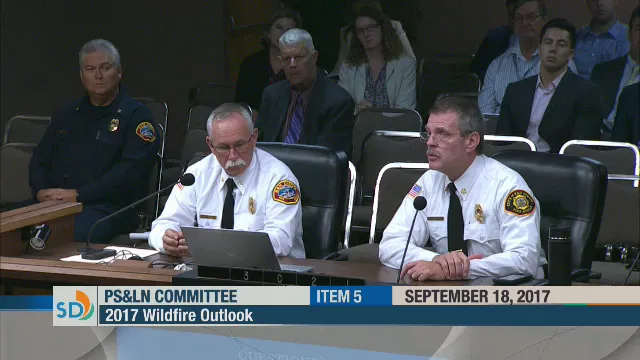
Wildfire Outlook 2017 – September through November (Informational): Fire Chief Brian Fennessey and Deputy Chief Doug Perry presented. Despite a wet winter, heavy grass crop and five years of drought have created critical fuel conditions. The city has 82 type 1 engines, 12 type 3 wildland engines, two helicopters (only night-capable in the county), and a SDG&E helitanker. The "Ready, Set, Go!" program was explained, emphasizing early evacuation. The city inspects ~13,000 homes annually but has 45,000-46,000 interface homes, resulting in a 3.7-year inspection cycle. Staffing of seven brush inspectors would ideally be increased to fifteen to achieve 18-month cycles. Councilmember Ward requested more information on high-risk areas in his district. Councilmember Zap shared a personal story of not evacuating during a wildfire and urged the public to leave early.
-
Connections Housing Annual Status Update (1250 Sixth Avenue) (Informational): James Alexander (Civic San Diego) and Jonathan Costillo (PATH) presented. The facility includes 150 transitional beds, 73 permanent supportive housing (PSH) units, and health/social services. The conditional use permit (CUP) requires a neighborhood advisory committee, 24/7 security, and outreach within a quarter-mile radius. Compliance has been maintained. PSH retention is 92%, and transitional bed success (moving to permanent housing) is over 65%. Councilmember Ward asked about expanding the service radius and converting transitional beds to PSH; PATH is open to exploring those options but noted no specific challenges with the CUP. Councilmember Bree and Chair Keat asked about expansion beyond downtown; PATH confirmed they are seeking opportunities in other parts of the city to avoid concentrating services.
-
Play All Day Parks Program (Informational): Robin Schifflet (Planning) and Lee Dogaroff (San Diego Unified School District) presented. The program will add over 45 new joint use parks in five to ten years, expanding the existing 79 joint use sites. Three parks have opened (Wegaforth, Montgomery, Angier), nine more are scheduled to open by FY 2019. The school district designs and constructs the fields (funded by Propositions S and Z), and the city maintains them. Operating costs average $60,000 per park per year, with gates locked at dusk. Councilmember Zapp asked about maintenance responsibilities and security. Chair Keat inquired about the timeline; from general development plan to completion is about three years.
Key Outcomes
- Consent Agenda (FY17 UASI Grant): Approved unanimously.
- Revisions to the Citizen Participation Plan: Approved unanimously.
- Cannabis Delivery Regulation: No formal action taken, but the committee received the public request to place the topic on a future agenda.
- All other items (Canine Unit, Family Justice Center, Wildfire Outlook, Connections Housing, Play All Day Parks): Received as informational; no votes were taken.
Meeting Transcript
But in some of these licensed dispensaries, they don't have to do delivery. They can choose to stay at this dispensary or they can do delivery if they want to. Some of the risks associated with this are that you're I know it came up at the last meeting on the 11th that you may have medicated drivers on the road. This is going to happen if there's not enough companies out there to do a delivery, so if someone's medicated, they're going to be on the road. And what we want to do is we want to avoid that. We want people to be sober behind the wheel. Another challenge that we're going to be experiencing is with the regulations of having a permit of having product tested. People are gonna, if they're not able to get a delivery, they're gonna go to a friend down the street that doesn't have their product tested, and this is gonna happen whether we like that or not. Uh there's people that are gonna be providing it illegally. So I think giving uh non-retail delivery a permit to operate, they're gonna meet the same requirements of having tested products so the public's gonna have safe access to what they're gonna be putting in their body. Additionally. Is that my sign? Thank you. Thank you, sir. Our next speaker will be Elizabeth Wilhelm, followed by Sam Humi. Yeah. Good morning, Public Safety Committee. Thank you for this opportunity to speak with you today. I really appreciate it. Um my name is Elizabeth Wilhelm. And if you were to ask me who I am, I'm a mother first. Um resident of the Great District 4 and a cannabis patient. And I'm also the president of the San Diego Cannabis Delivery Alliance. We are San Diego's first and only cannabis trade organization focused solely on delivery regulation. I also sit on the board of the statewide California Cannabis Delivery Alliance. Councilmember Zapp, I want to address you directly and to say as a mom who has raised a son who recently graduated from SDSU. I really understand your concerns, and I agree with a lot of them. It's only with sensible regulation that we can shut down the black market and keep our children from having access to any form of contraband, whether it's alcohol, illicit drugs, or cannabis. And I back you on that. As you may remember from our presentations to you on the 11th of September, the San Diego Cannabis Delivery Alliance was founded to bridge the communication void between established business operators following the state law and you guys as a city council grappling with the burgeoning cannabis industry in this town. Unfortunately, when the topic topic of delivery service regulation was addressed by City Council in January, the San Diego Cannabis Delivery Alliance had not yet formed. Um but we're here now and we are eager eager to begin a dialogue with you. At the San Diego Cannabis Delivery Alliance, our mission is very simple. We want to ensure public safety and reasonable access to cannabis medicine through a network of permitted independent delivery services in San Diego City and County. Our membership base is immeasurably important to the San Dieguans who rely on a well-established network of canopy cannabis therapy practitioners delivering medicine to them safely and affordably. At SDCDA, we are in the process. Oh, thank you very much for your time. You have one concluding sentence, if you don't have a question. Thank you very much. Um what we're looking for is to develop a licensing framework for independent delivery and to maintain the established supply chain and to position the city to benefit from the various tax windfalls of a sensibly regulated cannabis delivery industry. Thank you so much for your time today. Thank you. And our last speaker will be Sam Humead. Honorable members of the public safety committee, honorable police officers, involved members of the community. Uh thank you for your service and your time. The last time I was addressed this committee, access to cannabis edibles was on the chopping block. Um I come before you today as a member of the San Diego, as a board member of the San Diego Cannabis Delivery Alliance to thank you for addressing the needs of small business owners engaged in the activity of independent cannabis delivery. Some of you know me, Councilman Bree, you know me as your number one supporter for sensible Airbnb regulations. Uh Councilman Ward, you know me as a uh proponent of safe access for the LGBT community. In fact, I have worked with many of your predecessors and have been actively involved in San Diego cannabis regulations through four mayoral administrations.
openpublica.com