San Diego City Council Public Safety & Livable Neighborhoods Committee Meeting - July 11, 2018
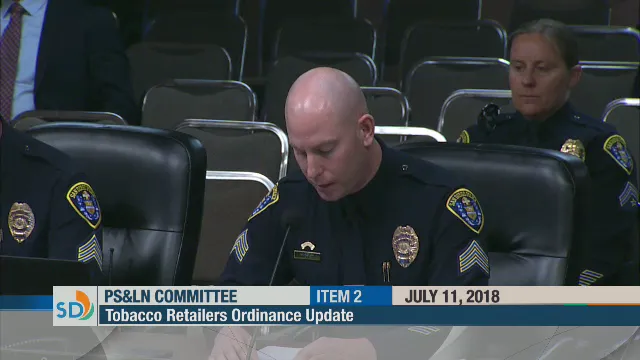
STREAMING COPY IN PREPARATION — RECORDING AVAILABLE FROM THE ORIGINAL SOURCE
San Diego City Council Public Safety & Livable Neighborhoods Committee Meeting - July 11, 2018
The Public Safety and Livable Neighborhoods Committee met on July 11, 2018, to receive updates on the new Neighborhood Policing Division, the annual Tobacco Retailers Ordinance report, and the Human Relations Commission's 2017 annual report. The meeting included public comments on homelessness, downtown safety, and concerns about the marijuana industry, followed by committee member questions and discussion.
Public Comments & Testimony
- First Speaker (name unclear): Expressed concerns about fire truck shortages, police officer shortages, and alleged misconduct by Supervisor Bill Horn, citing his use of an office number (5135) for 20 years. Criticized the city's handling of pensions, fire station conditions, and the use of Proposition B, stating it has caused problems. Also claimed the county shifted dispatch responsibilities to cities.
- Orville Glenn (lives at Second and Beach, believes Chris Ward is his representative): Stated that seniors and homeless people are often invisible or ignored by the public and drivers. Called for solutions to homelessness, citing mental health issues, veterans, and women with children. Urged immediate action.
- Kelly McCormick: Referenced a San Diego Union Tribune article about dubious medical claims for marijuana, quoting Dr. Joseph Califano (UC San Diego) comparing it to tobacco post-WWII. Also cited an AP article about the United Cannabis Business Association asking Governor Brown to delay testing standards. Argued the commercial pot industry is not ready, citing lack of track-and-trace systems, no state resources for code compliance, and a code enforcement backlog of 20 days. Concluded the situation does not improve public safety or neighborhood livability.
Discussion Items
1. Update from Neighborhood Policing Division
- Presenters: Captain Scott Wall, Lieutenant Dave Bautista, Dr. Mark Marvin (PERT), and others.
- The division was established March 10, 2018, consolidating quality-of-life teams, homeless outreach teams, and PERT administration under one command, with about 72 personnel.
- Mission: Enhance quality of life and safety through problem-solving partnerships and compassionate enforcement.
- The division has an enforcement branch and an outreach branch. Officers work seven days a week and are not required to handle radio calls, allowing time for complex issues.
- Homeless Outreach Team: Seven full-time officers, four provisional officers, two county health specialists, and two PERT clinicians. Conducts weekly coordinated outreach with service providers to connect homeless individuals to appropriate services.
- Serial Inebriate Program (SIP): One full-time officer (David McGowan) coordinates with city attorney, public defender, EMS, mental health systems, county, and McAllister Institute. On call 24/7. The program saved an estimated $1.4 million in transports in 2018. The chronic list dropped from 887 to 135.
- PERT (Psychiatric Emergency Response Team): SDPD has 24 of 50 county PERT clinicians. 25% of patrol staff are trained for PERT. County plans to add 20 clinicians by January 2019, with SDPD expecting 10 in mid-August and 10 in January, aiming for third watch coverage.
- Get It Done App: Since May 4, 2018, the division received nearly 700 complaints (within about two months), mostly homeless-related. Response goal is within 48-72 hours to prevent encampments.
- Councilmember Zaft: Discussed challenges of severely mentally ill individuals, and the need for patience and trust-building. Asked about categories of homelessness and barriers to help. Lieutenant Bautista noted that about 1 in 10 homeless individuals accept help when offered.
- Vice Chair Bree: Asked about additional resources needed. Captain Wall emphasized staffing growth and enhanced use of the Get It Done app. Bree asked about typical complaints and availability of services. Officers stated they find workarounds for service gaps and focus on relationship building.
- Councilmember Gomez: Questioned whether officers were relocated from other commands to form the division (yes, existing quality-of-life teams were consolidated). Asked about hot beds (50 beds, occupancy between 40-50). Inquired about data tracking for services provided; a survey app is in pilot phase, planned for full deployment by July 28. Gomez raised the HUD suggestion to evaluate police-led outreach; Captain Wall defended the model as bringing providers to the forefront.
- Chair Kate: Asked about reactive vs. proactive stance. Captain Wall emphasized using community reports to be proactive and prevent large encampments.
2. Update on Tobacco Retailers Ordinance (Annual Report for Calendar Year 2017)
- Presenters: Acting Lieutenant Daniel Meyer and Sergeant Brian McGillray (Vice, Permits and Licensing).
- The ordinance regulates sale of tobacco, e-cigarettes, and related products through police-permitting since 2007 (amended 2014).
- In 2017, the state had 1,053 tobacco licenses in San Diego; the city issued 982 permits (93% compliance).
- 79 violation notices were issued for expired permits.
- 46 permitted hookah locations (down 5 from 2016) and 21 vape shops (down 4).
- Conducted 169 covert decoy inspections (using minors aged 15-20) resulting in 18 citations (10.65% violation rate, down from 11.02% in 2016). Six citations were for e-cigarettes/vaping juice (3.55%).
- 146 overt inspections were conducted in response to complaints or randomly.
- Revenue: $181,298 collected ($166,768 renewal + $14,529 new permits), down $18,928 from 2016 due to fewer businesses.
- Vice Chair Bree noted fewer tobacco businesses is good news. Asked if fees cover enforcement (yes, by Prop 26). Asked about needed tools; Meyer stated they are working with the city attorney to adjust the municipal code but need more regulatory evidence.
- Councilmember Gomez requested breakdown of overt inspections per council district; Meyer said they can attempt to pull data. Gomez asked about denial of permits; Meyer said denials are limited to crimes of moral turpitude; the decrease is due to fewer applications.
3. 2017 Annual Report from the Human Relations Commission (HRC)
- Presenters: Dr. Joel Day (Director of Office of Boards and Commissions) and Chair Steph Gross.
- Dr. Day described HRC as
Meeting Transcript
Also in Bendy had 70 74 7 million for trucks. We never didn't go to the council. What happened to those trucks? We don't I think they're short of the trucks. Now the police, they don't have enough offers to clothes of their clothes. Not that's not fair to the public. We can't we can't go there. And the state, every um are 24-7 in the state, every day that you know why? We have a man called Bill Horn. He hides um his name because the number and then another name. He's been doing it for 20 years, and he uses office number and is 5135, his number. And he calls all the time, and that's why we have these problems in the city and the county. He does he's very mean and he doesn't care about what goes on the jail or the police or anything now. He's a supervisor and he rules the city just like the county. And he puts this uh he does this things because he's mean and cruel and he's greedy. And he's been doing this and it's not right, and he's ruined the city with the fire trucks and the and the and the overtime. OSHA should look at all this the stuff. He doesn't want the the state or the federalists to come here to the city and what's going on here. And so you're not honest because if you don't want these people to come here and look what's going on here with overtime and uh the fire stations don't have the way they can cook, eat and sleep is wrong. And um also the fire you on Pop B said you couldn't have a pension for the the fi the uh fire, so you won't everywhere in the state they have pensions for the firefighters, so it no you won't have a even field to hire them, so it won't be hired, so it's it's wrong what you're doing here um with the public station on the survey, that was the thing. But with you is is it's pension because you're on the pension, so you care about the pension, it's so big, it's huge, it's huge. Pop B was not the thing to fix the pro that problem, but it's causing all this problem the way you used it, you wouldn't build fire stations, police stations, all that stuff. And it's wrong. The city doesn't the county used to have a communication for dispatch, but they didn't want a new one, so they said the cities have to take over. That's what the county does. They don't step up, they make the cities pay for everything. Our next speaker is Orville Glenn, followed by Kelly McCormick. Morning, City Council. Thank you for your time. I live at second end beach. I believe Chris Ward is my representative. Seniors are not invisible people. I'm a senior. Some people make me walk around them. They don't see me. They're on their electronics or talking to other people. They see very little unless it's right here. Some people do look up. They don't step aside. Most of the drivers, when I'm in a crosswalk, do not slow down. They honk at me. Not a curse. Someday with luck, the youngsters will be in my place. Good luck. The homeless are also not invisible. But how many of us see them? How many did you see on your way to work? Or walking from your car to your office. In the 20 years plus that I have worked around the homeless as a volunteer, I've heard lots of stories about some people and why they're on the street. The truth is it's not healthy.
openpublica.com