Public Safety and Livable Neighborhoods Committee Meeting - August 1, 2018
STREAMING COPY IN PREPARATION — RECORDING AVAILABLE FROM THE ORIGINAL SOURCE
Public Safety and Livable Neighborhoods Committee Meeting Summary - August 1, 2018
The Public Safety and Livable Neighborhoods Committee met on August 1, 2018, with Vice Chair Bree presiding in place of Chair Kate (on paternity leave). A quorum was present including Councilmembers Zaf and Gomez. The meeting covered a consent agenda, a neighborhood watch sign purchase program, an update on marijuana delivery enforcement, and a status update on a fire apparatus repair facility.
Consent Calendar
- The record of action items for July 18, 2018, was adopted by unanimous consent.
- The consent agenda included a joint use park at Harriet Tubman Charter School. Public comment (Martha Welch) expressed concerns about the city not sharing costs with the school. Councilmember Gomez noted the city is providing funding and that the community has been working on this project for decades. The consent agenda was approved unanimously.
Public Comments & Testimony
Non-Agenda Public Comment:
- Kathleen Lippitt expressed opposition to the city's permitting of 40 marijuana production facilities (MPFs) without distinctly identifying commercial operations, and criticized code enforcement. She warned of potential harm to youth from tainted products and high THC.
- Kelly McCormick, representing herself and referencing the League of Cities, opposed proposed state rule changes that would limit local regulation of marijuana delivery businesses, reduce city review time for licenses to 10 days, and allow edibles with up to 500 mg THC. She urged the committee to join the League of Cities in objecting.
- Martha Welch raised concerns about fire department privatization, police station closures, and 911 response times, alleging the county does not share funds and that dispatcher issues exist.
Public Comment on Item 4 (Marijuana Delivery Enforcement):
- Mara Felsen criticized former Police Chief Zimmerman for presenting falsified statistics about cannabis outlet crime and called for sensible regulation rather than unlimited enforcement.
- Ben Martin, a medical cannabis user, described his choice of cannabis over pharmaceuticals for arthritis and urged licensing of delivery services.
- Seth Zibman, a medical cannabis user for anxiety, requested safe access via delivery and an end to the supply chain bottleneck.
- Amy Penzinski, a multiple sclerosis patient, described cannabis as life-changing and requested delivery service licensing.
- Sam Humeed, president of San Diego Cannabis Delivery Alliance, noted that $400 million in cannabis products were incinerated due to lack of licensed outlets, and urged the committee to begin licensing independent delivery services.
- Tiffany Wade, a patient and proprietor, stated that fewer than 20 permitted dispensaries serve 1.2 million people, creating a bottleneck.
- Terry Best, chapter chair of Americans for Safe Access, referenced the false data scandal and read a letter from retired Lieutenant Diane Goldstein calling the deceptive conduct untenable.
- Kathleen Lippitt (second appearance) warned against unproven therapies, comparing cannabis to thalidomide and laetrile.
- Kelly McCormick (second appearance) thanked the police department for enforcement and argued that the cannabis industry operates like big tobacco.
- Elizabeth Mack, founder of Holistic Caring, a nurse, described using cannabis to reduce opioid use and urged licensing for delivery services to support her clients.
- Phil Rath (extended time), executive director of the United Medical Marijuana Coalition, commended the police for closing 11 delivery services but noted an estimated 100 still operate, and urged the city to dedicate tax revenue from legal cannabis to enforcement.
Discussion Items
Item 3: Neighborhood Watch Sign Purchase Program Acting Captain Kevin Mayer presented a proposal to formalize a process for purchasing neighborhood watch signs using Councilmember CPPS funds, donations, or grants. Signs cost approximately $40 each. The program would be administered by SDPD community relations officers. Councilmembers Zaf and Gomez expressed support, noting the importance of neighborhood watch and the need for easier sign acquisition. Councilmember Zaf asked about installation costs and partnerships (e.g., Urban Corps). Deputy City Attorney Paige Fulkman clarified that a resolution would take effect within 10 days of the mayor's signature. The committee voted unanimously to forward the item to full council.
Item 4: Marijuana Delivery Enforcement Update (Information Only) Lieutenant Matt Novak reported that since August 2017, SDPD has closed 11 illegal delivery services, made arrests, and seized large amounts of product and cash. The investigation is more time-consuming than storefront enforcement. Assistant City Attorney John Hemling and Chief Deputy City Attorney Mark Skiels praised the police department's work as a model for other agencies. Councilmember Gomez asked about the estimated number of illegal services (approximately 100) and whether more resources would help. Lieutenant Novak said the current dedicated team is effective, and a domino effect may occur as enforcement continues. Public comment was divided, with some supporting enforcement and others criticizing the police department's past false data and calling for licensing of delivery services. No action was taken.
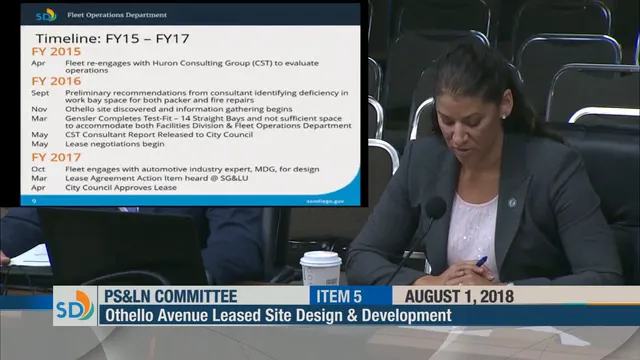
Item 5: Othello Avenue Leased Site for Fire Apparatus Repair (Information Only) Fleet Operations Director Alia Accore presented a status update on the design and development of a leased site at Othello Avenue for repair of San Diego Fire-Rescue apparatus. The Miramar facility currently shares space with refuse packer repair, leading to congestion (e.g., pushing vehicles, working outside). The Othello site will improve bay-to-technician ratios and centralize fire apparatus repair. Initial cost estimates ranged from $6.5 million (14 bays) to $17 million (27 bays), but a final design by Messias and Conwell using angled bays (57 feet long, 19 feet wide) achieved 24 bays for $6.3 million. The lease has a 10-year term with two five-year options, and total operating expenses over 10 years are $10.5 million. The city may finance the improvements or reimburse the lessor. Funds will not be needed until fiscal year 2020. Councilmember Gomez expressed frustration that the IBA flagged the cost issue rather than staff, and stressed the need for better communication. The presentation was well-received, and no action was required.
Key Outcomes
- Consent Agenda: Approved unanimously, including the Harriet Tubman Charter School joint use park.
- Neighborhood Watch Sign Purchase Program: Approved unanimously (motion by Councilmember Zaf, second by Councilmember Gomez) to forward to full council as a resolution.
- Marijuana Delivery Enforcement: Information only; no action taken. Committee received the update and public testimony.
- Othello Avenue Fire Apparatus Repair Site: Information only; no action taken. Staff will continue design refinement and financing discussions with the lessor, with a potential return to council for action in 60–90 days.
Meeting Transcript
Good morning. Welcome to the public safety and livable neighborhoods committee meeting of August 1st, 2018. The meeting is now in order. Let the record reflect that we have a quorum consisting of myself, the vice chair of the committee, Councilmember Zaf, and Councilmember Gomez. So you're wondering where Chair Kate is. He is officially on paternity leave. His first child was born yesterday morning. So congratulations to Vice Chair Kate. And later today we will learn the name, right? Yes. Okay. Okay, so now we will move on to non-agenda public comment. Public comment will be limited to two minutes per speaker. And we will it the uh we have three speakers. Um in order Kathleen Lippitt, Kelly McCormick, and Martha Welch. Good morning, Council members. I work with planning groups and community businesses being pressured and negatively impacted by the city's decision to allow 40 MPFs throughout the nature throughout the nature, uh excuse me, the city that fails to distinctly identify the nature of the operations with commercial, whether commercial cultivation, manufacturing, or distribution. Separate permits should be required by the city as they are by the state. Is code enforcement set up to check each site, has a state permit for each of those operations. You may find our objections to this whole process tiresome. But please remember that other than our concern for youth and public health, we don't have a horse in this race. You should have great trepidation for the future when you begin to hear from bereaved parents that their child was harmed or died because of tainted marijuana products or mental illness precipitated by high THC products. Thank you. Kelly McCormick, please. Good morning. As you may know, the Bureau of Cannabis Control is proposing rule changes that will limit the authority of cities to regulate commercial marijuana delivery businesses. The League of Cities opposes these and other proposed changes. The new rules would authorize pot deliveries anywhere in the state, regardless of local regulations. This will make it more difficult for law enforcement to know if deliveries are coming from legal delivery services and therefore make it harder to crack down on illegal deliveries. According to the League of Cities, the added influx of pot deliveries will also increase public safety costs for local jurisdictions. In addition, the BCC wants to drastically reduce the period of time that cities have to review and verify license applications. This time period would go from 60 days to only 10, creating an opportunity for bad actors to send in multiple purported local licenses, hoping that cities won't have the time or resources to check the validity of each license before the 10-day verification period ends, and they receive state approval. Finally, the new regulations would allow the sale of dissolving edibles that have up to 500 milligrams of THC. The harmful effects of high THC pod on teens and young adults is well documented. It leads to higher rates of addiction, increased risk of depression, anxiety, psychosis, and schizophrenia, and can lead to a permanent loss of IQ points, increased school dropout rates, and loss of potential. As a parent of teens and a professional who works with teens, I see firsthand how easy it is for 18-year-old to obtain doctor recommendations for POT under false pretenses. The smarter move would be to limit the allowable amounts of THC, as some other countries have done. In the interest of public safety, I urge you to join the League of Cities in objecting to the proposed rules changes. The BCC is accepting comments until late August. Thank you. Martha Welch. Good morning, Martha Welch. I'm also wondering if fire is private, because AMA does that also. I think you're hiding that stuff because if they don't have that after two um seven twelve, you change part um part um B. Um it wouldn't be rare because you can't hire people one on one um four or five, they wouldn't, it's not a pre-pint. If you go to a planning, you'll find out how much you put it there. And if the city doesn't match, it's really mean also. Because uh if you have that, you go there, you'll tell them you got about 10 zims or you couldn't live because it wouldn't fit, it doesn't work. So if you don't if not private, they would wouldn't have no pension, they wouldn't they wouldn't come here because not older, they wouldn't have money. So that's right.
openpublica.com