Public Safety & Livable Neighborhoods Committee Meeting – October 24, 2018
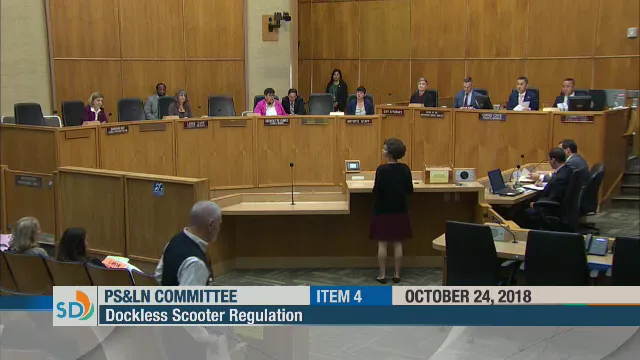
STREAMING COPY IN PREPARATION — RECORDING AVAILABLE FROM THE ORIGINAL SOURCE
Public Safety & Livable Neighborhoods Committee Meeting – October 24, 2018
The committee met on October 24, 2018, to discuss and vote on several items including an Arborist tree maintenance agreement, an update on the EMS transport contract, a proposed incentive-based illegal dumping reporting program, an appeal of a liquor license denial, and a regulatory framework for dockless scooters. Public comments addressed concerns about marijuana businesses, police patrol practices, and the safety and regulation of electric scooters.
Consent Calendar
- The committee approved the actions from the September 19, 2018 meeting. A motion by Councilmember Gomez was seconded and passed unanimously. Vice Chair Bree abstained (she had not attended the prior meeting).
Public Comments & Testimony
- Kelly McCormick (parent/works with teens): Expressed strong opposition to marijuana marketing, citing a Health and Human Services study showing increased teen marijuana use, with 42% of users using daily or near daily and 22% of 18-25 year olds currently using. She argued that marketing normalizes pot and harms youth cognition, urging leaders to protect children.
- Kathleen Lippitz (assisting disenfranchised businesses): Criticized the city for giving preferential treatment to marijuana businesses over churches, youth organizations, and professional businesses, leading to disenfranchisement of long-term community-friendly businesses.
- William Perno: Stated that a marijuana production facility in a disadvantaged neighborhood (Promise Zone) was permitted in error. He noted it is within 833 feet of an elementary school (524 students), 805 feet of a church, and 100 feet of homes—violating city ordinances. He expressed confusion that DSD recommended approval despite clear code violations.
- Francine Maxwell (4th District resident): Raised concerns about police patrol practices in Southeastern San Diego and City Heights, noting that unnecessary units linger at traffic stops after scenes are secured, wasting resources in communities that are 219 officers short. She requested a policy to ensure rapid dispersal.
- Martha Welch: Criticized city services for police and fire, stating stations are often closed, 911 response is poor, and the city is
Meeting Transcript
Good morning. We're gonna call the September. That's not right. October 24th. Meeting of the public safety and mobile neighborhoods committee to order. Let the record reflect that we have a quorum consisting of myself, Vice Chair Bree, and Councilmember Zaff. We're gonna start off with non-agenda public comments. Each speaker will have two minutes for non-agenda public comments. We have Kelly McCormick, followed by Kathleen Lippitz, followed by William Perno. And there are seats in the front. So if I call your name, feel free to come on up to the front and ready for the speakers. Good morning, I'm Kelly McCormick. And I just like to say that it looks like the marijuana industry's efforts to market and normalize pot are paying off in a big way. A new study by Health and Human Services shows that kids in their late teens are using more marijuana now than at any time in recent history. There are now twice as many daily or near daily marijuana users in the U.S. than just a decade ago. And according to the National Survey on Drug Use and Health, 42% of marijuana users use the drug daily or near daily. Most disturbing is the revelation that 22% of 18 to 25 year olds are currently using marijuana. It should come as no surprise that Colorado is now the number one state in the country for first-time marijuana use among teens. Previous studies have shown that teens who view more marijuana ads are more likely to use POT even if the ads are not directed toward them. Marketing works. Here's another important study to note published in this month's American Journal of Psychiatry. Adolescents who begin using marijuana regularly can suffer lasting repercussions in their thinking ability. Specifically, teenagers who used marijuana regularly were more likely to score lower on memory tests, learning new information, and higher level thinking involving problem solving and processing information compared to non pot users. What's more, even after the students reported stopping marijuana, their cognition did not improve. As a parent and as someone who works with teens, this is not the future I want for our kids. They deserve better. And our kids need adults and government leaders who are willing to stand up for them against a predatory industry. Kathleen Lippitt, followed by William Perno, followed by Francine Maxwell. Good morning, Council members. My name is Kathy Lippett. I've been assisting disenfranchised businesses such as churches, youth serving organizations, professional businesses, owners, and nonprofits. Yesterday I watched as yet another long-term community-friendly business condo complex. Fifty-three professional businesses were disenfranchised by the city's preferential treatment of marijuana businesses. And apparently neither does the city. Policies that the city adopts should be recognized for the incentives they create and inspire, not the hope that they were founded on. Thank you. Thank you. William Perno, followed by Francine Maxwell, followed by Martha Welch. Good morning, Council members and staff. I'm gonna be talking today about a marijuana production facility that's in the heart of one of the most disadvantaged neighborhoods in San Diego in a promise zone. This is one of the um 37 businesses that was permitted in error by DSD. You have a um marijuana production facility ordinance, and I have copies for you here that clearly state that they're not allowed within 1,000 feet of the following resources and populations city parks, churches, child care centers, playgrounds, libraries, residential care facilities, minor oriented facilities, or schools. This particular location, if I can put up uh number one, please is within eight hundred and thirty-three feet of an elementary school, K through fifth grade, uh, with five hundred and twenty-four students for Rodriguez Elementary. It is within eight hundred and five feet of a church. It is next door to residential homes within 100 feet of the production facility location. That business is applying, even though it was inaccurately placed in this city in this neighborhood, is applying for a uh production facility permit through DSD. DSD has clearly noted the major issues that I just brought up that recommend denial of that. But another unit within DSD, land development review is recommending approval for deviances to allow this marijuana production field facility in clear violation of your city ordinance. And the community and our Central Region Prevention Coalition were kind of very confused by the fact that this is not violating not one, not two, but three conditions of your city ordinance.
openpublica.com