Public Safety and Livable Neighborhoods Committee Summary - June 26, 2019
STREAMING COPY IN PREPARATION — RECORDING AVAILABLE FROM THE ORIGINAL SOURCE
Public Safety and Livable Neighborhoods Committee Meeting Summary
Date: June 26, 2019
The Public Safety and Livable Neighborhoods Committee met on June 26, 2019, to discuss a range of public safety, housing, parks equity, and police oversight issues. The meeting included updates on summer beach enforcement, a housing center for homeless individuals, maintenance assessment districts, a parks equity report, and presentations from two civilian police oversight bodies.
Consent Calendar
- Committee Actions from June 5, 2019: Approved unanimously.
Public Comments & Testimony
- Martha Welsh: Criticized police and fire overtime, station conditions, and claimed the city misrepresents officer numbers; urged improved resources.
- Peggy Walker: Requested the committee monitor public safety impacts of marijuana retail and manufacturing (DUIs, extraction lab explosions, condemnation); suggested engaging in a hazmat workshop.
- Kelly McCormick (public health educator): Highlighted the lack of certified marijuana testing facilities in San Diego County, noting that only a fraction of licensed manufacturers participate in track-and-trace systems.
- Judy Strang (coalition of parents): Expressed concerns about marijuana billboards normalizing use for youth and cited mental health issues; shared information from NAMI and a media event.
- Kate Yavendetti (Women Occupy San Diego, National Lawyers Guild): Supported the Citizens Advisory Board’s 30 recommendations, urged the committee to adopt proposals the mayor’s office may reject (racial profiling, pretext stops, recruitment, training).
- Darwin Fishman: Shared experience from a ride-along with a rookie officer recruited from Arizona; questioned the balance of recruitment and training; requested data on officer washout rates.
- Several members of Mid-City CAN Youth Council (Daniela Silva, Marita Rodriguez, Evelyn Cruz, Ricky Rodriguez, Fernando Gonzalez, Evelyn Soto, Yadira Calderon, Laura Besa) testified in favor of an independent community review board with subpoena power and youth representation, emphasizing that youth are over-policed and underrepresented.
Discussion Items
- Summer Beach Operations Plan Update (SDPD): Lt. Lisa McKean and Capt. Tina Williams presented the plan for Memorial Day, July 4th, and Labor Day. Key statistics: 1.5 million visitors expected across the summer; July 4th draws nearly 1 million people. Enforcement strategies include a dedicated beach team (10 officers plus sergeant) that issued 162 scooter citations and 188 traffic warnings to juveniles in May–June. The department coordinates with multiple agencies and uses mobile command posts. Committee members discussed crowd management, scooter enforcement, outreach to Tijuana (Councilmember Moreno urged Spanish-language social media blitz), and homeless population integration. SDPD confirmed they conduct bilingual press conferences but will enhance cross-border messaging.
- Connections Housing Annual Status Update: James Alexander (Civic San Diego) and Jonathan Castillo (PATH) reported on the one-stop service center for homeless individuals (150 transitional beds, 73 permanent units) at 6th and A streets. The conditional use permit (CUP) requires annual administrative reviews (final one presented). Occupancy fluctuates due to prioritization of street homeless. Monthly counts within a quarter-mile radius range from 60 to 85. PATH serves about 900 individuals annually through various programs. Committee members commended the community advisory committee model and requested updated baseline data for the area (current baseline of 245 from 2012). Chair noted the importance of street outreach.
- Maintenance Assessment Districts (MADs) – Items 1–3: Paul Saroy (Parks) and Luis Ojeda (EDD) presented annual reports for 64 MADs and five-year nonprofit service agreements for Civita and La Jolla MADs. The presentation explained how assessments are calculated (special vs. general benefits). Councilmember Moreno praised Luis Ojeda’s work and made a motion to approve items 1–3 as recommended by staff. Motion passed unanimously.
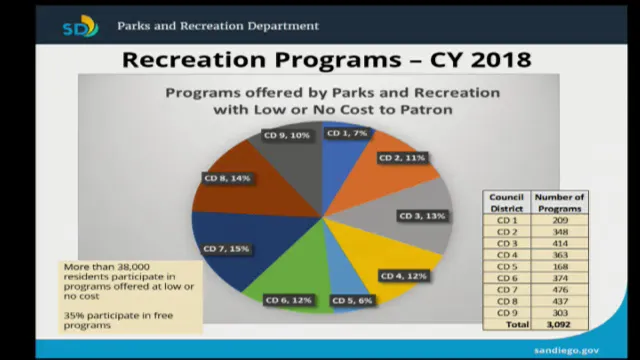
- Parks and Recreation Equity Report: Herman Parker, Andy Phil, and Shelley Stoll presented data on park funding, programs, and facility condition. The department offers 4,800 programs annually, 35% fully cost-recovered. Key finding: Recreation center funds with less revenue have more free/low-cost programs; high-revenue centers (e.g., Carmel Valley) offer more paid specialty classes (98 classes vs. 24 at one center in District 8). Councilmember Moreno highlighted disparities (Carmel Valley’s programming budget 13 times larger than Robert Eger’s in Nestor) and called for action, not excuses. Councilmember Kate emphasized that general fund programs are consistent citywide, but specialized classes depend on local demand and willingness to pay. The department committed to expanding specialty classes citywide and better tracking outcomes. Vice Chair Bree noted the need for cross-district analysis and a new parks foundation to address equity.
- Citizens Advisory Board on Police Community Relations (CAB) Biannual Update: Rev. Gerald Brown (executive director) and Barry Pollard (chair) summarized the board’s work since 2016: completed 30 recommendations organized under six pillars (trust, policy, technology, community policing, training, officer wellness). Key proposals include a pilot moratorium on pretext stops (with District 2 member not supporting), enhanced recruiting independent of military (to avoid “occupier mentality”), improved field training officer selection, and mandated medical review after carotid restraint use. The board requests funding for a full-time recruiter and an independent third party to review implementation. Councilmembers asked about data access difficulties and specifics of pretext stop pilot. Further discussion anticipated at next biannual report.
- Community Review Board on Police Practices (CRB) Annual Update: Chair Jill Craver, Brandon Hilbert, and Tara Gentry reported on FY2019 statistics: 55 cases reviewed (up from 43), 191 allegations (93 exonerated, 28 sustained, 64 unfounded). The board now reviews unlawful detention/search allegations and audits category two complaints. Policy recommendations include a de-escalation policy (department drafting) and carotid restraint changes (medical evaluation required after use). The board logged over 4,000 volunteer hours and reduced case review time to 60–90 days. Vacancies exist, especially from District 8. Committee members thanked volunteers and discussed transparency, including potential closed-session agenda descriptions.
Key Outcomes
- Items 1–3 (MADs annual reports and five-year agreements): Approved unanimously.
- Summer Beach Plan, Connections Housing, Parks Equity Report, CAB and CRB updates: Received as information; no formal votes taken. Committee directed departments to continue work on equity, follow up on CAB recommendations with the police chief, and explore improvements to the CRB (e.g., independent oversight, youth representation).
- Next regular meeting scheduled for July 24, 2019.
Meeting Transcript
Good good morning, everyone. Thank you for being here. I'd like to call this meeting to order. We have uh vice chair, uh Barbara Bree here and also Councilmember Kate. Um so we're gonna go ahead and get started. Um I would now entertain a motion for approval of uh committee actions from June 5th. So we have a motion, a second. All in favor? Passes unanimously. Thank you very much. Um we're now going to move to non-agenda public comment. Uh Martha Welch, as far as um you have uh one minute. Martha Walsh, I'm here to talk with the police and the fire. Many overtime. Shows lack of office and fire. I think I bet um don't follow the rules. And also um fire stations um are like number two so small, can't have a um kitchen and sleeping and showers all can have that also. And on Skyline has a temporary um for years. And also we know the police 150 will retire. And I think um you you're lying how much police we have right now because I've been to some of the stations and they're closed to the public. And so uh you're making a rent this um um risk um to us because um everywhere in the state they have pensions and everything for fiber, not here. Thank you, Ms. Welsh. We have uh Peggy Walker next, and after Ms. Walker, Kelly McCormick, so please be ready. You have one minute, ma'am. Good morning, thank you, committee. Um that San Diego has four uh marijuana outlets poor district about to start operating and 40 um MPFs about to start operating, it seems like we're gonna become something of a capital for marijuana retailing distribution and manufacturing. And so I would request of this committee as public safety that you monitor this activity and come back with some kind of a public report to let us know how it's impacting our public safety in livable neighborhoods. Three things of concern, DUIs. Uh second extraction lab explosions. Um we've talked about that before, but the DA has announced a hazmat workshop to explain the dangers of the equipment that's being used. And I would suggest that you, as a committee, engage in one of those workshops. And finally, condemnation. It's a serious issue. I wish you'd look into that too. Thank you. Thank you very much. Um, Ms. McCormick, Kelly McCormick. And after Ms. McCormick is Judy String. Good morning. I'm Kelly McCormick. As a public health educator, I'd like to request attention to an issue that's not being widely acknowledged, and that's the lack of certified marijuana testing facilities. Consumers are misled into thinking that marijuana is adequately screened for pesticides, heavy metals, and other contaminants before it's offered for sale. But most consumers are unaware that only a fraction of the so-called regulated marijuana is actually tested because of numerous exceptions. There are zero testing labs in San Diego County and not enough in the state to meet demand. A recent investigation by the Associated Press revealed that only 93 of more than 1,000 licensed manufacturing companies are participating in the track and trace system. Only 208 out of 1,532.
openpublica.com