San Diego Public Safety and Livable Neighborhoods Committee Meeting - July 24, 2019
STREAMING COPY IN PREPARATION — RECORDING AVAILABLE FROM THE ORIGINAL SOURCE
San Diego Public Safety and Livable Neighborhoods Committee Meeting - July 24, 2019
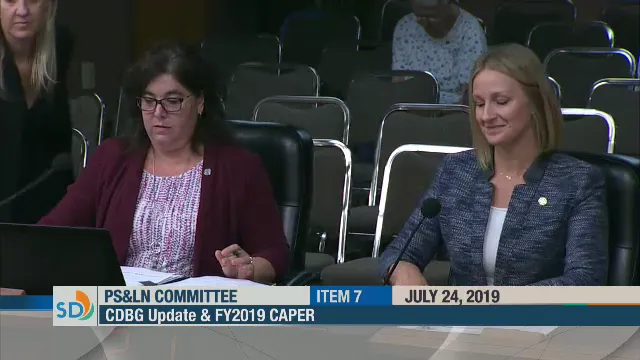
The Public Safety and Livable Neighborhoods Committee met on July 24, 2019, at 5:00 PM to discuss non-agenda public comments, police recruitment and retention, tobacco ordinance enforcement, CDBG program updates, and fire department Citigate studies. The meeting was chaired by Councilmember Montgomery, with Vice Chair Bree, Councilmember Kate, and Councilmember Moreno present.
Consent Calendar
- Unanimously approved the committee actions of June 26, 2019.
Public Comments & Testimony
- Martha Welch expressed concerns about police staffing shortages, pension issues, and the proliferation of dockless scooters obstructing sidewalks and wheelchair ramps, urging limits on scooter companies.
- Francine Maxwell (Southeastern San Diego resident) requested a PSA to inform residents about the CAP (Community Awareness Program) in her area, citing lack of data and training. She asked the committee to review data on the program's need.
- Terry Skelly opposed a proposed marijuana storefront in City Heights, citing a study showing increased youth marijuana use and positive views of drugs near storefronts. She urged strong billboard regulations.
- Michael McConnell criticized the vehicle habitation ordinance, stating it criminalizes homelessness. He cited a report showing 22,000 citations and arrests since 2013, a 300% increase, and argued that the safe parking lot program is poorly planned.
- Becky Johnson (parent of six) opposed a marijuana outlet application at 437 Home Avenue, saying it is too close to affordable housing and a youth tutoring center, and that the school bus stop is 25 feet away. She suggested modifying pot shop location regulations.
- Terry Best (District 3) criticized the San Diego Police Department's "Book of Excellence" for including a photo of an individual in a tragic situation, calling it unprofessional and calling for police accountability. He referenced Tasha Williamson's mayoral campaign.
Police Chief's Response to Photo
- Chief Neslike apologized for the photo, noting it was from a 2011 album and does not reflect current department culture. He highlighted recent policy changes, including use-of-force policy updates and a new vision and mission statement. The chair thanked the chief and noted the launch of a peace movement with Councilmember Moreno.
Discussion Items
Recruitment and Retention Update (SDPD)
- Assistant Chief Sandra Albertson and Lt. Steve Waldheim presented. Key statistics: 94 officers hired in 2019 (40% college educated, 50% minorities, 15% women). Marketing with Loma Media resulted in a 312% increase in website traffic. The latest academy cohort had 63 recruits, the largest in 25 years, with only two losses so far. The department has streamlined background processes and added polygraph examiners. Monthly officer losses decreased from 14 to 13, and losses to other agencies dropped from 3 to 2 per month.
- IBA representative Mr. Olson noted the FY20 budget includes $20.7M for police salaries, $400,000 for lateral incentives, and $250,000 for a home buyer down payment assistance program.
- Public comment (Francine Maxwell) expressed support but urged more community engagement, including recruiting from historically black colleges and universities, and noted the lack of African American female lieutenants or sergeants.
- Councilmember Kate asked about residency of new hires, improved hiring numbers despite fewer applicants, and competitive pay with surrounding agencies. He praised the use of geofencing and digital ads.
- Councilmember Moreno commended the department for using social media and focusing on homegrown recruits. She asked about learning from the Loma Media phase, changes in recruitment strategy, and efforts to recruit women. She noted the importance of a police department that mirrors the community. She also asked about high school and junior college outreach.
- Vice Chair Bree asked about the main disqualifying factor (narcotic use) and the rules. She also asked about the best sources of candidates and the national averages for college-educated recruits (not available), women (12% national vs. 15% SDPD), and minorities (27% national vs. 50% SDPD). She noted the academy loss rate has improved.
- Chair asked about the college-educated percentage (40% vs. national average not available). She also noted the 63 in the academy with only two lost, compared to previous 10-15% loss. She asked about test preparation and community-focused videos.
Tobacco Ordinance Update (SDPD)
- Lt. Andrew Brown presented annual report for calendar year 2018. There were 862 active state tobacco licenses and 943 city permits. 136 covert decoy inspections resulted in 20 citations (14.7% illegal sales rate, up from 10.65% in 2017). Four citations were for e-cigarette/vaping violations. $180,776.36 in fees collected. 57 violation notices were issued. The department also conducted 127 overt inspections.
- Public comment: Manuel Andrada (San Diego Smoke-Free Project) thanked the department and raised concerns about hookah lounges and new tobacco trends. He proposed following National City's ordinance changes.
- Public comment: Mary Baum (Say San Diego) thanked the department, noted an epidemic of vaping in schools, and asked to address smoke shops that open near schools, such as one across from Hoover High School.
- Chair asked about the October 30, 2018 operation showing zero violations but two citations; Lt. Brown explained it was a data entry learning curve. Chair requested a district breakdown of inspections.
Community Development Block Grant (CDBG) Program Update
- Christina Bibler (Economic Development Director) reviewed the history of reforms after the 2008 audit, current achievements (nonprofit academy, awards), and future funding challenges. HUD funding will decrease by approximately $20 million starting in FY2021 due to reductions in program income and transfer of HOPWA to the county. She outlined the consolidated plan goals and opportunity for council engagement.
- Councilmember Moreno spoke about using CDBG program income (repayment funds from former redevelopment agency) for affordable housing, noting that CDBG's primary goal is affordable housing. She suggested a policy change to redirect the $15 million in repayment funds toward gap funding for affordable housing.
- Councilmember Kate agreed on the need for policy discussion but cautioned about impacts on nonprofits and infrastructure. He asked about flexibility to amend the consolidated plan and timelines. Staff noted that substantial amendments require a 15-day public comment period, and the RFQ process begins in September.
- Chair emphasized the need to consider operational challenges, including the ability to spend funds within HUD timelines. She noted the importance of shovel-ready projects and asked about the nonprofit academy locations.
Citigate Studies Update (Fire Rescue Department)
- Fire Chief Colin Stahl and Deputy Chief Jim Gabri updated on active and completed studies. The Standards of Response Coverage study (2010 and 2017) identified 10 priority gaps, six of which are being addressed. New stations: Fairmont (design phase), UCSD (land swap), University City (under construction), Black Mountain Ranch (closed escrow). Other stations: Torrey Hills (early planning), Otay Mesa (funding accumulating). The MetroZone Emergency Command Center study is moving toward a co-located facility with four dispatch centers. The EMS ambulance RFP is expected to be released August 1-2, with award in early 2020. The maritime response study will be finalized in fall 2019.
- Councilmember Kate asked about updating response times as growth occurs. Chief Stahl explained using technology, peak hour engines, and operational changes. He also noted triaging calls to reduce unnecessary engine responses.
- Councilmember Moreno thanked the department for presence at community events and highlighted the importance of Station 54 in Paradise Hills and Station 49 in Otay Mesa. Chief Gabri clarified that Station 54 still lacks property.
- Vice Chair Bree praised progress in District 1, noting that new stations are funded by developer fees, and that urban core stations need other funding sources.
Key Outcomes
- Approved consent calendar (June 26, 2019 actions) unanimously.
- Received updates on recruitment and retention, tobacco ordinance enforcement, CDBG program, and Citigate studies. No votes were taken on these information items.
- Direction for continued work: staff to provide district breakdown of tobacco inspections; engage in policy discussions on CDBG program income usage; continue fire station planning, especially for Station 54; and move forward with co-located dispatch center study and EMS RFP.
- Next meeting scheduled for September 18, 2019.
Meeting Transcript
Good morning, everyone. Thank you for uh being here. I'd like to call this meeting to order. Where um Vice Chair Kate, uh Council, Vice Chair Bree, Councilmember Kate, Councilmember Rain are all are all present. Um at this time, I'd like to entertain a motion to approve the committee actions of June 26, 2019. We have a motion and a second. Uh all in favor, say aye. And that passes unanimously. Now we're gonna move on to uh non-agenda public comment. We have a few speakers um and you will each receive two minutes. So let us start with Martha Welch and then Francie Maxwell will follow Ms. Welch. Good morning, Martha Welch. Right now, man over time with um SFAR and the police. It shows we don't have enough police, right? And uh uh um we don't have enough point um um piece um we don't have enough people to that's a problem. Also, um B and uh 18 and uh and and so no um fire will get a pension for that reason. So they won't they won't you can't hire them because they uh they won't because every everybody in the state everywhere in the state has pensions, but not us here, so why would they come here? So um now the dock um scooters, there's too many companies right now. And I know that they um the people um there's who's gonna um forces being a lack of people of um police. So who's gonna do this? Because um on the bus stops, they they just they throw them down, they don't stand up there all the place, and the driver told me sometimes um the wheelchair ramp won't fit because all the docks um scooters are there, that's the problem with that, also. So that's the problem right here. We don't control it. And if we don't control it, it's gonna get worse and worse. There's too many companies, and it's we should limit it or something like that. We gotta do something better with doctors, um scooters because it's hard with people want to walk, and all the sidewalks, there's only a few of them go in the little boxes that you fix it, but not all of them. They're on the sidewalk or everywhere. People don't care where they put them down, they're in the way every way that people walk and everything else. So it's hard for people to walk because they're in the way all the time, you have to walk around them, and it's dangerous, especially if your wheelchair is something like that. There's no more room, there's not enough room to go around them sometimes. So you've got to do something with these um scooters and everything, and uh limited or somehow because there's just too many on the street right now. Thank you, Ms. Welch. Uh Francine Maxwell and then uh Miss Maxwell will be followed by uh Terry Skelly. Francine Maxwell, Southeastern San Diego resident. I'm asking for the committee to ask for a uh PSA in reference to the CAP program that has recently enacted in Southeastern San Diego. Many of the residents, after I attended my captain's advisory meeting, I passed out the new CAP flyer, and it doesn't have Southeastern in it anyway, but this is a Beach La Jolla program. And so to bring it to Southeastern San Diego and not tell the residents that it's here, what it represents. We need a PSA, and it can be shown in the loop on Channel 24 so that the residents know we have a lot of people moving in the community, and they don't know that they just need to knock on their neighbor's door to tell them to turn down James Brown. And so for them to want to keep calling the police, they said that there's all this data, and at the captain's advisory, there was no data shown that we that the CAP program needed to be in southeastern San Diego, but it's here. We asking for the data to be shown. We're asking for your committee to look at the data and compare the data. We have uh allegedly all these calls to the mayor's office. I asked some of my community officers, they said there's four addresses that they have to look at in southeastern San Diego. Some of the neighbors that I passed this out to that have a lot of King Cettas, they said that this is uh making them feel like this is the tailgate issue. So you always get pulled over. Oh, we saw we saw your tail light was out. So when somebody is playing music, it's summertime. So the community needs to know.
openpublica.com