Public Safety Committee Meeting - February 12, 2025
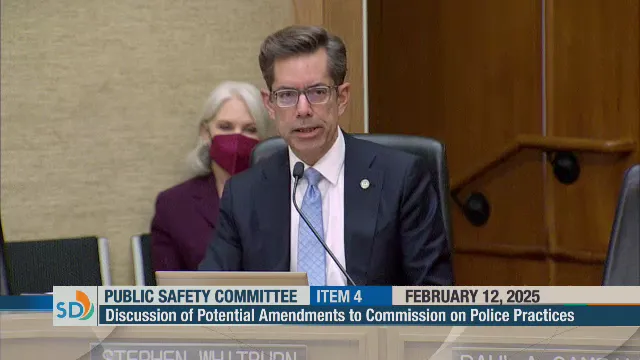
STREAMING COPY IN PREPARATION — RECORDING AVAILABLE FROM THE ORIGINAL SOURCE
Public Safety Committee Meeting - February 12, 2025
The San Diego Public Safety Committee met on February 12, 2025, at 2:00 p.m. The meeting covered consent agenda items, a discussion on firefighter wellness services, a lengthy discussion on potential amendments to the Commission on Police Practices (CPP), and an informational item on the 2025 work plan. The committee heard extensive public testimony on both non-agenda and agenda items, with over 30 speakers providing input.
Consent Calendar
- Item 1: Approval of committee minutes from January 22, 2025.
- Item 2: Authorization to enter into the second amendment to the agreement with Mallory Safety and Supply LLC for safety equipment and supplies.
- Both items were approved unanimously (3-0, with Vice Chair absent).
Public Comments & Testimony
- Non-Agenda Public Comment: Speakers addressed a variety of topics including:
- Exigent circumstances for tech placement (Blair Beekman).
- Shelter costs and homelessness (Rachel Hayes, advocating for lower-cost alternatives).
- Flood preparedness and sandbag distribution (Tasha Williamson).
- Drug-impaired driving and fentanyl awareness (Terry Ann Skelly, Madison).
- Marijuana commercialization and high-potency THC risks (Megan Stewart, Kathleen Lippett, Peggy Walker).
- Wildfire safety and ballot measures (Luis Rodoliko).
- Sexual assault case follow-up concerns (Lori Saldania).
- Staffing and hiring practices (Francine Maxwell).
- Consent Agenda Public Comment: Support for fire equipment and safety (Blair Beekman, Rachel Hayes, Lori Saldania, Tasha Williamson).
- Item 3 (Wellness Contract):
- Blair Beekman linked wellness to community communication.
- George Duardo (San Diego City Firefighters President) requested no action on the contract due to ongoing meet-and-confer process.
- Rachel Hayes and others supported the wellness program, emphasizing first responder well-being.
- Virtual speakers (including lifeguard union representative Patrick McVann) supported the contract.
- Item 4 (CPP Amendments):
- 12 in-person speakers and 14 virtual speakers commented. Many opposed any changes that would reduce commission independence, size, or council control over the executive director.
- Commissioners (including Clovis Honore, Bonnie Benitez, Armando, Darlene) requested time to address issues and opposed premature amendments.
- Community members (Andrea St. Julian, Francine Maxwell, Donna Kaiser, and others) emphasized the need for full implementation of Measure B with 75% voter support.
- Item 5 (Work Plan): Blair Beekman and others advocated for tech accountability, privacy, and a broadened definition of public safety.
Discussion Items
-
Item 3: Wellness Services Contract for Fire Rescue Department
- Presentation by Assistant Chief James Gabriel and Deputy Chief Willie Melendez. The proposed five-year contract with Concentra Health Services (not to exceed $12,069,945) would provide comprehensive physical wellness exams, cancer screening, and mental health support.
- Data showed stable claim counts despite 15% increase in staff and 40% increase in call volume (57,000 more calls annually).
- City firefighters union (Local 145) requested delaying approval due to active meet-and-confer. They noted the current contract was extended to June 2025.
- Chair von Wilpert moved to forward without recommendation, directing the city to continue bargaining before bringing to full council. Motion passed 3-0.
-
Item 4: Potential Amendments to Commission on Police Practices Ordinance
- Chair von Wilpert provided background: Measure B passed in 2020, CPP established in 2021, implementation ordinance in 2022, commissioners appointed in 2023. The city invested over $4 million. The CPP has not yet begun independent investigations due to pending standard operating procedures (SOPs).
- Exit memos from former Executive Director Paul Parker and former counsel Dwayne Bennett raised concerns about commission size (25 members), Brown Act compliance, impartiality, and unclear roles.
- CPP Chair Doug Case, Vice Chair Ada Rodriguez, and new General Counsel Bart Meesfeld presented recent accomplishments and steps taken: adopting staff-led case review, developing Brown Act training, clarifying roles, and planning to present SOPs to the commission in April 2025.
- Councilmember Whitburn expressed concern over disregard for legal advice and impartiality; commissioners acknowledged issues and progress.
- Councilmember Campbell suggested a working group to streamline operations.
- Motion (amended by city attorney and Campbell): Direct city attorney, CPP counsel, and staff to work with the chair’s office to draft potential ordinance amendments, bringing recommendations back to the committee. Passed 2-1 (Whitburn voting no).
Key Outcomes
- Consent Calendar: Items 1 and 2 approved unanimously.
- Item 3: Forwarded to full council without recommendation, with direction to complete meet-and-confer before final action (vote 3-0).
- Item 4: Motion passed to initiate a collaborative process to draft potential amendments to the CPP ordinance, with a report back to the committee. (Vote 2-1, with Whitburn opposing.)
- Item 5: No action required; the work plan was received as information.
- The next regular meeting is scheduled for March 12, 2025, at 2:00 p.m.
Meeting Transcript
All right. Welcome everybody. Thank you for coming out in the rain. I appreciate you being here. Welcome to the public safety committee meeting of February 12th, 2025 at 2 p.m. Our committee lays on Natalie Kessler will provide information and instruction for the public on how to participate in today's meeting. Natalie, please proceed. Thank you, Chair. While members of the public are able to attend the meetings in person, this meeting is being televised and live streamed on the city's website, and the council administration will continue to make arrangements for the public to comment using the Zoom webinar platform. Members of the public who wish to provide testimony via a call-in or an internet-based service option must enter the virtual speaking queue within five minutes after the conclusion of in-person public testimony or before the virtual speaking queue is exhausted, whichever occurs first. This will allow for better meeting management between the two platforms and ensure the committee is able to manage and conduct city business. We appreciate the public's cooperation. Chair. Thank you. I will now call the public safety committee meeting of February 12th, 25 to order. Natalie, uh yes, Natalie, please call the roll. Committee member Campbell. Yeah, here. Committee member Whitburn? Sure. And Chair Von Wolfert. Also attending the meeting today is Laura Easton with the Office of the City Attorney. Members of the public can join the webinar by computer, tablet, or smartphone by accessing the link which is listed online in the preamble language of the agenda on the city's webpage. To join the Zoom webinar by telephone, please dial 16692545252 when prompted. This information is also available on the agenda and will appear on the screen during the public comment period for each agenda item. Please note that if you are watching via City TV 24 or online, there may be a delay. Please participate via the audio on your phone and mute your TV or computer when it is your turn to speak. If you wish to speak on a particular item, wait for that item to be called and then raise your hand to speak by tapping the raise your hand icon, or if you're a call-in participant, press star nine on your phone. If you raise your hand during a non-comment period, your hand will be lowered. Chair. Each speaker will have two minutes. And Chair, we have received four speaker slips from individuals in chambers. So to try to continue, I think an important concept in tech placement for the future of San Diego is the idea of exigence circumstances. How we could possibly very easily take the tech away from the neighborhoods once the festival was over. A few other items. Exigent circumstances was the legal way that that tech and an emergency situation could be placed. I think we can really be working on a future of the exigence circumstances process. That in the era of 9-11 was on average about one to two years since tech accountability came in about 2014. Exigence circumstances process is now about a three to six month period. And that exigent circumstances is where police can have their investigation process unhindered by public oversight. And I think what uh why why it's currently going through court proceedings is as how to engage in that because the quick tech placement things I've talked about, there's programs growing across the country that want to use exigence circumstances a lot. We need to have good solid protections. Let's work on it. Thanks. Thank you. Natalie Raske. Please approach the lecture. Hi, Rachel Hayes with Lived Experience Advisors, uh, or representing myself for the non-agenda. Okay, I was thinking about yesterday, and we spoke about the shelters. And I think that paying 87 million to rehab the library, when we have an option to pay 405 million to rehab a different building, and we're so broke, we should go for that building, not the library.
openpublica.com