Rules and Economic Development Committee Meeting - May 15, 2013
STREAMING COPY IN PREPARATION — RECORDING AVAILABLE FROM THE ORIGINAL SOURCE
Rules and Economic Development Committee Meeting - May 15, 2013
The Committee on Rules and Economic Development met on Wednesday, May 15, 2013, at 9:00 AM in Council Committee Room, City Administration Building, 202 C Street, San Diego. Council President Pro Tem Sherri Lightner chaired the meeting with Vice Chair Kevin Faulconer and Councilmembers Mark Kersey, David Alvarez, and Marti Emerald present. The committee considered three action items: political party campaign contribution limits, a new targeted employment area for the enterprise zone program, and a proposed prevailing wage ordinance for municipal projects. Item #4 (Civic San Diego report) was continued to the next available meeting.
Consent Calendar
- There were no consent calendar items.
Public Comments & Testimony
- Item #1 – Political Party Contribution Limits: Several speakers expressed support for the proposed limits. Will Moore, attorney for the San Diego County Democratic Party, supported the $10,000 district / $20,000 citywide limits recommended by experts, arguing that without enforceable attribution rules, large contributions create an appearance of corruption. Simon Mieski of California Common Cause also supported the $10,000/$20,000 limits, calling them balanced and likely constitutional.
- Item #3 – Prevailing Wage Ordinance: Numerous individuals and organization representatives spoke in favor of the mayor's proposal to require prevailing wages on all city-funded public works projects. Scott Littlehale (Smart Cities Prevail) cited studies showing no significant cost increases and benefits such as higher local hiring and reduced public assistance costs. James Reed (Center for Contract Compliance) presented economic impact data from San Jose, including $164 million in lost economic activity without prevailing wage. Andy Berg (National Electrical Contractors Association) argued that prevailing wage levels the playing field and encourages local hiring and training. Tom Lemon (San Diego Building and Construction Trades Council) emphasized the need to catch up with neighboring cities and the impending state law (SB 7) that could withhold funds from charter cities not paying prevailing wage. Other speakers included representatives from the NAACP, faith community, local contractors, and union members who shared personal stories of how prevailing wage supports middle-class livelihoods.
Discussion Items
- Item #1: Political Party Campaign Contribution Limits – The committee heard presentations from Stacy Fulhorst (Executive Director, Ethics Commission) and professors Thad Kousser (UCSD) and Richard Hasen (UC Irvine). Fulhorst explained the difficulty of enforcing attribution rules and the potential for circumvention, citing over $1 million in party contributions during the 2012 mayoral race. Kousser and Hasen provided legal and policy analysis, recommending $10,000 per election for district candidates and $20,000 for citywide candidates as likely constitutional. Councilmember Faulconer moved to adopt the Ethics Commission's initial recommendation of $3,000 district / $12,000 citywide. After debate, that motion failed 2-3 (Lightner, Alvarez, Emerald opposed). Councilmember Emerald then moved to recommend $10,000/$20,000 limits, with direction to use Charter section 295(d) to allow the ordinance to take effect June 2, 2013, to be in place before the next election cycle. The motion passed 3-2 (Lightner, Alvarez, Emerald in favor; Faulconer, Kersey opposed). The committee directed the City Attorney to draft the ordinance accordingly, with legal review on the applicability of Charter section 295.
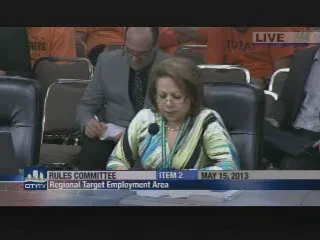
- Item #2: New San Diego Regional Target Employment Area (TEA) – Lydia Moreno (Economic Development Department) presented the update using current census data. The proposed TEA includes 209 qualifying census tracts (up from 189), covering parts of San Diego, Chula Vista, and National City. The boundaries expand the eligible employee pool for the enterprise zone program. Councilmember Alvarez moved to approve staff recommendation and requested staff return within 60 days with a second enterprise zone expansion proposal. The motion passed unanimously (5-0).
- Item #3: Prevailing Wage Ordinance – Nelson Hernandez (Mayor's Office) presented the mayor's proposal to require prevailing wages on all city-funded public works projects, not just those over $10 million. He argued it would create a level playing field and improve construction quality. Councilmember Kersey moved to request that: (1) staff work with stakeholders and the City Attorney to prepare a draft ordinance; (2) the Independent Budget Analyst (IBA) review a list of affected projects and provide an annual cost/savings analysis; (3) the City Attorney provide legal analysis of SB 7 and the proposed ordinance; and (4) staff report addressing questions raised by the IBA and councilmembers. The motion was amended to include a deadline to return to the committee on June 19, 2013, and to the full City Council on June 24/25, 2013. The motion passed unanimously (5-0).
Key Outcomes
- Item #1: The committee recommended that the City Council adopt an ordinance establishing political party contribution limits of $10,000 per election for district candidates and $20,000 per election for citywide candidates. The City Attorney will draft the ordinance and determine the applicability of Charter section 295(d) for an immediate effective date.
- Item #2: The committee approved the new boundaries for the 2013 San Diego Regional Targeted Employment Area. Staff will return within 60 days with a proposal for the second expansion of the enterprise zone.
- Item #3: The committee directed staff, the IBA, and the City Attorney to prepare analyses and a draft ordinance addressing prevailing wage applicability. The matter is scheduled for the June 19, 2013 committee meeting and the June 24/25, 2013 City Council docket.
Meeting Transcript
Good morning. Welcome to today's meeting of the Rules and Economic Development Committee. Let the record reflect that we have a quorum consisting of Vice Chair Faulkner, Councilmember Kersey, Councilmember Alvarez, Councilmember Emerald, and myself. Also here with us as committee staff, including Kerry Gleason from the Office of the City Attorney, Jeff Khoir from the Office of the Independent Budget Analyst, and Nelson Hernandez from the Mayor's Office. Additionally, Nika Bukulova, committee consultant, is here. Before we begin, I want to announce that given we are expecting a large number of speakers today for a couple of the items, we have decided to continue the Civic San Diego item number four to June 5th. I thank you all for being here. We will begin our agenda with non-agenda public comment. We have two speakers. If you would come forward, please. Oh, prevailing wage. Yes. Okay, thank you, sir. And then I think this might be true for Patrick Clifton as well as Patrick Clifton here. Okay, so both are number three. Okay. So we have no non-agenda public comment, and we have uh no comments specific to regulatory streamlining, open government, and economic development. Are there any committee comments? Yes, District 5. Sorry, I guess I don't know which of that one is up. We'll take care of that for you. Any other committee comment? Uh any comment from the city attorney, IBA, or mayor's office. Okay. Great. Um our first order of business is approval of the minutes from our evening meeting on April 24th, 2013. There's there's a motion by Councilmember Emerald, second by Vice Chair Faulkner. All in favor, please say aye. Aye. Motion carries unanimously. We do not have anything on the consent agenda, so moving to the first item on the action agenda. Item one is a report from the Ethics Commission regarding recommendation concerning political party contribution limits and recommending the adoption of an ordinance amending the municipal code relating to political party campaign contribution limits. I'd like to welcome Stacy Fulhorst, the Executive Director of Ethics Commission. Joining her are two consultants retained by the Ethics Commission, Professor Thad Cowser from UC San Diego and Professor Richard Hassen from UC Irvine. Thank you both for taking the time to be here today. And note also that Kathy Bradley from the City Attorney's Office is here as well. Thank you. Good morning, Council President Pro Tem and members of the committee. Just like to give a brief uh introduction in terms of background of the two consultants who were actually retained by the City Attorney's Office to be here today. Although, as I'm going to explain, Professor Cowser was previously retained by the Ethics Commission last year to assist with the Commission's evaluation of these issues. Both of the consultants have extensive backgrounds as Councilmember Leitner indicated. Professor Kauser is the professor at UCSD. He's written books and countless articles on election campaign finance law. He has an undergraduate degree from Harvard, two graduate degrees from Berkeley. And because of his recognized policy expertise in this area, he was hired by the Commission last year to put together a report that's part of your backup materials outlining the pros and cons of adopting new political party contribution limits, setting forth some legal and policy analysis relevant to the discussion, and providing some benchmarks for the commission to consider with respect to the setting of new limits. The commission ultimately concluded with Professor Cowser's recommendations to set contribution limits for political parties at 3,000 per election for district candidates and 12,000 per election for citywide candidates. As Professor Kauser is going to explain later this morning, he recently amended his recommendations as a result of new data from the 2012 election cycle. Although the Ethics Commission has not yet had an opportunity to review his amended recommendations, I have no reason to believe that the Commission would object to them. Professor Hassan is a nationally recognized expert in the field of election and campaign finance law. He too has authored books and numerous articles.
openpublica.com