San Diego Rules & Economic Development Committee Meeting: June 19, 2013
STREAMING COPY IN PREPARATION — RECORDING AVAILABLE FROM THE ORIGINAL SOURCE
San Diego Rules & Economic Development Committee Meeting – June 19, 2013
The Committee on Rules and Economic Development met on Wednesday, June 19, 2013, at 9:00 A.M. in the Council Committee Room, City Administration Building, San Diego. The meeting covered three major items: a proposed prevailing wage ordinance for municipal public works projects, an informational update on New Market Tax Credits from Civic San Diego, and a proposal to revise the council committee structure. All committee members were present (Chair Pro Tem Sherri Lightner, Vice Chair Kevin Faulconer, Mark Kersey, David Alvarez, Marti Emerald).
Consent Calendar
- None.
Public Comments & Testimony
- On Item 1 (Prevailing Wage): Multiple speakers testified in support, including:
- Peter Brownell, Research Director at Center on Policy Initiatives, submitted studies showing prevailing wage does not reduce competition or increase lowest bids relative to engineer’s estimates; he cited Oceanside’s experience with a contractor bankruptcy on a non-prevailing wage project and submitted articles on safety benefits.
- Corinne Wilson (Center on Policy Initiatives) argued that prevailing wage allows union and non-union contractors to compete on a level field and ensures access to skilled apprentices.
- Richard Barrera (San Diego & Imperial Counties Labor Council) said the city can build middle-class careers and cited the school district’s experience of projects completed under budget and on time with prevailing wage.
- Tom Lemon (Building Trades) stated that many qualified contractors currently refuse to bid city work because of the absence of prevailing wage, and that requiring it would increase the contractor pool by 500 to 1,000 bidders.
- Ray Rothrock (Heat and Frost Insulators) noted that without prevailing wage, his union faces health insurance funding challenges.
- Linda Jennings (Sheet Metal Workers) highlighted 39 years without work stoppage and the provision of healthcare and OSHA training for workers.
- Greg McClellan (Iron Workers) cited the underground economy and tax base erosion as reasons to require prevailing wage.
- Others: Joe Riley (World War II veteran), Avital Abouti (Greater Logan Heights Community Partnership), Mike Megalonis (Carpenters), Elizabeth Robinson (Interfaith Committee for Worker Justice), Katya Rodriguez (Community Leadership Association), and representatives from ACCE, League of Women Voters, and Women Occupy San Diego.
- On Item 3 (Committee Structure): One speaker, Robert McNamara, opposed several recommendations, particularly striking Rule 2.7 (communication requests) and the renaming of the Land Use and Housing Committee to “Smart Growth.” He argued for retaining public access through docketed communications.
Discussion Items
- Item 1: Prevailing Wage Ordinance –
- Nelson Hernandez (Assistant Chief Operating Officer) presented the mayor’s proposal to require prevailing wage on all municipal public works projects over $25,000, modeled after state law. He argued that labor cost impacts are difficult to isolate, that the IBA’s 5% cost estimate is flawed, and that prevailing wage leads to better quality, leveled playing field, and improved wages and training.
- Jeff Gward (Independent Budget Analyst) presented IBA Report 1326, estimating a 5–10% increase in total project costs (based on labor being ~25% of cost and wage rates increasing ~20%). This would translate to $13–$26 million more in FY14 and reduce street overlay by 22–44 miles over five years. He also raised concerns about impacts on SLBE (small local business enterprises) and recommended exemptions, a phased implementation (FY15), and annual reporting.
- Deputy City Attorney Tom Zellini explained that a charter amendment would be needed to apply prevailing wage to all projects without project-specific benefit analysis, as done in Los Angeles. He clarified the city can instead adopt an ordinance identifying benefits for grouped projects. He also discussed SB 7 (pending state bill that could condition state funding on prevailing wage) and noted potential issues with maintenance contracts.
- Committee members questioned staff about SB 7 status (passed Senate, in Assembly), the six-month phase‑in plan, and potential exemptions. Chair Lightner expressed support and outlined a motion to move the item to full council with specific requests for staff analysis on cost, exemptions, and benefits.
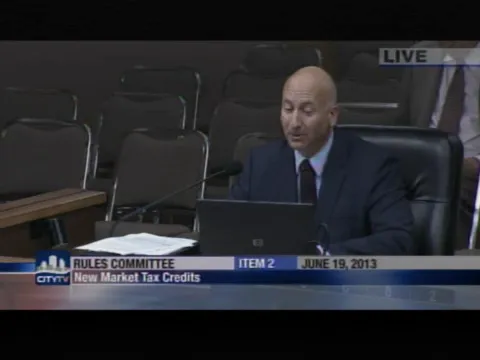
- Item 2: New Market Tax Credits (Informational) –
- Jeff Graham (President of Civic San Diego) reported that the city received $35 million in New Market Tax Credits (NMTC) in April 2013. He explained the program’s goals (job creation, community development in low‑income census tracts), qualification requirements, and the complex financing structure. Six pipeline projects were listed; the Copley YMCA in City Heights and Family Health Centers were closest to closing. Graham also discussed pending state legislation (SB 1, SB 33, SB 391) that could provide new funding tools.
- Committee members expressed strong support and asked about using NMTC for city‑owned infrastructure projects (libraries, etc.) through a nonprofit entity; Graham agreed to explore the legal feasibility.
- Item 3: Council Committee Structure Revisions –
- Chair Lightner presented a proposal to update committee names, revise areas of responsibility, require annual work plans and year‑end reports, consider a standing special issues committee, conduct regular reviews every three years, and strike Rule 2.7 (communication requests) as duplicative of non‑agenda public comment. The recommendation also included adopting the committee consultant’s suggestions (Attachment 5) and having staff prepare necessary ordinance amendments.
- Councilmember Alvarez requested clarifying language to ensure that water/wastewater/stormwater infrastructure matters remain in the Environment Committee rather than Infrastructure, except for individual project oversight. He moved the recommendations with that clarification and a request to prepare implementing ordinances.
- Councilmember Kersey supported the proposal, noting the value of work plans and mission statements, and suggested that future reviews need not mandate updates.
- The motion passed unanimously, and the item will return to committee for final ordinance language before going to full council.
Key Outcomes
- Item 1 (Prevailing Wage): A motion by Councilmember Emerald, seconded by Alvarez, carried 3‑2 (Lightner, Alvarez, Emerald in favor; Faulconer, Kersey against). The committee recommended forwarding the staff proposal (with modifications requested by the chair) to the City Council, with a target hearing of July 30, 2013. Staff were directed to:
- Provide responses to IBA recommendations #3 and #5.
- Include analysis of exemptions, project types/dollar thresholds, and concrete project benefits.
- Work with the City Attorney to draft an ordinance conforming to SB 7 language where advisable.
- Address grandfathering for existing contracts, completed projects, and contracts under negotiation.
- Item 2 (New Market Tax Credits): No formal action was required; the report was informational. The committee encouraged Civic San Diego to close at least one transaction by October 2013 to qualify for future allocations and to explore using NMTC for city infrastructure.
- Item 3 (Committee Structure): The committee unanimously voted to recommend the revised structure to the full Council, subject to further ordinance drafting by the City Attorney’s office and committee review. The changes are expected to take effect with the appointment of new committees in December 2013/January 2014.
Meeting Transcript
Good morning, everyone. Thank you so much for your patience. We just gonna wait a couple more minutes for the council members to show up, but we're still on for this morning. Welcome to today's meeting of the Rules and Economic Development Committee. Let the record reflect that we have a quorum consisting of Councilmember Kersey, Councilmember Emerald, and myself. Francisco Estrada from the Mayor's Office, and Nika Bukalova, committee consultant. I want to thank you all for being here. We have no non-agenda public comment. We have no regulatory streamlining open government and economic development comment. Any committee comment? Any comment from the City Attorney IBA or mayoral office. Okay. Moving right along, our first order of business is approval of the minutes from our June 5th, 2013 meeting. They are deemed approved if there are no corrections. Are there any corrections? Okay. Since we do not have a consent item, we move directly to the action discussion agenda. Item 1A is report from the Assistant Chief Operating Officer regarding prevailing wage requirements for municipal public works projects, recommending the adoption of an ordinance requiring compliance with state prevailing wage laws on municipal public works projects. I welcome Nelson Hernandez office, the uh assistant chief operating officer who is here to present item 1A on behalf of the mayor's office. Let the record reflect that Councilmember Alvarez is here. He is joined today by James Magelvoort, Assistant Director in Engineering and Capital Projects, and Jennifer Badgley, Director of Special Projects and Labor Affairs in the Office of the Mayor. Also want to recognize Murtaza Baksamusa, special advisor to Mayor Filmer, who is here today in the audience. I know that he has worked very closely with my office in bringing this item forward, and I thank you for that. We will follow Mr. Hernandez's presentation with a report from the IBA and then the City Attorney. Then we will take public comment and follow that with committee member questions and comments after all three of the items are heard. Thanks again. I look forward to your presentation. You do have the floor. Thank you very much. Thank you for inviting us back. And thank you for acknowledging the work of the other staff. We appreciate that very much. What I'd like to do today is give you a summary of some of the things that we talked about last time and also have an opportunity to address some of the issues and concerns raised by the IBA report. So as a summary, uh what we are talking about here is an ordinance that would apply prevailing wages on public works projects that are over $25,000. And it's essentially modeled after the Federal Davis Bacon law, which was actually created in the 30s during the height of the Depression. So which agencies are currently apply prevailing wages to their public works projects? Well, it turns out to that all the agencies in the State of California do, the counties, the general law cities, and most charter cities. And it's also mandatory on projects that receive a thousand dollars of state funds. So it's it's fairly widespread. With regards to the City of San Diego prevailing wage, uh we have prevailing wage right now on all state funded projects that receive a thousand dollars or more. And whenever the city engineer who is sitting to my left determines that the project will have will cost more than 10 million dollars, and it's a water or sewer project. And but it's not required on most public projects when they are contracted using city funds. Tell that person I'm busy right now, please. Just kidding. I got to work on my humor a little bit. Um with regards to the CIP for FY13, about 20 uh projects uh were subject to prevailing wages, and that worth about 48.5 million dollars, and about 93 were not worth about 150 million dollars. So that means there is a lot of opportunity to increase our prevailing wage uh compliance. I would like to now turn to the fiscal considerations and make a couple of observations. Beginning with the engineer's estimate.
openpublica.com