Rules and Economic Development Committee Meeting - July 10, 2013
STREAMING COPY IN PREPARATION — RECORDING AVAILABLE FROM THE ORIGINAL SOURCE
Rules and Economic Development Committee Meeting - July 10, 2013
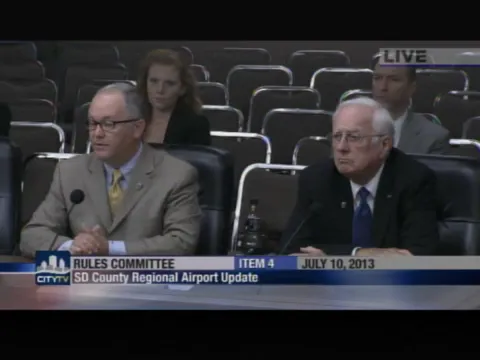
The Committee on Rules and Economic Development of the San Diego City Council met on July 10, 2013, at 9:00 a.m. (17:00 UTC) in Council Committee Room, City Administration Building. Chair Sherri Lightner presided, with Vice Chair Kevin Faulconer, Councilmember Mark Kersey (arrived at 9:15), and Councilmember David Alvarez present. Councilmember Marti Emerald was absent. The committee approved minutes from June 19, 2013, and considered four agenda items, including a report on elections charter cleanup, an open data policy presentation, and an update from the Airport Authority.
Consent Calendar
- Approval of the Record of Action Items for June 19, 2013, by unanimous consent.
Public Comments & Testimony
- No non-agenda public comment was received.
- No public comment on regulatory relief suggestions.
Discussion Items
-
Item 1: Presentation from GO-Biz (Governor's Office of Business and Economic Development) on AB 93 and SB 90 (Enterprise Zones) – This item was continued to the July 24, 2013, meeting because the GO-Biz office staff were unavailable to provide more concrete details.
-
Item 2: Report from City Clerk on Elections-Related Charter Clean-Up – City Clerk Liz Maland and Deputy Director Bonnie Stone presented on two issues: (1) term of office/inauguration date and (2) special elections to fill vacancies. For the inauguration date, they outlined alternatives: setting a date certain later in December, tying the inauguration to receipt of certification (e.g., within 10 days), or holding a simple swearing-in at a council meeting with a separate ceremonial event. For special elections, they proposed: (a) interim appointment by the council until the next regular election, (b) aligning the charter with state law, or (c) increasing the 49-day requirement to 90–180 days. Committee members discussed the trade-offs, including costs (a standalone special election costs $200,000–$400,000 vs. contracting with a regular election at $180,000–$335,000) and the need for immediate representation. Councilmember Faulconer favored a date certain for the inauguration; Councilmember Kersey opposed council appointments longer than one year; Chair Lightner proposed a hybrid of interim appointment and a coordinated election.
-
Item 3: Report from Open San Diego/Code for America Brigade on Open Data Policy – Jeff Johnson and Joe Lakava presented on the benefits of open data for transparency, economic development, and participatory governance. They noted that San Diego is one of the few major U.S. cities without an open data policy, citing examples from Chicago, San Francisco, and New York. Speakers Eric Busboom (San Diego Regional Data Library) and Ben Katz (former founder of Complete Campaigns) urged the city to release data in machine-readable formats, noting obstacles like PDF-only publication and resistance from departments. Councilmember Kersey emphasized the city's lagging position and called for a subcommittee to accelerate progress. Councilmember Alvarez suggested immediate release of non-sensitive data already in PDF form. The mayor's office representative (Mr. Estrada) confirmed commitment but noted resource and legacy system challenges.
-
Item 4: Update from San Diego County Regional Airport Authority – Chair Robert Gleason and Board Member Bruce Boland presented an overview of airport operations, including the Green Build project (on time and $45 million under budget), the upcoming rental car center (opening early 2016), and the Quieter Home program (2,600 homes completed, 8,000 remaining). They highlighted local business participation (75% local, 30% small business) and new international routes. Councilmember Faulconer raised concerns about traffic impacts on Harbor Drive and potential changes to FAA noise measurement standards. Councilmember Kersey inquired about the possibility of nonstop flights to Asia, noting that the Dreamliner's extended range might enable such routes.
Key Outcomes
- Item 1: Continued to July 24, 2013, by unanimous consent.
- Item 2: Motion by Councilmember Faulconer, second by Chair Lightner, to direct the City Clerk to work with the City Attorney to provide further detail and a formal recommendation on Issues 1 and 2, as follows:
- Issue 1 (Term of Office/Inauguration Date): Explore a later date certain (mid-December) and adjusted dates for future efficiencies.
- Issue 2 (Special Elections to Fill a Vacancy): Provide detail on a hybrid option – an interim appointment (limited to one year) combined with an election coordinated with the next regular or special election, and align the Municipal Code with state law.
- Vote: 4-0 (Lightner, Faulconer, Kersey, Alvarez; Emerald absent).
- Item 3: Motion by Councilmember Alvarez, second by Chair Lightner, to request the Office of the Independent Budget Analyst (IBA) to prepare a report on open data, including:
- Review of best practices in other cities.
- Identification of city departments with the most Public Record Act requests and the types of data requested.
- Identification of resources (staff and funding) needed.
- Recommendations for a timeline and implementation strategy.
- Analysis of legal issues by the City Attorney's Office.
- Vote: 4-0.
- Item 4: No action taken; informational only.
Meeting Transcript
Good morning. Welcome to today's meeting of the Rules and Economic Development Committee. Let the record reflect that we have a quorum consisting of Vice Chair Faulkner, Councilmember Alvarez, and myself. We do expect Councilmember Kersey to arrive shortly. Councilmember Emerald is absent today. Also here with us, including committee staff are Carrie Gleason from the Office of the City Attorney. Thank you all for being here. We will begin with non-agenda public comment, and there are no items, no speaker slips on that, and there are no speaker slips on regulatory streamlining open government and economic development, non-agenda public comment. We are in communication with the Go Biz office staff, and we plan to take this discussion up on July 24th when more concrete details about the new program are available. Are there any comments from the city attorney, IBA, or mayoral staff? Okay. And then are there any committee comments? Okay. And as I noted already, the uh first item, which was to be a presentation from the Governor's Office of Business and Economic Development regarding Assembly Bill 93 and Senate Bill 90 relating to enterprise zones and the governor's new economic development initiatives will be continued until the July 24th, 2013 meeting. So the next item on the agenda, item two is report from the city clerk regarding elections. Okay. I'm being reminded I skipped an item. No, sit down, sit down. The minutes are deemed approved if there are no corrections or additions. Okay. So item two, report from the city clerk regarding elections-related charter cleanup and requesting input and direction from the committee. I welcome Liz Mayland, our well-known and very efficient city clerk, Bonnie Stone, Deputy Director of Elections and Information Services in the Office of the City Clerk. And I know you have the able assistance of Denise Jenkins, who's my elections analyst. Denise Jenkins, who's joining us. So thank you. I really appreciate this opportunity. And as you mentioned, I'm here with my wonderful elections team. We also have Deputy City Attorney Sharon Spivak in the audience, and she is available to answer questions of a legal nature should they arise at the conclusion of the report. Just to by way of introduction, we were before you on April 24th when we presented a detailed timeline with a variety of elections-related issues. And at that time we were directed to return today, July 10th to talk about two of those specific issues, and those are the inauguration slash term of office as well as the special election to fill a vacancy. The first issue that Ms. Malin referred to regards the term of office and the date that that begins for officeholders that are elected via the regular election process. Now, two charter provisions come into play here, the first of which requires us to the City of San Diego when having a runoff election because there is no outright winner in the primary election. We consolidate our runoff elections with the very good. With the November statewide general election. Now state law mandates that those elections are held on the first Tuesday of after the first Monday of November in even numbered years. The second relative Charter provision says very specifically that regularly elected officeholders begin their terms of office at 10 a.m. on the first Monday following the first day of December in the appropriate years. So we have a November date and we have a December date. And there is a range of time between those two dates from 27 days to 34 days. Now in 2014, we're at the longer end of that scale. There are 34 days between the election date and the inauguration date. And that's not so much of a problem. Where we run into some difficulty is when the time frame between November and December is at the shorter end of the range, with 27 days between the election date and the inauguration date. That's because state law enables the registrar of voters to have as much as 28 days of time to finalize the election results. Consequently, we could have the formal term of office beginning even before the registrar has completed the final canvas of the election results. To further make things a little more complicated, there is pending legislation in Sacramento that would extend that 28-day period of time for the registrar of voters to complete the final canvas from 28 days to 30 days. So you can see that we have some concern there. Now, again, in 2014, we're going to be at that longer end of the scale, 34 days. But in 2016 and in 2018, we'll be at the shorter end of the scale with 27 days between the election date and the inauguration date.
openpublica.com