San Diego Rules and Economic Development Committee Meeting - July 24, 2013
STREAMING COPY IN PREPARATION — RECORDING AVAILABLE FROM THE ORIGINAL SOURCE
San Diego Rules and Economic Development Committee Meeting - July 24, 2013
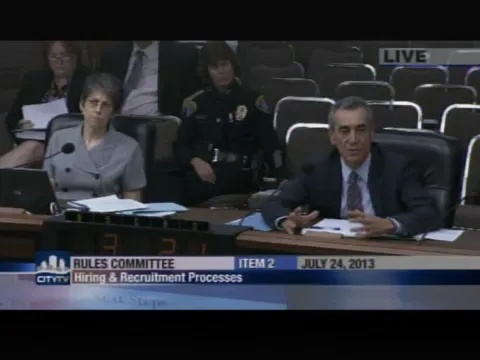
The Committee on Rules and Economic Development met on Wednesday, July 24, 2013, at 9:00 a.m. in Council Committee Room, City Administration Building. Chair Sherri Lightner presided, with Councilmembers Kevin Faulconer, Mark Kersey, and David Alvarez present; Councilmember Marti Emerald was absent. The meeting covered four agenda items: the impact of recent state legislation on the San Diego Enterprise Zone program, the City's hiring and recruitment processes, ministerial amendments to the Ethics Ordinance, and the quarterly performance report on the 2013 Youth Employment Initiative (Connect2Careers).
Consent Calendar
- Approval of the Record of Action Items from July 10, 2013, was approved by unanimous consent.
Public Comments & Testimony
- Robert McNamara (District Three) spoke during non-agenda public comment, suggesting that committee agendas should include previews and reporting of past committee actions.
- During the hiring item, Robert McNamara expressed support for predictive recruiting, particularly for public safety, and suggested exploring provisional hiring practices used in other jurisdictions.
- Jeff Jordan, representing a police officer standpoint, expressed concern about the length of time for police applicant responses, noting that only 3 out of 100 applicants become sworn officers, and that the city loses candidates to other departments due to delays. He also raised concerns about unfilled grant-funded positions, including those for rape kit processing.
Discussion Items
Item 1: Impact of State Legislation on the San Diego Enterprise Zone Program (Informational)
- Sid Voracara, Business Development Specialist from the Governor's Office of Business and Economic Development (GO-Biz), presented on new state bills (SB 90 and AB 93) that redirect approximately $750 million annually from the enterprise zone program to three new incentives: a sales tax exemption on manufacturing equipment (starting July 1, 2014), a hiring credit for high-unemployment/poverty census tracts, and the California Competes Fund. The hiring credit is for 35% of wages above $12/hour and up to $28/hour, with retail excluded unless small businesses (under $2 million gross receipts). The California Competes Fund will allocate $30 million in FY 2013-14, increasing to $200 million in year three.
- Lydia Moreno, Community Development Coordinator for the City's Economic Growth Services, reported that the City is winding down the Enterprise Zone program, with outreach to businesses and workshops. Since 2006, the regional zone has hired over 40,000 employees, assisted over 2,000 companies, and resulted in over $6 million in investment and 2,500 jobs impacted.
- Councilmember Kersey expressed concern about the loss of local control, noting that San Diego administered the program well, and that new programs should have been additive rather than replacing the existing one. He cited the example of SoyTech, a solar manufacturer that chose San Diego partly due to the Enterprise Zone.
- Councilmember Lightner expressed optimism about the new programs benefiting high-tech R&D and improving transparency. She requested that GO-Biz provide dates and locations of public hearings on the Investment Incentive Funds, possible economic impacts, and more information on pilot areas. She also asked the City Attorney to reassess the City's ability to use a sales tax incentive for local businesses.
- Councilmember Faulconer noted that the Enterprise Zone was one of the few economic incentives the City had, and asked for an overall economic impact estimate for the new bills.
- Action: Informational only; no action taken. Committee requested periodic updates from GO-Biz and the City's Economic Growth Services, and specifically asked for the next update to include public hearing dates, economic impacts, and pilot area outreach details.
Item 2: City's Hiring and Recruitment Processes
- Lisa Byrne, Fiscal and Policy Analyst with the Office of the Independent Budget Analyst (IBA), presented report 13-30 on civil service hiring. She noted that approximately 95% of City positions are classified. Average timeframes for hiring steps have declined in some areas, e.g., from 84 to 64 days for promotions. Recent improvements include predictive recruiting, electronic application review, and automatic rejection for incomplete applications. The IBA recommended that the committee further review the Personnel Department's needs and consider position increases for mid-year budget adjustments.
- Hadi Degani, Personnel Director, presented additional suggestions, including a one-stop shop for background/medical processing, an outstation program to place personnel analysts in departments, and a consultant to optimize the NeoGov system. He noted that the department has 60 employees and hired 969 new employees in FY 2013.
- Police Chief Shelley Zimmerman highlighted challenges: the department may lose 900 officers (half the force) over the next four years, and the city lost 51 candidates to other departments last fiscal year. She supported sharing background check information to avoid duplication.
- Councilmember Faulconer emphasized the need to hire the best people in the shortest time, and pressed for benchmarks. He noted that the City Auditor's office is conducting an audit expected by November 2013.
- Councilmember Alvarez asked about the appeals process impact on hiring timelines. Joan Dawson, Deputy City Attorney, clarified that the current practice of exhausting appeals before promulgating eligible lists is a longstanding policy, and changing it could involve a meet-and-confer issue.
- Motion: Councilmember Faulconer moved, seconded by Chair Lightner, to request that the Personnel Director provide additional follow-up and analysis on civil service rules and a consultant for NeoGov; that the IBA work with the committee consultant to request hiring departments submit suggestions for process improvements by August 21, 2013, vet those suggestions, and provide information on how the appeals process impacts hiring timelines. The motion also requested that the fall discussion include whether any position increases should be recommended for mid-year budget adjustments. The committee also requested that the Personnel Director explore provisional hiring and expanding temporary employee pools, and that the IBA interview recent hires and review civilian hiring practices of the military in San Diego.
- Vote: 4-0 (Lightner, Faulconer, Kersey, Alvarez aye; Emerald absent).
Item 3: Ethics Commission Ministerial Amendments
- Stacey Fulhorst, Executive Director of the San Diego Ethics Commission, presented amendments to the Ethics Ordinance and Council Policy 000-04 to update state law references and reflect current training practices. Changes include adopting state laws by reference so updates are automatic, and increasing the initial training deadline from 60 to 90 days, and eliminating the March 31 retraining deadline in favor of a two-year cycle.
- Motion: Councilmember Faulconer moved, seconded by Councilmember Alvarez, to forward the staff recommendation to the City Council.
- Vote: 4-0 (Lightner, Faulconer, Kersey, Alvarez aye; Emerald absent).
Item 4: Quarterly Performance Report on Connect2Careers (C2C) Youth Employment Initiative (Informational)
- Peter Calstrom, President and CEO of the San Diego Workforce Partnership, reported that the $200,000 city investment has leveraged an additional $300,000 from the Walmart Foundation and the Aspen Institute, for a total of $500,000. As of the meeting, 177 youth had been hired (approaching the goal of 200), with almost 400 applicants. Over 600 youth received work readiness training, and over 1,000 employers were reached. The May 30 Job Summit resulted in 20+ jobs, including one for a young man named Miguel.
- Marlene Taylor, Vice Chair of the Workforce Investment Board and owner of Taylor Trim & Supply, praised the program for making the hiring process effortless and emphasized the value of the intern.
- Alexa Forness, C2C intern at Taylor Trim & Supply, described her experience working as a contracts administrative assistant and gaining exposure to multiple departments.
- Councilmember Lightner noted that the $200,000 did not pay salaries; private companies cover wages. She expressed excitement about the program's success and sustainability planning.
- Councilmember Kersey noted that Council District 5 had the highest participation (18% of interns).
- Councilmember Alvarez thanked the employers and suggested recognizing them for their investment.
- Action: Informational only; no action taken.
Key Outcomes
- Item 1: No formal action; committee requested updates and a City Attorney review of local sales tax incentives.
- Item 2: Motion passed 4-0 directing the Personnel Director and IBA to conduct further analysis and report back in the fall, with specific requests for changes to hiring processes.
- Item 3: Motion passed 4-0 to forward Ethics Commission amendments to the City Council.
- Item 4: Informational only; no action taken, but strong support for continuation and expansion of the youth employment program.
Meeting Transcript
Welcome to today's meeting of the Rules and Economic Development Committee. Let the record reflect that we have a quorum consisting of Vice Chair Faulkner, Councilmember Kerzy and myself. Councilmember Emerald will not be joining us today. Also here with us is the committee staff, including Priscilla Dugard from the Office of the City Attorney, Jeff Coir from the Office of the Independent Budget Analyst, Francisco Estrada from the Mayor's Office, and Nika Bukolova, committee consultant. Thank you all for being here. Begin our agenda with non-agenda public comment. We have one member of the public who wishes to speak, Mr. Robert McNamara. Good morning, committee members. The council members who are present. Thank you, sir. And the reason for the comment was your comment here at non-agenda public comment because we used to do that quite a bit was give the preview and then some of the reporting out as to what had transpired at the committee. Um there are no comments on regulatory streamlining open government and economic development. Um is there any committee comment? Seeing none, city attorney, IBA or mayoral comment. No. Um with that, our first order of business is approval of the minutes from the July 10th, 2013 meeting. They are deemed approved, unless there are any objections to those minutes. Seeing none, the minutes are deemed approved. Moving on to item one. This is an informational presentation from the governor's office on business and economic development. Go biz, so-called, um, regarding the governor's new economic development initiatives. This item was continued from our July 10th, 2013 meeting. Um, and that will be followed by presentation um informational item once again, memorandum from the San Diego Regional Enterprise Program regarding the status of San Diego Regional Enterprise Zone Program and Local Agency Military Base Recovery Area. I'd like to welcome Sid Voracara, business development specialist for the San Diego area in the Governor's Office of Business and Economic Development, also known as GoBiz, and Lydia Moreno, community development coordinator with economic growth services, who manages the Enterprise Zone Program for the City is also here to present a recent handout compiled on the changes to the program and to answer questions. I want to thank you for joining us today and look forward to your presentation and others in the future. Terrific. Thank you, Chair Leitner for having me. Good morning, members of the council and committee. Um before I begin, I should should warn you that um you know I have prepared talking points, and I recently went to see my optometrist and I told her something's wrong with my contacts, and she said, No, you're just getting old. So uh if I'm squinting here, I apologize in advance. Um as you all know, the governor was actually in San Diego uh on July 11th to sign into law SB 90 and AB 93. Uh these two bills reshape the State's economic development tax programs uh and bolster and are moving towards bolstering um business our California's business environment. So, as you also know, uh these bills redirect roughly $750 million annually from the current enterprise zone program to three new business incentive uh programs. A sales tax on manufacturing equipment uh or research and development manufacturing equipment purchases, a hiring credit, uh, and the California Competes Fund. First and foremost, I think what m many people want to know is that taxpayers will be allowed to continue using enterprise carryover uh credits for 10 years and will be able to continue to earn hiring credits for emplo employees hired prior to January 1st, 2014. But in terms of the new incentive packages, there are three agencies that are going to be responsible for overseeing the rules and regs of the programs. Uh the franchise tax board will oversee the hiring credits, the Board of Equalization will oversee the sales tax exemption, uh, and the Governor's Office of Business and Economic Development, where I am, uh, will oversee the California Competes Fund. So as you can imagine, planning for rules, regs did not really begin until after the governor signed the two bills, and as a result, agencies are only really now beginning the process of working on drafting rules and regulations. So more time is really going to be needed to pass before any one of the agencies provide some specifics. In the meantime, what I can actually affirm is that taxpayers can begin to exclude the first 200 million dollars of equipment purchases from the State's share of sales tax beginning on July 1st, 2014. And the exemption is going to be available statewide until June 20th, 2022. The hiring credit uh is based on census tracks with the 25 percent highest share of both unemployment and poverty in the state, uh, and it applies to Lamborough and current enterprise zone boundaries. The credit is only going to be allowed to taxpayers who have a net increase in jobs. Uh that's a uh a big change from the current uh program. Now the credit is also going to be for 30 uh be for 35 percent of wages um above twelve dollars an hour and up to twenty-eight dollars. Um other notable uh points for all of you is that retail and restaurants are excluded unless you are a small business, and the state has defined uh a small business as less than two million dollars in annual gross receipts. So there are also going to be five pilot areas designated by the Governor's Office of Business and Economic Development, and we're going to work with the Department of Finance, and those will actually allow for the uh wages to be above $10 an hour. Several folks have already approached me and told me that they are um reaching out to the Governor's office about um designating parts of San Diego County as uh a member of that pilot program. We're just beginning the conversation with the Department of Finance on where those will be.
openpublica.com