San Diego City Council Rules Committee Meeting: Ballot Proposals Considered, January 13, 2016
STREAMING COPY IN PREPARATION — RECORDING AVAILABLE FROM THE ORIGINAL SOURCE
San Diego City Council Rules Committee Meeting: Ballot Proposals Considered (January 13, 2016)
The San Diego City Council Rules Committee convened on January 13, 2016, at 5:00 PM UTC (9:00 AM local) to consider ballot measure proposals for the June 7, 2016, primary election and to set the stage for November 2016 ballot items. The committee addressed three agenda items: a proposed Citizens Review Board on Police Practices measure, a transient occupancy tax (TOT) increase proposal, and a measure to require disclosure of public business conducted on private devices. Key actions included continuing the police review board item, discussing the TOT proposal without immediate action, and directing staff to prepare legal and operational analysis for the private devices measure. The meeting featured public testimony from community members and a moment of tension between a speaker and committee members.
Consent Calendar
- No consent calendar was listed on the agenda.
Public Comments & Testimony
-
Non-Agenda Public Comment:
- Catherine Rhodes presented a proposal for a contiguous convention center expansion to finance a Chargers stadium without a public vote, using FAA revenues, citing grandfathered airport exceptions for tide lands.
- Martha Sullivan (Women Occupy San Diego) requested that the Citizens Review Board measure be placed on the November ballot and quoted a Union-Tribune editorial supporting the proposal.
-
On the Continuance of the Citizens Review Board Measure (Item 1):
- Faith Ada Gia: Expressed support for placing the measure on the ballot, emphasizing the need for transparency and independent powers.
- Jude Litzenberger (former CRB member): Encouraged citizen involvement and warned against the process being "run around."
- Doug Case (CRB Second Vice Chair, speaking individually): Supported the continuance, stressing the importance of refining the proposal before a vote.
- Joy Cash: Praised the council for taking up the issue, citing the need to rebuild trust and protect citizens.
- Miriam E. Clark: Recalled past failures of the review board, strongly supporting the continuance and ballot placement.
- Martha Sullivan: Grateful for the dual track to the November ballot, viewing the June 15 Rules Committee meeting as a backstop.
- Margaret Kushnea: Reported support from police Chief Zimmerman and others, urging voters to decide.
- Lucille Pearson (former CRB member): Supported the continuance for community input.
- Ray Lutz (Citizens Oversight): Initially criticized the continuance and engaged in an extended exchange with the committee over speaking time; later expressed support for the measure but was ruled out of order.
-
On the Private Devices Disclosure Measure (Item 3):
- Joy Cash: Supported transparency, stating San Diego should lead in integrity efforts.
- Catherine Rhodes: Endorsed closing the loophole, noting that all public records should be public, and specifically called for transparency in text messages during council meetings.
- Robert McNamara (District 3): Supported the measure, recommending adding "whether publicly or privately owned" and cautioned against the "Hillary Clinton" situation.
- Ray Lutz: Supported the measure but criticized side conversations during public testimony.
- JW August (Californians Aware, SPJ): Urged the council to adopt the measure, noting the rest of the country would follow San Diego's lead.
- Irene McCormick (former Filner communications director): Shared passionate support, citing her experience with open government challenges.
Discussion Items
-
Item 1: Citizens Review Board on Police Practices Ballot Measure
- Women Occupy San Diego and coalition partners proposed a charter amendment to create an independent community review board. The council president pro tem moved to continue the item to allow for further review by the Public Safety and Livable Neighborhoods Committee, followed by Charter Review if needed, setting a deadline of June 15, 2016, for the Rules Committee to meet the November ballot deadline. The motion passed unanimously.
-
Item 2: Transient Occupancy Tax (TOT) Increase Proposal
- Catherine Rhodes presented a proposal to increase TOT from 10.5% to 15.5% and redefine operators to include online travel agencies. She claimed the city loses $165 million annually due to the current definition, and cited an $18.57 million value per 1% TOT.
- Councilmember Emerald noted a pending lawsuit about online travel agencies and requested staff provide a status update and comparative TOT rates with other cities. The mayor's office and IBA indicated they could provide information. No vote was taken; the discussion was informational.
-
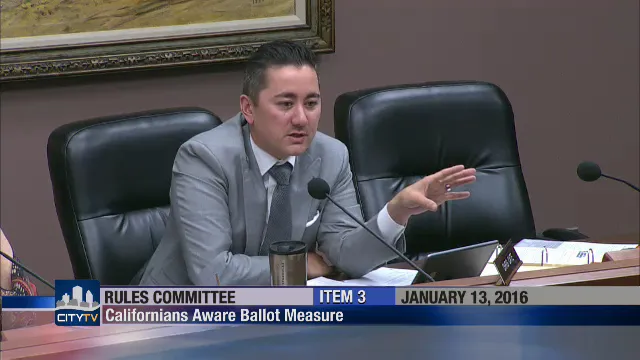
Item 3: Disclosure of Public Business on Private Devices
- Donna Fry (Californians Aware) presented a proposal to amend the city charter and/or municipal code to require that all records of the public's business on private devices be subject to the California Public Records Act. She advocated for the council to adopt this measure or direct the city attorney to draft language.
- Committee members debated whether to place the measure on the ballot, with some raising concerns about the pending San Jose Supreme Court case and labor issues. The chair (Council President Pro Tem Emerald) moved to refer the matter to the city attorney for legal and operational analysis, the city clerk for operational review, and the Public Records Act working group for implementation recommendations, with a report back to the Rules Committee before June 15, 2016. The motion passed unanimously.
Key Outcomes
- Item 1 (CRB Measure): Continued to a future meeting; the motion passed unanimously with directions to route through Public Safety and Livable Neighborhoods and Charter Review, aiming for the June 15, 2016, Rules Committee meeting.
- Item 2 (TOT Proposal): No vote taken. Council requested updates on the TOT litigation and comparative rates; no formal action on the proposal for the June 2016 ballot.
- Item 3 (Private Devices): Motion passed unanimously to have the city attorney, city clerk, and PR working group prepare an analysis and draft language, returning to the Rules Committee before June 15, 2016.
Other Notes
- The June 15, 2016, Rules Committee meeting was identified as the deadline for considering proposals for the November 8, 2016, general election ballot.
- A speaker (Ray Lutz) was asked to leave the podium after exceeding time limits, causing a brief disruption.
Meeting Transcript
Good morning, ladies and gentlemen. Welcome to this meeting of the City Council's Rules Committee. The purpose of this mid meeting is to consider proposals for the June seventh, twenty sixteen primary election ballot. The proposals on the agenda were submitted to the city clerk as required by the January fifth twenty sixteen deadline. Proposals for the November eighth, twenty sixteen general election ballot will be considered at the June fifteenth, twenty sixteen rules committee meeting. For the record, we do have a quorum consisting of Councilmember Cole, Councilmember Kate, Council President Pro Tem Emerald, and myself also present are from my left. The general policy advisor for the mayor, Marshall Anderson, and for late the he will be here for item one, and then for items two and three, we will have the mayor's deputy chief of staff for community engagement, Felipe Monroy, the independent budget analyst deputy director, Jeff Coir, Committee Consultant Steve Hadley, Chief Deputy City Attorney Priscilla Dugard, and also assisting is Council Administration Committee liaison Mary Ann Wallace. First, we have a non-agenda public comment about issues within the committee's jurisdiction. We do have two speakers on that item. Catherine Rhodes, followed by Martha Sullivan. Catherine, do you wish to do non-agenda public comment at this time? And please note if you're having difficulties with your presentation for item two, we'll be glad to wait on you for that at that time. Okay. Hi, Catherine Rhodes. And what I wanted to bring before you because you know the chart. This turned on. I'll try this one. No, no, you're fine. It's the monitor I was asking about. Okay. Um, this right here is what I gave to the chargers back in the day for a way to finance the charger stadium without the need for a public vote. And what that would be is basically an extension, a contiguous convention center expansion. It would be an extension, so no new taxes, no public vote required, no gift of public land. It would be a 15-acre contiguous site, and it could be financed basically with airport FAA revenues. Um this is just the location of where I think it should go. And because it's state tide lands, um, you know, we the people of San Diego own the property. And then also with the you know the issues of walling off the um waterfront, you know, some of the reasons was because they didn't put the second pedestrian bridge there, they lowered the five-acre park. But you could solve those problems through mitigation. And so one of the things what I always call this is um my La Playa regional plan for a reclam a full reclamation of our tide land so that we could actually use the space below the tide lines. And then, you know, um 1960, Senator Is that me? Okay, 1960 said Senator Kennedy promised desalinization as a presidential promise. 61 after he won, he finded he funded five pilot desalinization projects like right away. 1962, the um reverse osmosis general atomic plant was built in Point Loma, and that was so um de-seltinization started in the city of San Diego. And um, I feel that it should be also, and we're losing so much space because we are just um for our tide lands, we're just building on top of the tide lands instead of doing a full reclamation where we could actually have space to store water or stormwater and actually clean it. And one of the big issues, um, funding issues is that a lot of people think FAA revenues can only be used in airports. That's federal law. But there's 12 grandfathered airports that have a big exception, and that's because they're on state tide lands, and that includes Washington DC, New York, New Jersey, San Francisco, San Diego, Denver, because I believe it's um tribal lands there. But we could use instead of building a new parking structure for um for um the second terminal, we could actually build a charger stadium. And I would rather have the money go to regional infrastructures. Um, and one of the reasons for that is because on Monday, through Tony Atkins, the port tried to take over all our state tide lands from the state land commission's. Thank you, Catherine. Thank you. Was that Martha Sullivan? Good morning, uh committee members. Um I'm here representing uh women occupy San Diego, and um we recognize that our ballot proposal, which is item one, we have asked that this be put on the November ballot because we want the largest voter turnout possible to consider this ballot proposal for a truly independent um community review board. Um but we also want to share with you. You hopefully you saw the San Diego Union Tribune editorial that was published online June 7th and actually was printed in their Sunday paper. And the Union Tribune, this is a more fulsome explanation of why the City Council should put this item on the November ballot. And I just want to quote from it, and I think Mr. Hadley is circulating copies of it, and we're passing it around the audience as well.
openpublica.com