San Diego City Council Rules Committee Meeting - March 23, 2016
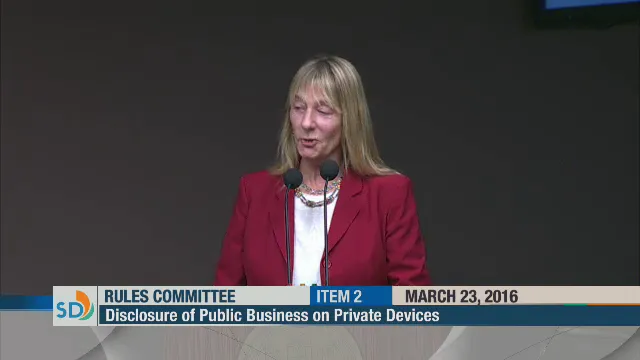
STREAMING COPY IN PREPARATION — RECORDING AVAILABLE FROM THE ORIGINAL SOURCE
San Diego City Council Rules Committee Meeting - March 23, 2016
The San Diego City Council's Rules Committee met on March 23, 2016, to consider three significant items: a proposed ballot measure to increase affordable housing capacity, an ordinance requiring disclosure of public business conducted on personal devices, and amendments to the city's ticket policy for Qualcomm Stadium and Petco Park. All three items were unanimously forwarded to the full City Council for further action, with directions for additional legal review and stakeholder input.
Public Comments & Testimony
- Beryl Flum (League of Women Voters of San Diego) spoke on both the affordable housing ballot measure (supporting it) and the disclosure ordinance (urging that it apply to all employees and elected officials, not just unrepresented employees).
- Robert McNamara spoke in support of the disclosure ordinance, noting the San Diego chapter of the Society of Professional Journalists also supports it.
- Irene McCormick spoke in support of the disclosure ordinance, advocating for public right to know.
- Ron Cho (Rancho Penasquitos Little League) spoke in support of the ticket policy amendments, emphasizing oversight and transparency.
- Steph Gross (Claremont Town Council) spoke in support of the ticket policy amendments, citing alignment with equality and community investment.
- Sid Vivek (YMCA of San Diego County) spoke in support of the ticket policy amendments, noting the opportunity for underserved youth to attend games.
- Bob Oddley (Salary Setting Commission) opposed the ticket policy amendments, arguing that the program should be terminated by voter decision. He claimed the city gives away approximately $1,010,000 in tickets annually ($450,000 for Chargers, $560,000 for Padres) and that this money could instead fund parks, libraries, rec centers, and firehouses.
Discussion Item: Affordable Housing Ballot Measure
- The San Diego Housing Commission presented a proposal for a November 2016 ballot measure to increase the city's affordable housing capacity by an additional 10,000 units. The city currently has 10,500 units authorized, with only 3,247 units of capacity remaining. The Housing Commission recommended the 10,000-unit increase based on past usage and a reasonable horizon, but acknowledged that the San Diego Association of Governments (SANDAG) estimates a need for 38,680 affordable units (at or below 80% of area median income) by 2020.
- Council President Pro Tem Emerald expressed interest in a larger number and noted the high cost of housing as a driver of poverty in San Diego. He and Councilmember Cole supported affordable housing but emphasized balanced communities and job growth.
- Chair Leitner recommended amending the request to 38,680 units to align with SANDAG's regional housing needs assessment and avoid returning to voters soon.
- The committee voted unanimously to forward the matter to the full City Council with the recommendation to increase the request to 38,680 units and direct the City Attorney to work with the Housing Commission to prepare ballot materials for November 2016.
Discussion Item: Disclosure of Public Business on Personal Devices
- Donna Fry (on behalf of Californians Aware) presented the proposal for the fourth time. The City Attorney had drafted an ordinance amending the municipal code to require disclosure of public business conducted on personal devices. The committee had previously requested legal review and input from a working group, but the working group had concluded its work.
- City Attorney's Office clarified that the ordinance could move forward for unrepresented employees immediately, but represented employees (covered by labor unions) would require meet-and-confer negotiations before inclusion.
- Public speakers supported the measure, emphasizing transparency and the need to update municipal code for electronic media.
- A motion by Council President Pro Tem Emerald, seconded by Councilmember Cole, passed unanimously to:
- Forward the ordinance to the full City Council for placement on the November 2016 ballot.
- Direct the City Attorney to amend the ordinance language to cover all city employees (both represented and unrepresented).
- Initiate meet-and-confer negotiations with labor unions.
- Seek input from the Mayor's Office and City Clerk on records retention time frames.
Discussion Item: Amendments to Ticket Policy (Council Policy 700-22)
- Councilmember Kate and his Deputy Chief of Staff, Ian Clampett, presented proposed amendments to the city's ticket distribution policy for Qualcomm Stadium and Petco Park. Key proposals included:
- Removing behest authority from individual council members and consolidating it under the Council President's Office.
- Making Council Administration the official ticket coordinator.
- Prioritizing nonprofit organizations and community groups (including "friends groups" and local chapters) as Category 1 recipients.
- Prioritizing city employees as Category 1 recipients, linked to the city's rewards and recognition program.
- Limiting tickets to one event per organization every six months.
- Requiring a signed code of conduct from ticket recipients.
- The presentation noted that in 2015, the city's suites (26 seats at Petco Park, 52 at Qualcomm Stadium) were fully occupied for only 9 events and completely empty for 11 events.
- Council President Pro Tem Leitner requested review by the Ethics Commission to ensure compliance with Fair Political Practices Commission (FPPC) regulations.
- Councilmember Kersey asked about prohibiting nonprofits from using tickets for fundraising auctions; the City Attorney noted such use has historically been prohibited under FPPC rules, and the committee agreed to include explicit language in the policy.
- The motion by Councilmember Kate, seconded by Council President Pro Tem Emerald, passed unanimously to:
- Direct the City Attorney to draft ordinance language reflecting the proposed amendments.
- Include review by the Ethics Commission and City Attorney before presentation to the full City Council.
- Address the prohibition on resale or auction of tickets by recipients.
Key Outcomes
- All three items were forwarded to the full City Council with unanimous votes.
- For the affordable housing measure: the committee recommended amending the request from 10,000 to 38,680 additional units, aligning with SANDAG’s regional housing needs assessment.
- For the disclosure ordinance: direction was given to amend language to cover all employees, begin meet-and-confer, and obtain input on records retention policies.
- For the ticket policy: direction was given to draft amendments consolidating authority under the Council President, prioritizing nonprofits and city employees, and ensuring FPPC compliance, with Ethics Commission review.
Meeting Transcript
Good morning, ladies and gentlemen. Welcome to this meeting of the City Council's Rules Committee. For the record, we have a quorum consisting of Councilmember Cole, Councilmember Kate, Council President Pro Tem Emerald, and myself. Also present are Marshall Anderson from the Mayor's Office. The independent budget analyst, Deputy Director should be here shortly. Committee consultant Steve Hadley, Assistant City Attorney. No. Chief Deputy City Attorney Priscilla Dugar, also assisting as Council Administration Committee liaison, Mary Ann Wallace. I want to note that the Rules Committee's next meeting will be Monday, April 11th at 9 a.m. here in this room. We plan to consider two issues being proposed by Council President Pro Tem Emerald, the firehouse bond and the mini-dorm ordinance. Moving on to the committee's record of actions for our January 13, 2016 meeting. They are considered approved by unanimous consent unless they are pulled for discussion. Hearing no requests to poll the actions, they stand approved. At each meeting, we do invite public comment for up to two minutes about issues within the committee's jurisdiction, but not on the agenda. This morning we do not have any speaker slips for non-agenda public comment, I believe. That's correct. Okay. Do any of the committee members have comments? No. Um mayor's office. We will proceed to the discussion agenda in item one report by the San Diego Housing Commission regarding consideration of a proposed ballot measure for November 16th, titled City of San Diego Affordable Housing for Qualified Seniors, Families and Persons with Disabilities, as defined by Article 34 of the California Constitution. Please note for the record that Councilmember Kercy joins us, as does Jeff Kawar from the Independent Budget Analysts Office. And on four occasions since the Housing Commission was created in 1979, San Diego voters have approved similar ballot measures to provide the capacity for up to the current 10,500 affordable housing units, which is the limit of our capacity within the city. We received the approval for an additional 500 units in 1972, 2500 units in 1976, an additional 2500 units in 1981, and 5,000 units in 19 or in 2002. Of these 10,500 units, which is our current capacity, we have only 3,247 units of capacity left. And we believe that we will far exceed that before the next election four-year cycle to occur in 2020, which is the reason that we're with you today in trying to get ahead of this issue. The proposed ballot measure that we are recommending would increase the city's affordable housing capacity by an additional 10,000 units. And I'll get back to those numbers in just a minute. This additional affordable housing capacity is needed for the city to be able to apply for and use State and Federal funds for housing programs. And without this additional capacity, it is possible, and I think likely, highly likely, that the construction of low-income housing units supported by government financing or assistance could be halted in the City of San Diego. For these reasons, the Housing Commission is recommending adding this proposed ballot measure to the November ballot. I will also add that Chair Leitner and I had a telephone conversation yesterday about this number. And she asked basically where it came from and why we were not more aggressive in asking for a larger ceiling capacity, particularly given some of the numbers that the SANDAG uh report lately has indicated that is needed for the City of San Diego. In particular, what Sandag is pointing out is that there is a need for over 38,000 units for the low income, which is defined as 80 percent of median income or less or lower for the for the city between now and 2020. And my response to Chair Leitner was that the Housing Commission looked at past usage and looked at a reasonable horizon going forward and made a judgment of what might be a likely uh acceptable number to the electorate. However, uh we would stand ready to increase that or amend it as you all wish. And Madam Chair, that completes my report. Thank you very much. We do have one public speaker on this item, uh Beryl Flum. Beryl Flum from the League of Women Voters of San Diego. Uh the League of Women Voters has always supported increasing the number of affordable housing units and definitely supports this proposed ballot measure as the city's population grows largely from within and as the real estate market keeps rising. The demand for affordable housing to support lower income wage earners is even more in demand. Thank you. Any comments from the mayor's office, IBA, or city attorney's office on this? In particular. Okay. And I do thank you for bringing this matter to the attention of the Rules Committee and for your ongoing efforts to provide quality affordable housing to the residents of San Diego. The last time, as you noted, this went before the voters. They were requested to approve 10,500 units.
openpublica.com