San Diego City Council Rules Committee Meeting on Mini-Dorms and Fire Station Bond, April 11, 2016
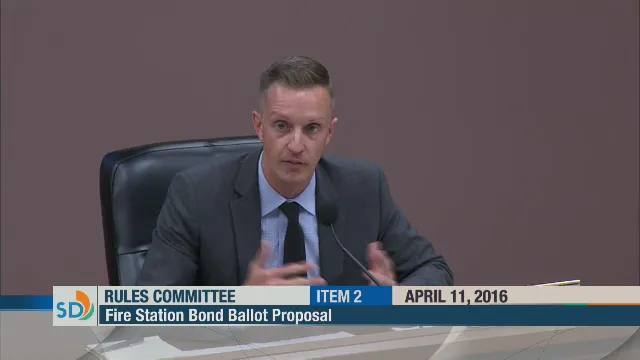
STREAMING COPY IN PREPARATION — RECORDING AVAILABLE FROM THE ORIGINAL SOURCE
San Diego City Council Rules Committee Meeting on Mini-Dorms and Fire Station Bond, April 11, 2016
This meeting of the City Council's Rules Committee, chaired by Councilmember Leitner, addressed two major issues: the proliferation of oversized student rental homes ('mini-dorms') near San Diego State University and a proposed general obligation bond to fund the construction of fire stations across the city. The committee heard extensive public testimony and deliberation, resulting in referrals for further study and a vote to advance the bond measure to the full council.
Public Comments & Testimony
- Supporters of mini-dorm regulation (residents, community leaders, and volunteers) testified that supersized mini-dorms (five-plus bedrooms) have overwhelmed single-family neighborhoods, causing noise, trash, partying, parking problems, and increased city costs. Many noted that investor-owned properties are converting living rooms, garages, and yards into bedrooms and parking lots, displacing families and degrading community character. Specific data presented included: 82% of supersized mini-dorms have required city intervention; 54% of houses cited under the city's Chronic Annoyance Program (CAP) have five or more bedrooms; and on some streets, police issue an average of 2,000 parking violations per year.
- Opponents of the proposed ordinance included property owners, landlords, and the San Diego County Apartment Association. They argued that the ordinance would reduce affordable housing, create a landlord's market, and displace residents to other areas, increasing commuting and environmental impacts. They also contended that existing regulations (RHOP, CAP) are not fully enforced and that a construction moratorium would hurt the construction industry and reduce city revenue. Some opponents expressed willingness to work with the community but urged more stakeholder input before any emergency action. Specific concerns were raised about the cost of requiring on-site managers (triggering labor law obligations) and the risk of neighbor lawsuits.
Discussion Items
1. Nuisance Rental Housing / Mini-Dorms near SDSU
Council President Pro Tem Emerald presented a report and draft ordinance to address the proliferation of mini-dorms. The proposed overlay zone would require conditional use permits for homes with five or more bedrooms, limit parking to four spaces per home (with no more than two in rear yards visible from the street), impose operating standards for repeat violators, and allow private lawsuits for abatement. An interim administrative hold on permits for five-plus bedroom homes was also requested. Councilmembers debated the scope and legality of an emergency moratorium. Councilmember Leitner suggested a proactive code enforcement pilot and asked DSD for a 90-day feasibility analysis. Councilmember Cole supported the effort but noted SDSU must do more to house students. Councilmember Kate emphasized the need for inclusive stakeholder dialogue and opposed an interim hold. Councilmember Kercy questioned whether the situation qualified as an emergency and called for a broader working group involving all parties. Ultimately, a motion was made to direct city staff, the City Attorney, the Mayor's Office, and the IBA to conduct a comprehensive analysis and draft an ordinance, returning within 90 days. The motion also asked the City Attorney to research the feasibility of an interim urgency ordinance and to launch a pilot proactive code enforcement program in the college area.
2. Fire Station General Obligation Bond
Council President Pro Tem Emerald introduced a proposal for a $205 million general obligation bond to build 18 fire stations over ten years, addressing gaps identified in the 2010 Citigate study. The bond would cost the average homeowner about $25 per year ($5 per $100,000 assessed value). Fire Chief Brian Fennessey noted that while six stations are already partly funded, the new study (starting June 2016) may revise priorities. The IBA raised concerns about ongoing operational costs ($2.2 million per station per year), potential double taxation from impact fees, and the need for a thorough fiscal analysis. Councilmembers Cole and Leitner strongly supported moving the measure to the full council for ballot placement. Councilmembers Kate and Kercy expressed concerns about insufficient detail on station locations, timelines, and cost schedules, as well as the pending Citigate study that won't be complete until October 2016—after ballots would be mailed. Councilmember Kercy also worried about staffing capacity to hire for new stations. Despite these reservations, a motion passed 3-2 to send the proposal to the full council for further consideration of placing a bond measure on the November 2016 ballot.
Key Outcomes
- Mini-Dorm Ordinance Referral: Motion passed 4-1 (Councilmember Kercy dissenting) to direct the City Attorney, Development Services, Mayor's Office, IBA, and District 9 staff to conduct a thorough analysis of the proposed ordinance and return to the committee within 90 days. The motion also directs the City Attorney to study whether an interim urgency ordinance is legally permissible. Additionally, Development Services will launch a proactive code enforcement pilot in the college area.
- Fire Station Bond Advancement: Motion passed 3-2 (Councilmembers Kate and Kercy dissenting) to refer the fire station bond proposal to the full City Council for consideration of placing a general obligation bond on the November 2016 ballot. The council will receive the measure after the June 2016 primary election results are certified.
Meeting Transcript
Good morning, ladies and gentlemen. Welcome to this meeting of the City Council's Rules Committee. For the record, we have a quorum consisting of Councilmember Cole, Councilmember Kercy, Councilmember Kate, Council President Pro Tem Emerald, and myself also present are from my left. Committee consultant Steve Hadley, Chief Deputy. Deputy you wouldn't like to be Deputy City Attorney Sharon Spivak. Also assisting is Sarah Mojabi from my office and council administration committee liaison, Mary Ann Wallace. Moving on to the committee record of actions for our March twenty-third, twenty sixteen meeting. Seeing no interest in that. Scheduling this special meeting and docketing this very important issue. The city has made efforts over the past eight years or so to address the problem of mini dorms that threaten the character of our beautiful San Diego State neighborhoods. But those efforts have not truly addressed the problem or limited the expansion of these dorms and the proliferation of them in the college area. We do have in our possession now a long-awaited memo from the Development Services Department that addresses that says that even that we've tried. But unfortunately, as you can see from this full house, we have failed. And we need to take a different attack if we're going to save the neighborhood character near San Diego State, and if we're going to have appropriate housing for all of the students who come to SDSU to get a world class education. So with that, I would like to turn the presentation over to Tim Taylor from my office, who is a career planner himself. He has been working with Chris Pearson in our office, Mike Jenkins in our community, and of course, many of the people who you see here today who bring their concerns about the quality of life and the continued character of their neighborhoods. With that, Tim, thank you for all of your hard work, your thoughtfulness, and I turn the floor over to you. The balance of the speakers will be allotted two minutes per person. So if you would plan your comments while Mr. Taylor is speaking, that would be terrific. Mr. Taylor. Good morning, Chair Leitner, committee members. I'm Tim Taylor, Chief Policy Advisor for Council District 9. I'm pleased to present a report on nuisance rental housing in the area around San Diego State University, as well as a draft ordinance offered as a potential solution. Council President Pro Tem Emerald and the residents of the college area believe there is a severe problem and that new legislation is required. Additional efforts are needed to prevent the college area from reaching a tipping point with regard to single family residential character. This tipping point has already been experienced for certain blocks in the college area where the single family residential character may have been lost forever. These developments and nuisance activities create a drain on city resources and impact the quality of life in the neighborhood, even for those students who desire to live in a normal residential community. Additional efforts. Students have been renting houses in the single-family neighborhoods near San Diego State University for as long as the school has been there. They do this for convenience and lifestyle reasons. The students are young, and for the most part, they have not been on their own previously. They are very short-term residents, and they want to have a good time. Unfortunately, they can create huge impacts on the quality of life of other residents of these neighborhoods. The impacts include unruly behavior, loud parties late at night, accumulation of trash, poor property maintenance, and excessive demand for parking. These problems require the resources of the city, including the police department, environmental services, and the code enforcement division. They also impact the resources of the school. What has changed over recent years is that the school has grown, creating new demand, and an industry has developed to profit from this demand. Developers buy up existing single-family homes, which are typically two to four bedrooms, and expand them into homes as large as eight to ten bedrooms or more. These supersized mini dorms are created by adding additional square footage, converting living rooms, garages, dens, patios, and even closets into bedrooms, and by subdividing existing bedrooms. And the impacts of these extra large mini dorms are exponentially greater than that of student rentals in traditionally sized homes. The proliferation and its impacts have been more thoroughly documented in the backup materials than I can go into here. The data shows that 82% of supersized mini dorms have necessitated city involvement, and nearly half have involved the city in two or more ways. And this is only the ones that have been identified by the community. The ones shown in blue on this map have been added in the last three years. Identified mini dorms comprise about 20 percent of all RS1s in the college area, RS1 zoned homes in the college area. Three to four bedrooms is typical in the college area. Nationally, only four percent of homes have five or more bedrooms. The density of mini dorms close to campus is a major factor in the well-known party scene at San Diego State.
openpublica.com