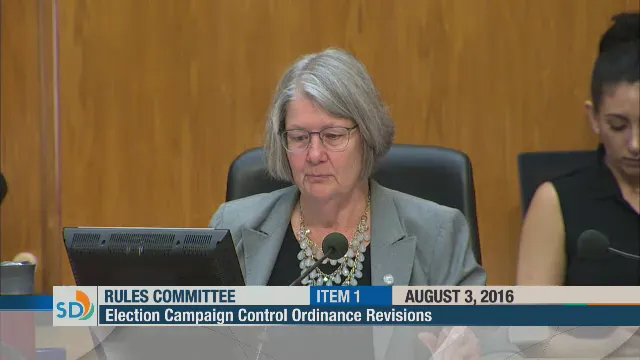
San Diego City Council Rules Committee Meeting - August 3, 2016
STREAMING COPY IN PREPARATION — RECORDING AVAILABLE FROM THE ORIGINAL SOURCE
San Diego City Council Rules Committee Meeting - August 3, 2016
The San Diego City Council's Rules Committee met on August 3, 2016, to discuss proposed revisions to the city's campaign finance laws and consider the city's response to a grand jury report on campaign law enforcement and training. The committee also heard public comment on a Brown Act concern and took action on several items.
Consent Calendar
- The committee record of actions for the June 20, 2016 rules committee meeting was approved by unanimous consent with no discussion.
Public Comments & Testimony
- Kevin Swanson, a Paradise Hills resident who has lived in San Diego since 1958, spoke during non-agenda public comment. He reported that at the June 7th Balboa Park Committee meeting, he submitted speaker slips on two agenda items but the committee chair chose not to hear public comment, which he alleged was a violation of the Brown Act. He requested the rules committee take action to ensure committee chairs enforce Brown Act rules and asked what recourse the public has when violations occur.
- Later, during the grand jury report discussion, Mr. Swanson commented on ethics commission representation, stating that voters with no party preference are not represented on the ethics commission and that the commission should include more non-partisan members.
Discussion Items
-
Report from the San Diego Ethics Commission on Proposed Revisions to the Election Campaign Control Ordinance
- Executive Director Stacey Fulhorst, joined by Commissioners Bill Baber and Sid Vorakara, presented a package of changes developed over five subcommittee meetings, a public hearing, and outreach to community organizations. Key recommendations included:
- Eliminating the requirement to alphabetize contributors on campaign statements, now obsolete due to electronic filing.
- Extending vendor credit payment deadlines from 180 days after receiving goods/services to 180 days after the election, aligning with the post-election fundraising period.
- Allowing campaign committees to deposit contributions immediately and obtain contributor information within 60 days or by the next campaign statement filing, whichever is earlier.
- Changing the pre-election fundraising start date from one year before the primary to January 1 of odd-numbered years (previously a three-week window before June 30 caused a rush and errors).
- Removing the requirement for printed campaign materials to include a notification about reimbursement prohibitions, as it was difficult to draft clearly and caused confusion.
- Eliminating the third pre-election filing requirement for independent committees, since they already file 24-hour reports for contributions over $1,000 and typically have no additional activity to disclose.
- Additional cleanup items: adding a 48-hour filing period for non-monetary contributions during petition signature gathering, updating identification disclosure requirements on campaign mail and website ads to match state law, and updating requirements for yard signs.
- Councilmember Myrtle Cole expressed concern that the January 1 start date would extend the fundraising period to 18 months, which she said could favor incumbents and place more emphasis on money. She noted she would not support that specific part but would vote for the overall package. The motion to approve the proposed revisions passed 5-0.
- Executive Director Stacey Fulhorst, joined by Commissioners Bill Baber and Sid Vorakara, presented a package of changes developed over five subcommittee meetings, a public hearing, and outreach to community organizations. Key recommendations included:
-
Review Report from the Independent Budget Analyst (IBA) on the Proposed Response to the Grand Jury Report "Campaign Law Enforcement and Training"
- IBA analyst Lisa Byrne presented the proposed joint Mayor-Council response to five findings and recommendations from the grand jury report. The proposed responses were:
- Finding 1 (appointment process): Disagree – the current process is consistent with other city boards, includes public confirmation and diversity requirements.
- Finding 2 (charter amendment to remove council authority over ethics commission): Agree that the recommendation (establishing the commission as a permanent body via charter) requires further analysis, referencing prior charter review committee action and noting the next available election is 2018.
- Finding 3 (lengthen commissioner terms): Disagree – the grand jury's recommended six-year term would reduce current potential service by two years, and there is no evidence of retaliation denying reappointment.
- Finding 4 (rename the ethics commission): Agree – the recommendation (rename to City of San Diego Fair Political Practices Commission) requires further analysis, referencing prior charter review committee action and a 2018 ballot timeline.
- Finding 5 (expand subpoena power for witnesses): Disagree – the commission has a proven track record, and the benefit of subpoena power is not compelling enough to warrant change.
- Councilmember Chris Kate moved to approve the proposed response and direct the ethics commission to develop a process to review any further recommendations that may be warranted. The motion passed unanimously.
- IBA analyst Lisa Byrne presented the proposed joint Mayor-Council response to five findings and recommendations from the grand jury report. The proposed responses were:
Key Outcomes
- Approved the minutes of the June 20, 2016 rules committee meeting by unanimous consent.
- Approved (5-0) the proposed revisions to the Election Campaign Control Ordinance, with Councilmember Cole voting yes but noting concerns about the January 1 fundraising start date. The changes will take effect for the next election cycle.
- Approved (unanimously) the proposed response to the grand jury report and directed the ethics commission to develop a process for reviewing additional potential changes to campaign law enforcement and training. The city's response is due October 28, 2016.
Meeting Transcript
Good morning, ladies and gentlemen. Welcome to this, the August third meeting of the City Council's Rules Committee. I'm sure we're all very excited about our upcoming legislative recess, so let's have a smooth and efficient meeting. For the record, we have a quorum consisting of Councilmember Cole, Councilmember Kate, Council President Pro Tem Emerald, and myself. Also present at the Mayor's Director of Council Affairs, Marshall Anderson. For the record, we have a quorum consisting of Councilmember Cole, Councilmember Kate, Council President Pro Tem Emerald, and myself, also president, the mayor's director of council affairs, Marshall Anderson, the independent budget analyst, Deputy Director Jeff Kowar, Committee Consultant Nika Buglova, Chief Deputy City Attorney Priscilla Dugard. Also assisting is Sarah Mojabi from my office and council administration, committee liaison, Mary Ann Wallace. Beginning with the committee record of actions for the June 20th, 2016 rules committee meeting. They are considered approved by unanimous consent unless they're pulled for discussion. Seeing no interest in that, uh hearing no request to poll the June 20th actions, they stand approved. At each meeting, we invite public comment for up to two minutes about issues within the committee's jurisdiction, but not on the agenda. This morning we have a speaker slip turned in for non-agenda public comment. Kevin Swanson Good morning, Council President Leit here, members of the committee. My name is Kevin Swanson. I live in Paradise Hills, and I've lived in San Diego since 1958. Last month on June 7th, I attended the Babo Park Committee to speak on two agenda items that were informational presented by city staff. The Balboa Park Committee chair elected not to hear public comment on those items. To me, that was a violation of the Brown Act. City staff did not say anything. Even Mr. Gloria's representative said, well, I don't know. You weren't heard. I don't know what happens. So I requested the person taking the notes for the meeting meeting, uh, Mr. Mario Lonos, who's the district manager for Balboa Park Operations, to have the meeting minutes reflect the fact that I had submitted speaker slips and was denied the opportunity to speak. His response was at this point I am not sure how the minutes will reflect, as this is not a common occurrence. I'm waiting to hear what would be most appropriate given the situation. As a member of the public, if an item is if an item is on an agenda, the public should have a right to speak to that item. I don't know if you have the responsibility as the rules committee to make certain that everyone on city committees that are appointed, and that are taking minutes, have the knowledge to be able to enforce Brown Act rules and other rules. But I would certainly like to see some action taken, not only against the chairman of this committee, but I would like to know what recourse the public has when Brown Act is violated. Thank you. You may be interested in something we're going to be doing this fall, which is a review of the boards and commissions and how we standardize some of the expectations and training of our various boards, but I will um I think we need to look into this one. Get back to you, sir. Okay. Do any committee members, mayor's office, IBA, or city attorney have any comments at this point in time? I can tell you're really ready to go. I I would like to make a comment myself. I want to bring to the committee's attention a memorand that I issued last Thursday, July 28th, regarding Charter Section 225, which relates to mandatory disclosure of business interests. I have requested legal analysis from the city attorney's office, which I plan on docking at this committee in October. Um there are no requests for continuance. We will proceed to the discussion agenda and item one, which is uh report from the City of San Diego Ethics Commission requesting council approval of proposed revisions to the election campaign control ordinance. Welcome to uh Stacey Fulhorst, Executive Director of the San Diego Ethics Commission. She's joined by uh Commissioners Bill Baber and Sid Vork Vorakara. Welcome and thank you very much for being here today. Uh it how much time would you like for your presentation? I think we need uh maybe about five or ten minutes. Ten minutes toxic. Okay. Thank you. Good morning, thank you for having us.
openpublica.com