San Diego City Council Rules Committee Meeting - September 28, 2016
STREAMING COPY IN PREPARATION — RECORDING AVAILABLE FROM THE ORIGINAL SOURCE
San Diego City Council Rules Committee Meeting - September 28, 2016
The Rules Committee convened on September 28, 2016, at 9 a.m. to discuss five agenda items: an update on the city's boards and commissions, revisions to municipal code for the redistricting commission, establishing a permanent bicycle advisory committee, improving the effectiveness of boards and commissions, and ordinances addressing high-occupancy single-family dwellings (mini-dorms) in the College Area. The committee heard extensive public testimony and voted on several items.
Consent Calendar
- The committee record of actions for the August 3, 2016, Rules Committee meeting was approved by unanimous consent without discussion.
Public Comments & Testimony
- David Modi (Chair of the Community Planners Committee, speaking as an individual) commented on the boards and commissions matrix, advocating for streamlining, terminating inactive boards, reducing membership sizes, and addressing term expiration issues. He noted that many boards have quorum problems and that continuing members after term expiration is widely seen as a way to influence decisions.
- Robert McNamara (District 3 resident) suggested starting the appointment process three to four months earlier, standardizing board terms, and having boards choose their own reporting format (annual work plan, annual report, or regular committee report). He also recommended a survey of all 43A boards.
- On item 5 (mini-dorm ordinances), many speakers testified. In favor: Rhea Kuhlman (27-year College Area resident) argued the ordinance would preserve single-family character and cited statistics: 82% of high-occupancy homes required city involvement, and nearly half had multiple violations. She presented data showing 34 houses adding bedrooms in the first six months of 2016, compared to 21 in neighboring Navajo and 2 in Kensington-Talmadge. Other supporters included Gary Campbell (president of College View Estates Association) and Ann Catrol (50-year resident). Opposition: Chris Wood (College Area Renters and Landlord Association) argued the ordinance would reduce affordability, push students further from campus, and was not supported by city staff or advisory committees. Dylan Callflower (SDSU student) noted that 10% of CSU students experience homelessness and that high fines ($10,000 per person) could cripple students. Keith Henderson (landlord) stated that rental properties are 30% cheaper than on-campus housing. The Community Planners Committee voted 19-2 to support the ordinance, while the Technical Advisory Committee and Code Monitoring Task Force voted against key provisions.
Discussion Items
Item 1: Update on Boards and Commissions
- City Clerk Liz Maland presented a matrix of 54 active and 31 inactive boards/commissions. The matrix is updated quarterly and includes links to code sections, appointment processes, conflict of interest codes, and term expiration data. She noted that the online version lists only 46 active boards (excluding those with restricted membership). Council President Pro Tem Emerald expressed concern about the unwieldy number of boards and supported streamlining.
Item 2: Redistricting Commission Municipal Code Revisions
- City Clerk Liz Maland explained required updates to align with Proposition A charter amendments, including increasing commission membership from 7 to 9, adding two alternates, extending the nomination period from 30 to 60 days, and shifting random selection duties from the city manager to the city clerk. She requested feedback on: vetting retired judges, alternate selection process, use of Council Policy 000-13, earlier publication flexibility, application content (e.g., removing college transcript requirements and social security numbers), and department support. Committee members discussed conflict of interest codes, district-based alternates, and budget provisions. Council President Leitner emphasized the need for adequate funding and independence from political influence.
Item 3: Bicycle Advisory Committee (BAC) Codification
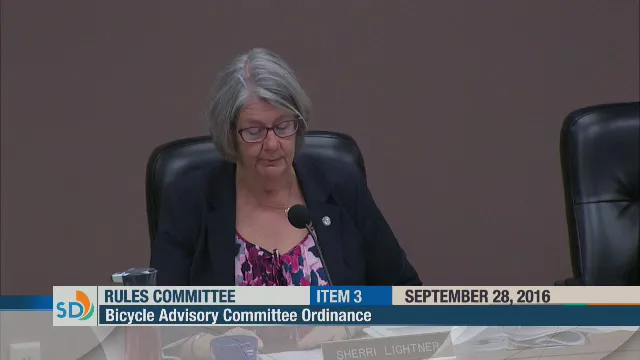
- Kyle Heskla (Council President's office) and Andy Henshaw (BAC Chair) presented. The BAC was established in 2014 by resolution under Charter Section 43B (temporary), with objectives including a five-year bicycle strategic plan and ongoing advisory roles. Given the long-term need (Climate Action Plan goals: 6% bike mode share by 2020, 18% by 2035) and recent SANDAG $200 million early action program, they recommended codifying the BAC as a permanent committee under Charter Section 43A. The committee directed the City Attorney to draft an ordinance with duties referencing the BAC’s original objectives, the Climate Action Plan, and Vision Zero, and to bring it to City Council.
Item 4: Boards and Commissions Effectiveness
- Council President Leitner introduced a memo seeking feedback on improving appointment processes, standardizing staff support and training, requesting annual work plans, and reviewing boards/commissions for continued relevance. Francis Barraza (Mayor's Office Director of Appointments) outlined the current appointment process, which includes background checks, council nominations, and coordination with departmental staff. Public comment included David Modi’s calls for smaller board sizes and better tracking. Councilmember Cole suggested automatically sunsetting inactive boards after five years and requiring quarterly or semi-annual reports from boards. The committee directed the Mayor's Office to return with recommendations for improvements.
Item 5: High-Occupancy Single Dwelling Units and Increased Penalties
- Tim Taylor (Council District 9) presented two ordinances. The first ordinance applies mostly in the College Area (around SDSU) and includes: citywide definition of bedroom to include rooms designed to have a door; no more than 5 bedrooms on lots <10,000 sq ft and 6 on lots ≥10,000 sq ft in the College Area; no more than 6 surface parking spaces citywide on lots ≥10,000 sq ft; no parking within 30 feet of front lot line; and a 60% cap on gross square footage for bedrooms. The second ordinance increases maximum civil penalties for code enforcement violations citywide from $2,500 to $10,000 per violation (cumulative per person per day). Supporters argued that mini-dorms degrade neighborhoods and drain city resources (e.g., 214 of 277 party house caps in the College Area). Opponents claimed the ordinance would reduce affordable student housing and push students further from campus. The committee voted to recommend approval of both ordinances to full council, with direction to staff to study expansion of the first ordinance’s boundaries (including eastern areas) and to research penalty levels in other jurisdictions.
Key Outcomes
- Item 2 (Redistricting Code): Motion to direct the City Attorney to consider committee feedback and return on October 26, 2016, passed unanimously.
- Item 3 (Bicycle Advisory Committee): Motion to direct the City Attorney to draft an ordinance establishing the BAC as a permanent committee under Charter Section 43A, with duties including implementation of the Bicycle Master Plan, Climate Action Plan, and Vision Zero, and to bring it to City Council, passed unanimously.
- Item 4 (Boards and Commissions): Motion to request the Mayor’s Office to consider committee feedback and return with recommendations for improving appointment processes, staff support, training, and reporting, passed unanimously.
- Item 5 (Mini-Dorm Ordinances): Motion to recommend approval of both ordinances to the full City Council, with directions to staff to evaluate expansion of the first ordinance’s boundaries to include eastern areas and to research penalty maximums in other jurisdictions, passed unanimously. The committee also asked to explore carport loopholes and clarify the 30-foot parking setback from curb line.
Meeting Transcript
Okay. She'll give our presentation. I think it's only six minutes. She's gonna she's gonna hear it. Do you know what I'm doing? I don't know what I'm doing. One. Good morning, ladies and gentlemen. Welcome to this September twenty-eighth meeting of the City Council's Rules Committee. For the record, we have a quorum consisting of Council Member Cole, Council President Pro Tem Emerald, and myself. Also present, the mayor's director of council affairs. Felipe Mon wrong title, right, Felipe. Felipe Monroy, the independent budget analyst, deputy director Jeff Kuwar, Committee Consultant Nika Bukalova, Chief Deputy City Attorney Priscilla Dugard. Also assisting is Sarah Mojabi from my office and council administration committee liaison, Mary Ann Wallace. We also will be joined on item five by Sherry Carr. She will be committee consultant on that particular item. Beginning with the committee record of actions for the August 3rd, 2016 Rules Committee meeting, they are considered approved by unanimous consent unless polled for discussion. Seeing no interest in that, they stand approved. We do invite public comment for up to two minutes about issues within the committee's jurisdiction, but not on the agenda. We have no public speakers this morning. Do any of the committee members? Mayor's office, IBA or city attorney have comments at this time. Moving on, we do we'll start immediately with the informational agenda. Item one, which is review report from the city clerk providing the commission committee an update on the city's boards and commissions. Ginormous matrix. That's not in the am I in trouble for saying that, Madam City Attorney. Welcome uh City Clerk Liz Malin. Um I'll turn it over to you for your I am Liz Maland, your city clerk, and I'm here with my elections team, Deputy Director Bonnie Stone, my elections analyst Denise Jenkins. We're here to review with you our boards and commissions matrix. As you'll recall, we brought this forward first at the Charter Review Committee meeting in February of this year. And since that time we have updated it as promised quarterly, so it's been distributed twice, and we're here now to provide you a chance to give us additional feedback or ask questions to see how we might be able to improve what we have before you. Next slide. So what's in front of you? The matrix, which is ginormous and it contains the 54 active boards and commissions as well as 31 inactive boards and commissions. It's worth noting that it differs a bit from what's online on my website. As you know, there's a boards and commissions tab, and under that tab, there's a huge amount of information on boards and commissions for the public or geared toward the public. And it's important to note, I think for the record, that all of the information that's included in the matrix is already publicly available. It's just that this pulls it together and it has a little bit of a different twist. And I think there are a couple of things worth mentioning. Number one, the material that's online is updated more timely, that's updated more frequently. This, as we had agreed upon, is a quarterly update, which means what you're looking at before you was updated last June 30th of this year. We're about to update it again September 30th, and we will then be distributing it shortly thereafter. But so almost as soon as we do this snapshot in time and send it out, it can be out of date as far as the matrix goes. Whereas what's online is kept up to date regularly since what's online again is geared toward members of the public. There are only 46 active boards and commissions listed online, and that discrepancy, those different numbers, are because again, what's online, those are the boards and commissions where members of the public might wish to apply to either participate or to be on one of those boards or commissions. The matrix includes an additional eight. Those additional eight boards and commissions are boards and commissions where there are statement of economic interests filers, but they also the membership is not open to the public in the same way. There might be elected officials who serve on those boards or commissions, or there might be the municipal code might determine who gets to sit on them. So since what's online is geared toward members of the public, there is that difference. And again, we will be sending it out quarterly as I mentioned.
openpublica.com