San Diego City Council Rules Committee Meeting - October 26, 2016
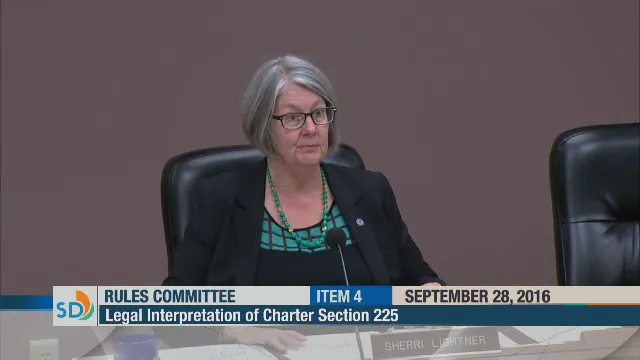
STREAMING COPY IN PREPARATION — RECORDING AVAILABLE FROM THE ORIGINAL SOURCE
San Diego City Council Rules Committee Meeting - October 26, 2016
The Rules Committee of the San Diego City Council met on October 26, 2016, to discuss and vote on several items. The committee reviewed the 311 program roadmap, revisions to municipal codes regarding the Citizens Equal Opportunity Commission and redistricting, a charter section on business interest disclosure, rules of council amendments, and several council policies. All motions were approved unanimously.
Discussion Items
311 Program and Get It Done Pilot
- Alex Hampton from Performance and Analytics presented an overview of the 311 roadmap and updates on the Get It Done pilot. The program, launched May 20, has received over 30,000 reports, with about 80% of reports going through the mobile app or website. Approximately 8,500 mobile app users have been recorded. About half of the reports have been completed, 25% referred to other agencies, and the rest are in progress.
- The roadmap aims to expand the program, improve customer experience, and explore a centralized contact center. Implementation costs are estimated over several years, with a soft launch planned between January and July 2018.
- Kathleen Higgins from the Municipal Employees Association (MEA) expressed support for consolidating call centers but raised concerns about employee transitions and emphasized the need for labor sensitivity. She requested that labor be brought into the process. Alex Hampton assured that they are working with labor and are sensitive to employee concerns.
- Councilmember Kersey praised the Get It Done app for its effectiveness. Councilmember Kate asked about the CRM update and costs; the consultant report cost less than $25,000. Council President Leitner expressed concern about status updates for referred reports and noted that a report she filed was closed without action.
Citizens Equal Opportunity Commission (CEOC) – Municipal Code Revision
- Matt Helm, Deputy Director of Purchasing and Contracting, presented a proposed revision to San Diego Municipal Code Section 26.16(b) to add representation for women and disabled veterans. The revision changes the requirement from "possess the characteristics" to "actively advocate for or represent the interests" of the groups, addressing City Attorney concerns about unconstitutional application.
- Councilmember Emerald asked about current commission representation; Felipe Monroy noted there are openings and that the Mayor's office is identifying applicants. Councilmember Kate asked about the application process. The committee voted unanimously to direct the City Attorney to draft an ordinance and forward to full Council with a recommendation for approval.
Redistricting Commission – Municipal Code Amendments
- Trisha Tackey from the Independent Budget Analyst's office presented research on other cities' redistricting commission application processes and budgets. None of the reviewed cities required social security numbers or transcripts, but most asked about education. The IBA recommended adding budget guidance to the municipal code.
- City Clerk Liz Maland presented proposed municipal code updates resulting from the approval of Ballot Measure A (June 7, 2016). Changes include updating the nomination period, eliminating transcript requirements, and providing a process for vacancies. The IBA noted that the 2010 redistricting cost about $500,000.
- Councilmember Emerald asked about Austin's voter registration number request; the IBA explained it was likely to verify voter status. Councilmember Kate requested adding language that social security numbers would not be released to the public, which was accepted. The committee voted unanimously to forward the ordinance to full Council with that amendment.
Charter Section 225 – Disclosure of Business Interests
- Deputy City Attorney Tom Zellani explained Charter Section 225, which requires disclosure of business interests for city transactions. The proposed ordinance would implement the section, but several details remain open. Discussion included identifying information, where to send information, when the council should see it, and enforcement authority.
- Felipe Monroy (Mayor's office) and Jeff Kawar (IBA) expressed concerns about implementation costs and recommended further study. Council President Leitner suggested a working group. The committee voted unanimously to refer the matter to a working group to review implementation costs, considerations, and whether to ask voters to amend the charter.
Charter Section 32.1 and 270 – Reporting and Summons Authority
- Deanna Jurado Santos, Director of Legislative Affairs, presented an ordinance to implement charter amendments related to information exchange and council summoning authority. The proposal includes a 45-day timeline for providing information and changes "staff member" to "department head."
- Councilmember Emerald asked about enforcement if summons are ignored; staff noted it would be a municipal code violation. The committee voted unanimously to forward the ordinance to full Council with the noted amendments.
Rules of Council – Amendments
- Deanna Jurado Santos presented amendments to the Rules of Council: moving closed session from 9 a.m. to 11 a.m., clarifying the failure of a motion, and updating public comment procedures. Councilmember Kate asked about public hearings; the committee voted unanimously to forward the amendments to full Council.
Council Policies – Amendments and Repeals
- Deanna Jurado Santos presented several amendments to council policies, including repealing policies 000-06 and 000-22, and updating others to reflect current practices. The committee voted unanimously to forward the amendments to full Council.
Key Outcomes
- All motions were approved unanimously.
- The committee directed the City Attorney to draft ordinances for the CEOC and redistricting changes.
- The committee referred the Section 225 implementation to a working group for further review.
- The committee forwarded the charter section 32.1/270 ordinance and rules/council policy amendments to full Council.
- The next Rules Committee meeting is scheduled for November 14, 2016, at 9 a.m.
Meeting Transcript
Good morning, ladies and gentlemen. Welcome to the October 26th meeting of the City Council's Rules Committee. For the record, we have a quorum consisting of Council President Pro Tem Emerald, Councilmember Kate, and myself. Also present, Felipe Monroy, the mayor's deputy chief of staff and community engagement. The Independent Budget Analyst, Deputy Director Jeff Kawar, Committee Consultant Nika Bukolova, Chief Deputy City Attorney Priscilla Dugard. Also assisting is Sarah Mojabi from my office and council administration committee liaison, Mary Ann Wallace. We have a very full agenda today. Now we now have a plan that gives us some guidance going forward that we'd like to uh give you a preview of. With that, I'll turn it over to Alex Hampton. Thank you. So today I'd like to provide an uh an overview of our 311 roadmap and with an update on the get it done pilot. So 311 started almost 20 years ago in Baltimore as a way to decrease the number of non-emergency calls received by 911. Today, most major cities have 311 programs with the exception of Phoenix and San Diego. 311 programs spread across the country and were initially focused on service provided by voice phone calls. Now multiple communication channels are available to customers, such as mobile apps, social media, the web, and through text messages. We are focused on making it easier for customers to connect with the city through the communication method they prefer. While we are working to emphasize and improve the web and mobile service, we while also upgrading the customer experience on the phone. In fiscal year 2016, Performance and Analytics had the opportunity to partner with the Transportation and Stormwater and Department of IT departments on the Get It Done pilot project. Since the launch earlier this year, customers have been able to report a variety of street related issues to the city. Most of the problems people can report are handled by a transportation and stormwater, and the reports received are sent directly into their work order system. A few other reports, such as abandoned vehicles, illegal dumping, are currently referred to other departments to be corrected. Get it done replaced the old web interface for reporting street and stormwater problems. While it was state of the art when it was launched, the old system was not able to be used on a mobile device, asked customers for unnecessary information, and was confusing and became error prone. The new system features a mobile app for iPhone and Android, a redesigned web interface, which also works on mobile phones, and follows the city's new web design guidelines. In addition, the information we we request from customers has been streamlined, and customers can submit anonymous reports. During the development of Get It Done, we held sessions with employees and community members to collect feedback and make adjustments to the user interface. We wanted to make sure that the app was user-friendly both for customers and the employees processing the reports. Since the launch on May 20th, the response has been enthusiastic. Over 30,000 reports have been made through Get It Done, with about 80% of all the reports that go into Transportation and Stormwater's dispatch center, also known as Station 38, being received through the mobile app and the website. And we currently have about 8,500 mobile app users. Out of the 30,000 reports received, around half have been completed. 25% have been referred to other agencies or departments, and the rest are in progress. Graffiti is one of the top reports because we and because we not only want a positive customer experience but also an efficient process once a report is submitted. We have spent time with the graffiti team to see how the new system is working and what improvements are needed. So it turned out that the graffiti team was not getting enough information from the system on the pieces of paper printouts regarding where the graffiti was and what it looked like. To solve this problem, the graffiti teams now use iPads in the field, and this lets them see exactly where the problem is located and the foot photo submitted by the customer. And we were working on options to eliminate the paper altogether. Customers are offered an opportunity to provide feedback via an online survey when the report is closed. Overall feedback has been positive. However, if someone provides a low score, we've been following up with them to try to understand and resolve the issue, as well as take any lessons learned going forward with the 311 roadmap. So speaking of our roadmap, I'd like to take a moment to introduce our new team members and thank you for providing funding to support them in this year's budget. We have, and hopefully they can wave or stand up in the audience. We have Ellen Paneski, our knowledge management coordinator, Samantha Young, our business process coordinator, and Greg Gerhant, our technology and innovation coordinator. The 311 roadmap was developed in the last fiscal year, and the three new program coordinators will be essential to implementing the different components identified in the roadmap and the overall program. The roadmap aims to expand on the success of the Get It Done pilot and more effectively connect the work order systems included in phase one. This means that customers will receive more details on the reports they submit. Currently, reports referred to departments outside of transportation and stormwater do not receive status updates. Under the phase one plan, more updates will be possible. This chart outlines some of the business drivers behind the program. The overarching goal is to improve the overall customer experience from start to finish, whether reporting a pothole or trying to get an answer to a question.
openpublica.com