San Diego Rules Committee Meeting on TOT, Homelessness Committee, and Equal Pay - April 5, 2017
STREAMING COPY IN PREPARATION — RECORDING AVAILABLE FROM THE ORIGINAL SOURCE
San Diego City Council Rules Committee Meeting – April 5, 2017
The Rules Committee, chaired by Council President Cole with members Vice Chair Kersey and Councilmember Ward present, met on the morning of April 5, 2017, to consider three major items: a proposed ballot measure to increase the Transient Occupancy Tax (TOT) to fund a convention center expansion, homelessness initiatives, and road repairs; the creation of a select committee on homelessness; and an equal pay ordinance for city contractors. All three items were advanced to the full City Council.
Consent Calendar
- The committee record of actions from February 8, 2017, was approved unanimously.
Public Comments & Testimony
-
Non-Agenda Public Comments: Several speakers addressed issues not on the agenda. Martha Welch criticized the city's charter and budget process. Catherine Rhodes argued that the city had given $2 billion in cumulative pension increases over the last three years despite a supposed pay freeze, and that pension savings claimed for infrastructure were illusory. Daniel Beaman raised concerns about the difficulty of accessing public notices, recommending they be published in free community papers rather than only in paid publications. Richard Melbourne urged the committee to treat homelessness as an emergency, citing the need for immediate shelter. Patricia Cloyd, who is homeless, described the burden of predatory enforcement (e.g., a $600 encroachment ticket) and urged the city to provide secure storage for homeless individuals attending meetings. Martha Sullivan echoed the need for storage, comparing it to the service provided at Homeless Connect.
-
Item 1 – Proposed TOT Ballot Measure: Over 20 speakers testified. Many opposed the measure, arguing it insufficiently addressed homelessness and affordable housing. Ismahan Abdullahi (Partnership for the Advancement of New Americans) stated that $10–15 million per year for homelessness is a “band-aid” and that the measure “holds the homeless community hostage” to the convention center expansion. Stephen Russell (San Diego Housing Federation) said the funding is “a small down payment” on a $1 billion need. John Brady (Voices of Our City Choir) calculated that $10 million per year would create only 36 units annually, totaling 3,240 over 40 years. Others, including Jeannie Crescenzo, Fayaz Nawabi, and Emily Serafine Cox (MAC), called for a separate measure fully dedicated to homelessness and affordable housing. Supporters included Mike McDowell (San Diego Lodging Industry Association), Sophie Barnhorst (San Diego Regional Chamber of Commerce), Joe Turse (San Diego Tourism Authority), and Gil Cabrera (Vice Chair, San Diego Convention Center Corporation), who argued the expansion is needed to retain conventions and that the project generates a 140% return on investment. Ken Seaton (Building Trades Council) urged inclusion of local hire and prevailing wage provisions.
-
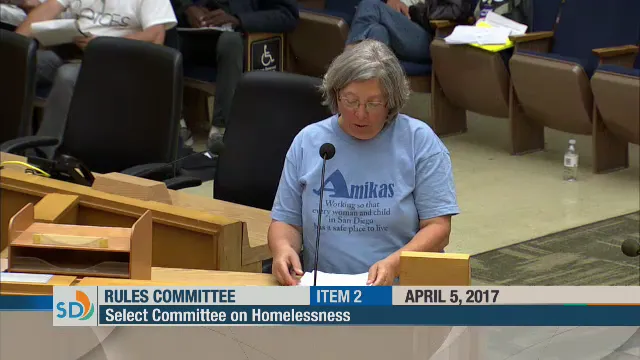
Item 2 – Select Committee on Homelessness: Speakers generally supported creation of the committee but urged expedited action and inclusion of homeless individuals and customer satisfaction metrics. John Brady, Susan DeBoer, and Martha Sullivan emphasized the need for input from currently homeless people. Catherine Rhodes noted unused funds (e.g., $268 million in Housing Commission reserves) that could be tapped immediately. Tom Thiessen (PATH) stressed that the committee should treat homelessness as an emergency and start work immediately, not wait until July.
-
Item 3 – Equal Pay Ordinance: Several speakers supported the ordinance. Rebecca Hookheld (San Diego LGBT Community Center), Emily Howe (Center on Policy Initiatives), Susan Swan (Lawyers Club of San Diego), and Marlene Lara (Planned Parenthood of the Pacific Southwest) highlighted the persistent gender pay gap, with statistics showing that women in San Diego earn 72 cents for every dollar a man earns, with even larger gaps for women of color (Black women: 50 cents; Latina women: 37 cents). Daniel Beaman urged implementation and robust enforcement.
Discussion Items
-
Transient Occupancy Tax Increase Ballot Measure
- Jessica Lawrence (Mayor's Office) presented the proposal: a 1% citywide TOT increase, plus an additional 1% in a middle zone, and another 1% in downtown (total up to 3%), to be voted on by a two-thirds majority. Revenue would fund three dedicated funds: (1) contiguous Phase 3 expansion of the San Diego Convention Center (estimated cost $630–685 million), (2) homelessness initiatives (estimated $900 million over 40 years), and (3) street repairs (estimated $900 million over 40 years). The measure would also allow bonding to generate $140–150 million for homelessness and streets in FY2019. The Mayor's Office requested a draft ordinance for council consideration in June, with a special election in November 2017.
- The Independent Budget Analyst (IBA) raised several concerns: the $15 million annual TOT gain from the expansion may be overstated (the IBA's estimate is $4–9 million); the proposal lacks a spending plan for homelessness and roads; legal questions remain regarding the Fifth Avenue Landing leasehold; and the timeline is tight. The IBA recommended returning the item to committee in May for further discussion.
- Committee members debated the measure. Vice Chair Kersey supported it, noting that the convention center is losing business to competitors like Anaheim and that the measure provides a return on investment. Council President Cole called for increasing the share of revenue for homelessness, especially in early years. Councilmember Ward raised several issues: legal viability (Fifth Avenue Landing litigation), the need for a “lockbox” to protect homelessness and road funds from cost overruns, and the possibility of expanding the definition of “road infrastructure” to include sidewalks and safe crossings. He also questioned the $5 million cost of a special election. Councilmember Bree asked about local hire and prevailing wage requirements. Councilmember Kersey emphasized the need to avoid supplanting existing funding and to include a “maintenance of effort” clause.
- The committee voted unanimously to direct the City Attorney to work with the Mayor's Office to prepare a draft ordinance, with the goal of council consideration in June for a November 2017 special election. The motion included a request for the IBA and Mayor's Office to explore increasing the proportion of funding for homelessness.
-
Select Committee on Homelessness
- Ralph DeMericott (Council President's staff) presented a proposal for a 12-month select committee (with potential 6-month extension) composed of four council members, with support from the Mayor's Office, City Attorney, IBA, and a .5 FTE consultant. The committee would review current programs, funding mechanisms, and the city's 1995 Comprehensive Homeless Policy. The requested action was to forward the proposal to the full council for approval.
- Committee members supported the proposal but urged an expedited start. Councilmember Ward requested that the committee be formed as soon as possible, not necessarily waiting until July. Council President Cole noted that the earliest council action could be mid-May. The committee voted unanimously to forward the report to the full council with a recommendation to create the select committee and direct the City Attorney to draft a resolution.
-
Equal Pay Ordinance
- Pam Ison (Council District 3 staff) presented the proposal, which would require businesses seeking city contracts to certify that they provide equal pay for substantially equal work regardless of gender or ethnicity. The ordinance would apply to all city contracts, regardless of dollar value, and would be enforced through complaint-driven audits. The effective date would be July 1, 2017, to align with the fiscal year. The proposal builds on state law (SB 358 and SB 1063) and does not require additional upfront reporting from contractors.
- The IBA reviewed similar programs in six cities, states, and counties, noting a variety of approaches (certification, wage data reporting, random audits, etc.). They highlighted that San Francisco is still in a pilot phase and that Tempe, Arizona, offers a business designation for low wage gaps.
- Committee members expressed support for the goal of equal pay but raised concerns about avoiding undue burden on small businesses, nonprofits, and community planning groups (CPPS recipients). Councilmember Kersey asked about enforcement and current compliance processes for living wage. Christina Peralta (Purchasing & Contracting) explained that contractors currently submit compliance certifications and that complaints are investigated.
- The committee voted unanimously to direct Councilmember Ward to work with the City Attorney, IBA, Mayor's Office, and appropriate departments to prepare an ordinance for the full council.
Key Outcomes
- Item 1 – TOT Ballot Measure: Motion passed unanimously (3-0) to direct the City Attorney to draft a TOT increase ordinance for council consideration in June, with a special election in November 2017. The motion also requested exploration of increased homelessness funding.
- Item 2 – Select Committee on Homelessness: Motion passed unanimously (3-0) to forward the proposal to the full council and direct the City Attorney to draft a resolution creating the committee.
- Item 3 – Equal Pay Ordinance: Motion passed unanimously (3-0) to direct Councilmember Ward to work with city departments to develop an ordinance for full council consideration.
The next Rules Committee meeting was scheduled for June 7, 2017.
Meeting Transcript
Good morning. Good morning, and welcome to the rules committee meeting of April 5th, 2017. This meeting is now in order. Let the record record reflect that committee members Bree, Ward, and Vice Chair Kersey are here. And present and alert and ready for this meeting to get underway. All right. So we're gonna really get started and go through this meeting. Uh the committee record of actions from February the eighth, twenty seventeen, will be approved by unanimous consent, and let's pull for discussion. See none. We'll move to non-agenda public comment. Do we have any members of the public wishing to speak on non-agenda public comments? We do. We have Martha Welch. Martha, if you would come to to the um the microphone, and then we have Catherine Rhodes after that, and Daniel Beaman. You will have two minutes. Martha Well, I wish we had forced the rules we have. Also, I like if we vote something, we don't get anything back. The library is supposed to be six pen of the D um. We don't get that either. And who changed the charter for the budget? I don't know. We didn't vote for that. I looked up at voting this morning, and we didn't vote for that change for the budget. I know 2015 was only to have the budget all the time, but now it's a performance audit. I don't like that as a person. I want five hands. That's what I want. Okay, Catherine Rhodes. You probably don't know this, but you guys here on the city council gave over two billion cumulative cash into the SD pension system for the next 29 years. And the reason why you did this is because I don't think you understood, but throughout these last couple of years, you have been giving um massive pensionable and non-pensionable pay increases. Um and it totals at $2 billion that you gave that you gave themselves. This was during the supposed five-year pensionable pay freeze that never happened. One of the things as it relates to Mark Kercy's ballot proposal previously, there is going to be zero pension savings ever. So that 100% of the pension savings going into infrastructure, doesn't matter. There is no pension savings, because you guys gave uh again pensionable and non-pensionable pay increases in the last three years. They were all done through um closed sessions, negotiations, where no elected official was there to communicate. Um, that these pension increases were gonna happen. And then you guys kind of approved them all on consent. So this is the first actual report since 2013, now here in 2017, and the numbers differ by two billion dollars. And so, in theory, of course, um things that are um things that you have to do, you can, but there's a whole bunch of things that you can do. You can um erase drop, you can um change the seven percent um payment to whatever percentage you want to do. You can do that because now SD SERS no longer has that veto power over the city council that they used to have because again of Carl DeMaio's issue. Thank you. Daniel Beaman. The next would be Richard Melbourne. I'm sorry, Council Plan uh President. Can you give me the subject? I lost my paperwork on that, so I have to go from my head. This is not agenda public comment. But I put down the subject there.
openpublica.com