San Diego Rules Committee Meeting Summary – June 7, 2017
STREAMING COPY IN PREPARATION — RECORDING AVAILABLE FROM THE ORIGINAL SOURCE
San Diego Rules Committee Meeting Summary – June 7, 2017
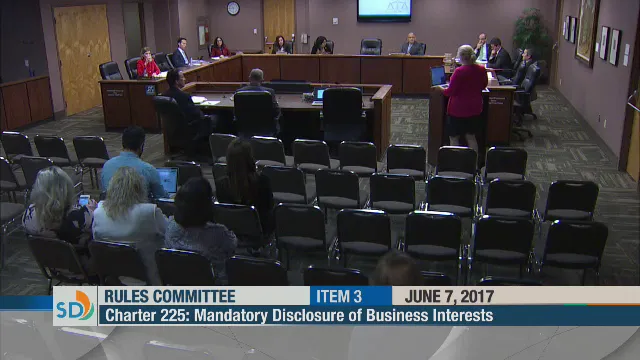
The San Diego City Council Rules Committee met on June 7, 2017, at 10:00 a.m. (presumed, per transcript) under the chairmanship of Council President Cole. The committee considered several significant items, including a performance audit of advisory board management, proposed changes to the Ethics Commission governance, implementation of Charter Section 225 requiring disclosure of persons doing business with the city, and a response to a grand jury report on refuse bin replacement. Votes were taken on all action items.
Consent Calendar
- Approved the committee record of actions from April 5, 2017, by unanimous consent.
Public Comments & Testimony
- Martha Welch (non‑agenda public comment) criticized the committee for moving public comment to the bottom of the agenda, stating it was disrespectful to the public and suggesting it was done to silence dissent. She expressed a belief that the committee does not care about the public.
- Catherine Rhodes (Point Loma resident) commented on Item 50 (passed on consent earlier in the week) which exempted two program manager positions from classified service. She argued that this action violated the five-year pensionable pay freeze and mirrored a pattern of granting raises through exemptions without required actuarial reports, as previously reported by the Union-Tribune.
Discussion Items
Performance Audit of Advisory Board Management (Informational)
- Presented by Andy Hannah (Supervising Senior Performance Auditor) and Danielle Novikolski (Performance Auditor II) from the Office of the City Auditor.
- Key findings: As of March 2017, over half of the 334 member positions on 30 active advisory boards were vacant or held by members serving on expired terms. Many vacancies had persisted for over two years, impeding quorum and board effectiveness. The city’s appointment and vetting process lacks formal timelines and does not uniformly notify the council of its authority under Charter Section 43C to fill vacancies if the mayor does not act within 45 days. Additionally, many boards lack Brown Act training and dedicated websites for posting agendas and minutes.
- Recommendations: (1) Improve notification to the council of its 45‑day appointment authority; (2) establish formal vetting procedures with deadlines; (3) develop a strategy for publicizing vacancies; (4) require all advisory board members to receive Brown Act training; (5) provide all boards with a website or designated city web page for posting agendas/minutes; (6) perform cost–benefit analyses before creating new boards, require annual reports, and conduct biennial reviews of existing boards. All 14 recommendations were accepted by the mayor’s office, city clerk’s office, city attorney’s office, and administration.
- Public comment: Kate Yavendetti (Women Occupy San Diego, National Lawyers Guild, District 3 resident) noted that the Community Review Board (CRB) has six vacancies despite many applicants waiting at the mayor’s office. She urged the council to move forward with appointments once the implementing ordinance (Measure G) is adopted. She also highlighted potential overlap between the CRB and the Citizens’ Advisory Board (CAB) and raised concerns about overly restrictive membership requirements (e.g., bankruptcy bars).
Ethics Commission Governance (Action Item)
- Presented by Barrett Tetlow (Chief of Staff to Councilmember Sherman). The proposed ordinance would amend municipal code to increase the required number of attorneys on the Ethics Commission from two to four (making it a majority), require all commissioners to have demonstrated familiarity with campaign finance, lobbying, and conflict‑of‑interest laws, and establish a five‑year waiting period for candidates or staff who have run against a current city elected official. The proposal came in response to a prior rules committee discussion and a grand jury report.
- Committee discussion: Councilmember Kersey opposed the five‑year waiting period, arguing that the commission must be impartial and that former candidates could not be objective. He proposed reducing the required attorneys from four to three and changing the “required” familiarity with ethics laws to “recommended.” Councilmember Kate supported these amendments, noting difficulty in measuring “familiarity” and preferring to keep the pool broad. Councilmember Bree also supported three attorneys rather than four, and Councilmember Ward echoed that preference.
- Vote: Motion by Vice Chair Kersey to approve the ordinance with the following amendments: (1) reduce required attorneys to three; (2) change “required familiarity” to “recommended familiarity”; (3) strike the five‑year waiting period for candidates/staff. Seconded by Councilmember Kate. Passed unanimously, subject to full legal review by the city attorney.
Implementation of Charter Section 225 (Discussion and Direction)
- Presented by Steve Hadley (Committee Consultant) with input from the City Attorney’s Office (Mr. Zelini), the Independent Budget Analyst (IBA), and Mayor’s Office staff. Charter Section 225, approved by voters in 1992, requires all persons doing business with the city to disclose their identities and interests. However, the provision is broadly worded and has been inconsistently enforced. The working group proposed an interim ordinance requiring disclosure from entities doing $500,000 or more in aggregate business annually, including corporate officers, board members, shareholders with 10% or greater interest, and investors with felony convictions or crimes related to truthfulness. Publicly traded companies would be excluded from certain requirements due to existing federal disclosures.
- Discussion: Councilmember Kersey questioned the feasibility of enforcing the 10% shareholder/felony disclosure for publicly traded companies; Councilmember Bree noted the working group had already discussed excluding public companies. The IBA noted that the city already collects such information for real estate leases but not consistently for other contracts. The city attorney clarified that an interim ordinance could prioritize enforcement on larger transactions but could not narrow the charter’s scope; a charter amendment would be needed for permanent clarity.
- Direction: Councilmember Bree moved to: (1) direct the city attorney, with the working group, to draft a charter amendment for the November 2018 ballot; and (2) immediately draft an interim ordinance to implement enforcement priorities. Seconded by Vice Chair Kersey. Passed unanimously.
Grand Jury Report Response (Action Item)
- Presented by Lisa Byrne (Fiscal & Policy Analyst, Office of the IBA). The grand jury report “Broken Garbage Cans, City Apathy, Free Cans for a few” (filed March 22, 2017) contained seven findings and seven recommendations. Three recommendations were directed to the City Council: (1) amend the municipal code to establish procedures for free replacement of damaged refuse bins (recommendation not implemented due to limited city resources and equity concerns); (2) amend Council Policy 100-06 to more clearly define allowable uses of CPPS funds (recommendation not implemented, as policy is adequate but implementation was flawed); (3) establish oversight of CPPS spending (recommendation implemented via current procedures and training). The proposed response was to partially disagree with the findings and not implement recommendations 1 and 2, while confirming implementation of recommendation 3.
- Vote: Motion by Council President Cole to approve the proposed response. Seconded by Vice Chair Kersey. Passed unanimously.
Key Outcomes
- Approved committee minutes and consent calendar items.
- Received the advisory board audit as informational; all recommendations accepted for implementation.
- Passed amended ordinance modifying Ethics Commission qualifications, subject to legal review.
- Directed the city attorney to draft a charter amendment on Charter Section 225 for the November 2018 ballot and an interim enforcement ordinance.
- Approved the proposed response to the grand jury report on garbage cans, forwarding it to the full council.
- The next rules committee meeting was scheduled for Thursday, July 27, 2017, at 2 p.m.
Meeting Transcript
Good morning. Uh welcome to the rules committee meeting of June seventh, twenty seventeen. This meeting is now in order. Let the re record reflect that council members pre ward and Kate and our vice chair. Kate. Uh curcy. This is my day. It's been a long week, and this is gonna possibly be my day, so please excuse me. Um it says that I will be arriving shortly, but I am here. That way now. So the committee record of actions from April the fifth, twenty seventeen will be approved by unanimous consent and let's pull for discussion. Do we have any members of the public wishing to speak? Okay, we have Martha Welch. Martha Welch on non agenda public comment, and you will have two minutes. Two. Okay. Two minutes. Also, it used to be also um the top like this the meeting. But not in the and uh not um in the Monday and Tuesday is not like that. It's on the bottom. Why? Because you want people to hear us when you say something because you don't like us or or what? Because um you moved it purposely, I think, because um if you're not Democrats, I don't think because uh if you both have um uh um both have a jury, but I don't think so because this is voted with those people. And if you can vote something down, uh you can vote it down also. And uh that's a rule that we should change because a lot of people are mad about this um agenda. It's not right what you did. You're the only one that in the state that did this, move moving it down in two minutes. It's uh it's you it's your choice to do that, and that's what you want to do. Well, that's that that's that's what you do all the time. You're you to me you don't care about the public very much because I see it all over the city what you do with with public stuff, and it's not working out very well. Thank you. Uh next speaker is Catherine Rhodes. Hello, Catherine Redditz from Point Loma, and I wanted to talk about yesterday's item 50 that was on consent, which was called exempt two program manager positions from classified service for golf park and rec. So what you did there again is very similar to the Union Tribune article that came out by David Garrick entitled San Diego uses loopholes to hand out large raises during pay freeze. So what you guys did yesterday on consent, without ever going to the budget department or to any other committee department, is you increased um pensionable pay during the five-year pensionable pay um increase. Excuse me, in during the five five-year pensionable pay freeze. And so you did it again. And so when people when you know you guys come over and said you now have to get another sixty million dollars for the pension payment. That's all on you. You can't say that came from other people, um, specifically for Mark Kercy and and also for you, Mrs. Cole. They um you guys approve this. And again, and now you are in it on it too, because you guys approved it on consent on Monday. Item 50. And so what it is is that um when you exempt somebody from classified service, you take them out of the um out of the category so they could get a higher rate. I think it goes up to 178 million. So let's just say your your people that um work in your offices, they're not allowed to get this um exemption from classified service so they could get these pay raises that other people have been putting on, and you guys don't know anything about it. So you've been giving pensionable pay increases during this five-year freeze. You just did it again for two more people in the parks and golf department. It has not um, and the thing is because of the law, you're supposed to have an actuary report.
openpublica.com