San Diego City Council Rules Committee Meeting - October 4, 2017
STREAMING COPY IN PREPARATION — RECORDING AVAILABLE FROM THE ORIGINAL SOURCE
San Diego City Council Rules Committee Meeting - October 4, 2017
The San Diego City Council Rules Committee meeting on October 4, 2017, addressed four agenda items: proposed changes to sidewalk repair liability policy (Council Policy 200-12), a campaign finance amendment requiring principal officers of independent committees to sign a form, amendments to the ballot measure process (Council Policy 21), and updates to the city's campaign finance code. The committee voted unanimously on motions for each item, including directives for further analysis and referrals to the full council.
Consent Calendar
- The committee approved the record of actions from July 27, 2017, by unanimous consent, with no items pulled for discussion.
Public Comments & Testimony
- On item 3 (Council Policy 21 amendments), Jay Powell, a founding member of San Diegans for Managed Growth, expressed support for the City Attorney's proposal but requested that updates to Section 630 (related to the 1985 Prop A land use initiative) be addressed as a companion item, with proper noticing to stakeholders. He noted that Section 630 refers to odd-year elections and needs updating.
Discussion Items
Item 1: Proposed Changes to Council Policy 200-12 (Sidewalk Repair Liability)
- City Attorney George Schaefer warned that shifting sidewalk repair liability to the city and imposing a 90-day repair deadline would increase litigation risk. He stated that 35-50% of new cases are dangerous condition cases (mostly sidewalk related), with 110-120 claims annually and over $10 million in payouts from FY2013-2017. He recommended a study before implementation.
- Kevin Smith, Chief of Policy for Council District 8, presented the proposed revisions: shifting repair costs to the city unless damage is caused by a property owner, requiring city repair within 90 days of notice, and eliminating the 50-50 cost share program. He noted that a 2015 sidewalk condition assessment identified 85,000 damaged locations at a cost of $52.7 million, now reduced to $38.8 million unfunded. He cited a $5 million settlement as an example of potential savings.
- Vice Chair Kersey expressed concern about creating an unfunded liability without a funding source. He moved to have the IBA, city attorney, and staff conduct a financial and legal analysis of the proposed changes, including a look-back at past liability. He also suggested allocating infrastructure funds from Prop H for sidewalk repair.
- Councilmember Ward seconded the motion and questioned the comparison between liability fund payouts and infrastructure dollars. He noted that the 50-50 program has a $300,000 annual budget that is not fully used. He also asked about the city's current obligations and repair timelines.
- Councilmember Bree supported the motion and emphasized the need to educate property owners about the 50-50 program.
- Councilmember Kate asked about the evaluation and repair timeline; Transportation and Stormwater Director Chris McFadden explained that slicing contracts (for defects under 1.5 inches) take 4-6 weeks, while full panel replacements may take 2-3 years due to backlogs.
- The motion passed unanimously.
Item 2: Amendment to Campaign Laws – Principal Officer Acknowledgment Form
- Stacey Fulhorst, Executive Director of the Ethics Commission, proposed requiring principal officers of independent committees to sign a one-page form acknowledging their duties. This was prompted by situations where individuals were listed without knowledge or consent, or did not understand their responsibilities.
- Vice Chair Kergy suggested that the state Fair Political Practices Commission (FPPC) should amend the state form, rather than creating a local form. He moved to have the Ethics Commission send a letter to the FPPC conveying the committee's support for the change.
- Councilmember Ward seconded, but also asked if the Ethics Commission could send a notice to listed principal officers as an administrative action. Fulhorst said they could partially address it. The motion passed unanimously.
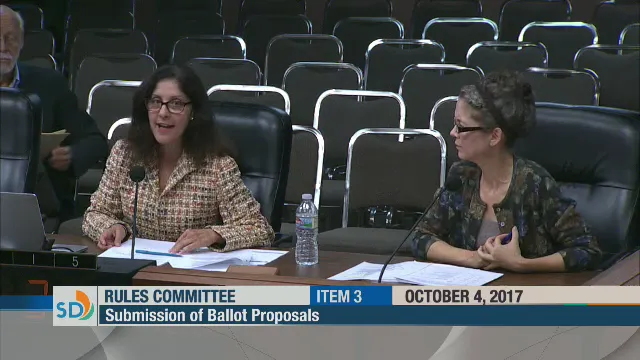
Item 3: Proposed Amendments to Council Policy 21 (Ballot Measure Process)
- City Attorney Sharon Spivak proposed adding a second committee hearing to allow more time for legal review, drafting, and public input for ballot measures generated by the city (not citizens' initiatives). The policy encourages early submission and provides for 120 days of review.
- Councilmember Ward moved to forward the item to the full city council. Councilmember Kate seconded. Discussion included questions about timelines for the June 2018 ballot (deadline March 9, 2018) and the need for early submission. The IBA questioned whether the timeline for June 2018 would allow two hearings. The motion passed unanimously.
Item 4: Proposed Amendments to Chapter 2, Article 7, Division 6 (Ballots for Candidates)
- City Clerk Elizabeth Maland proposed updates to the municipal code, including removing detailed formatting requirements to City Clerk Administrative Guidelines, allowing electronic submission of candidate photos and statements, and updating language for legal compliance. She also requested a future discussion on charging candidates for printing candidate statements (Section 27.0627), to return in July 2018.
- Councilmember Ward moved to accept the recommendations but amended the motion to remove restrictions on the use of bullets, italics, underlines, bold, and all capital letters in candidate statements, arguing these tools help convey key points. He noted that symbols and excessive formatting could be restricted.
- Vice Chair Kersey seconded and noted a minor typographical issue in the proposed ordinance. The motion passed unanimously.
Key Outcomes
- Item 1: Motion passed unanimously directing the IBA, city attorney, and staff to conduct a financial and legal analysis of the proposed sidewalk policy changes, including a look-back at past liability. The item will return to the Infrastructure Committee.
- Item 2: Motion passed unanimously for the Ethics Commission to send a letter to the FPPC requesting amendment of the state Form 410 to include a signature line for principal officers, and to provide notice to listed officers.
- Item 3: Motion passed unanimously to forward the proposed amendments to Council Policy 21 to the full city council for approval.
- Item 4: Motion passed unanimously to forward the proposed municipal code updates (with the amendment removing formatting restrictions) to the full city council, and to direct the City Clerk to return in July 2018 for a discussion on candidate statement fees.
Meeting Transcript
Good morning now. October the fourth, twenty seventeen to order. Let the record reflect that committee members are all here, including my Vice Chair Kercy. The committee record of actions from July twenty-seventh, twenty seventeen will be approved by unanimous consent, unless pulled for discussion. Do we have any members of the public wishing to speak? Okay. Next we'll move on to committee member comments. Any committee members wanting to comment? All right. Okay, we will now take up the discussion agenda. Before the presentation, City Attorney George Schaefer would like to comment on this item. Thank you, Council Council President Cole and members of the council. I'm here to uh discuss the proposed changes to uh Council Policy two hundred-twel. Um you have the memo from our office uh regarding concerns regarding those proposed changes. And I'm presenting here regarding the potential impact from a litigation standpoint uh these changes would have. Um, where there's injury on a sidewalk. And of more concern or equal concern is one of the proposed changes is that there is a duty placed on the city to when noticed of a defect in a sidewalk to repair it within 90 days. And it could be argued where the city was given notice of the need to repair, and that 90-day deadlock deadline was not met, that because that was a mandatory duty, the city has strict liability for any damages caused, and therefore there'd be no defense to such lawsuits. The impact of such a change has to be considered. Currently, 35 to 50 percent of new cases are dangerous condition cases, most of which are sidewalk cases in which our office defends the city. And many times in these cases, the homeowner is brought in because they have homeowners' insurance. And frequently there are cases where, because of the existence of homeowners insurance, the city is able to either get out of the case with a waiver of cost, or the city shares the damages with the insurance company. The effect of these changes, if implemented, would be to benefit insurance companies that offer homeowner insurance. And just very briefly, yesterday we asked the risk management department to run some statistics about the number of claims from fiscal year 2013 through fiscal year 2017 involving sidewalk injuries, and they average between 110 and 120 claims, and the total payout in damages for that period was over 10 million dollars. We believe that before this policy is implemented, there should be a study in which it is determined how many more cases there would have been and how much additional damages would there have been if only the city was liable in these circumstances when a street defect results in injury. One last comment here. A claim came in later that year in November, and it wasn't until a year after that the sidewalk was repaired. Had this policy been in place, it wouldn't have changed anything. What the council may want to explore is allocating additional resources when there's notice of a defect in a sidewalk to make sure that remedial action is taken immediately. Last, I will mention I have here Chief Deputy City Attorney Jane Boardman. She's in the trenches on these cases every day. She and her litigators, she can identify specific cases in which the city was either dismissed from a lawsuit or paid substantially less because there was a homeowner insurance policy in place and the insurance company ended up paying all or a significant significant portion of the damages in the case. Thank you, City Attorney Schaefer. We will now welcome Kevin Smith, Chief of Policy for Council District 8. And Mr. Smith, how much time would you need for your presentation? About six minutes, please. You got it, sir. Thank you, Council President Cole for docketing this item for discussion today. Council policy 200-12 was adopted in 1975 and is based on the state's street and highway code. It places the main responsibility of sidewalk repair and maintenance on abutting property owners. Abutting property owners are responsible for, among other things, damage caused by old age and deterioration. However, there are instances where the cost of replacing damaged sidewalks is borne by the city. You can see the list here on this slide. In the meantime, a city crew will mitigate damage via temporary fix, such as an asphalt patch or even closing the sidewalk. Property owners do have the option to participate in the city's 50-50 cost share program. Under this program, a property owner pays half the cost and submits a permit to the city for repair. City crews then repair the location within 90 days of receiving payment, and about $300,000 is budgeted annually to this program. In 2015, the city completed a sidewalk condition assessment. Over 85,000 damaged sidewalk locations were identified.
openpublica.com