Rules Committee Meeting on Mobility Board and Vacancy Ordinance - September 12, 2018
STREAMING COPY IN PREPARATION — RECORDING AVAILABLE FROM THE ORIGINAL SOURCE
Rules Committee Meeting on Mobility Advisory Board and Vacancy Ordinance - September 12, 2018
This meeting of the City of San Diego Rules Committee, chaired by Cole, was held on September 12, 2018, starting at 10:30 AM. The committee considered two major items: a proposal to create a new Mobility Advisory Board consolidating the existing Bicycle Advisory Board and Parking Advisory Board, and an ordinance implementing charter amendments (Measure E) regarding elective office vacancies, succession, and removal. Public testimony was heard on the first item, and both items were approved unanimously.
Public Comments & Testimony
- Nicole Burgess (District 2 representative for the Bicycle Advisory Board): Expressed strong support for the Bicycle Advisory Board's work, noting 250 miles of buffered bike lanes implemented in the last five years and the recent passage of the Strategic Implementation Plan (SIP). She stated that dissolving the board would lose momentum and progress. She was not opposed to a mobility board but recommended either keeping the bicycle board as a leader or making it a subcommittee, and suggested that Vision Zero become a subcommittee funneling proposals to the mobility board.
- Sophia Wolfram (Climate Action Campaign): Offered conditional support, emphasizing that the board must prioritize biking, walking, and transit. She called for the mayor's office to clearly signal that mode shift is a high priority and to back it with investment. She recommended that the board's objectives reflect mode share targets from the Climate Action Plan, that the board expedite the Transportation Master Plan, and that equity be prioritized by reducing technical expertise requirements and appointing members from communities of concern.
- Gary Smith (Chairman of the Parking Advisory Board): Supported a holistic approach to managing the public right-of-way, noting that bike lanes, parking, and other uses compete for space. He argued that advisory boards should focus on policy, not implementation, and that a mobility board makes sense for integration.
- Joy Sanyata: Spoke briefly in favor of the proposal.
Discussion Items
- Creation of a Mobility Advisory Board: Staff presented a proposal to consolidate the Bicycle Advisory Board (29 members) and the Parking Advisory Board into a single Mobility Advisory Board. The board would advise on biking, walking, transit, and parking, with a focus on achieving mode shift goals in the Climate Action Plan. The mayor's office (Joel Day) indicated that the board would be overseen by the Office of Boards and Commissions, and that a mobility manager would soon be hired. Committee members discussed the role of MTS, the need for ADA expertise, and ensuring existing board members could apply for new seats. A motion by Councilmember Ward included an amendment requiring at least one appointee possess expertise in ADA accommodations. The board would be formed by the end of 2018, with existing boards dissolved only after the new board is operational.
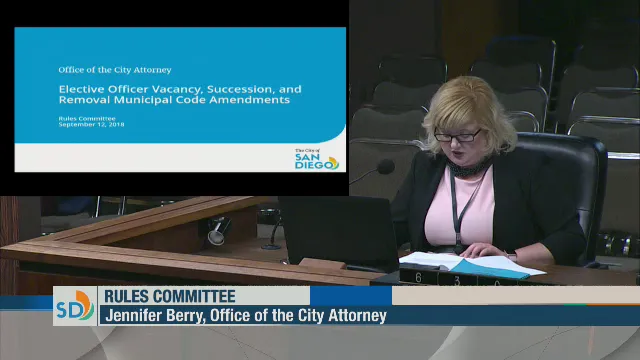
- Ordinance on Elective Office Vacancies, Succession, and Removal: Priscilla Dugard and Jennifer Barry from the City Attorney's office presented an ordinance implementing Measure E, approved by voters in November 2016. The ordinance adds new causes for vacancy (mental/physical incapacity, resignation, felony conviction, removal for cause), creates a consistent appointment process for all elective officers, and establishes a special removal election for dereliction of duty or malfeasance. The procedure mirrors recall elections. No public testimony was heard.
Key Outcomes
- Motion on Mobility Advisory Board: Moved by Councilmember Ward, seconded by Councilmember Kate, with an amendment to require at least one appointee with ADA expertise. The motion passed unanimously (voice vote). The board will be formed by the end of 2018, with existing boards dissolved upon formation.
- Motion on Vacancy Ordinance: Moved by Vice Chair Kersey, seconded by Councilmember Kate, to forward the ordinance to the full City Council with a recommendation for adoption. The motion passed unanimously.
- The next Rules Committee meeting was scheduled for October 10, 2018.
Meeting Transcript
Cycling, this mobility board should be about elevating all the other modes and concerns relating to mobility to the same level as the bicycle advisory board and making sure that all of those modes are um are working together in synergy so that we reach our goals and not about taking down the bicycle advisory board and its role. It's very important role. Um again, we're in support. We're here um to be a part of it, and thank you so much. Thank you. Next we have Nicole Burgess, followed by Sophia Wolfram. Hi, thank you. I I'm for bikes. I'm here in the room with a lot of other advocates that are speaking the same note as the value of the bicycle advisory board. Um as many of you know me, I'm Nicole Burgess, I'm District 2 representative for the bicycle advisory board, and I thank you for your continued support. I've been around the for about 10 years advocating for better bike infrastructure, for safe routes to schools, and for a healthy, vibrant economy. And that has happened mostly in part of the bicycle advisory board. As Judy and Andy say, we are a working board. We've just passed the SIP, which is a roadmap, but a lot of what we heard at the council is it doesn't have any timelines. So if it doesn't have any timelines, who's really gonna make that stuff happen? And it's gonna take the bicycle advisory board. Though last month we were tasked with a heavy task by the bike program that needs our support to help establish design guidelines. I've got 300 pages of different cities to guidelines to go off of and is used as a model for our city. But if this bicycle advisory board is dissolved, you lose a lot of work, a lot of momentum. And I'll have to say all the districts have great representatives representation. And you guys know I'm Randy Van Fleck, Andy, uh, Nicole Capritz, uh, Kathy Kehan, those are great inclusive advocates. We they are speaking for the pedestrians. They are speaking for the transit. A lot of the stuff that's in this proposed mobility board is what we are doing right now, and we would actually like to do the extra couple things that are on that proposal. So I I believe I'm not opposed to the mobility board. I see the value of it, but I also see that what the progress we're making at the bicycle advisory board, and either A, have them be the leaders or B have that part of a uh almost like a subcommittee. I I would actually recommend that um your vision zero be a subcommittee and those funnel in proposals to the mobility board. But to try to get 10 more people to advocate through our city on mobility when you have uh a working board that is dedicated to spending time, volunteer times to try to create our city into better bike infrastructure is a huge thing. And then I just also want to say I am very involved with Fision Zero. I'm a big component proponent for it. It is about creating safer streets. So in the last five years with our bicycle advisory board and the city, we've implemented 250 miles of buffered bike lanes. We've reduced lane traffic, calming traffic, and that we can take to a whole nother level. But we finally got the SIP passed, and so it's the time is now to go that level. But if we get dissolved, we we lose all that momentum when we lose all that progress. So I just really, you know, if we're gonna go forward with the mobility board, it really needs to have the bicycle as a main component. Thank you. Thank you. Next we have Sophie Wolfram, followed by Joy Sanyata. Good afternoon, Sophia Wolfram with Climate Action Campaign. Um I want to offer some feedback to help ensure the success of the board, but first I also want to look at where this proposed board fits in the big bigger picture of mobility in the city of San Diego. Certainly a holistic approach to mobility can be a step in the right direction as long as it's clearly focused, as others have said, on prioritizing biking walking and transit. But CICAC remains concerned about this continued piecemeal approach toward reshaping the future of mobility in the city. The formation of this committee would, or this board would make a lot of sense if it were a piece of a broader discernible vision and strategy. If there were, for example, a mobility champion in the mayor's office, if the city were counting bike and ped trips and reporting annually on mode share, if the transportation master plan were progressing quickly and with meaningful public engagement, then a mobility advisory board would fit right in as one piece of a multi-pronged strategy to address one of the city's top priorities. But as it is, it's not clear that mobility is a key priority of the city and that the context surrounding this board is going to facilitate its success. And so it's hard to muster full-throated support for this shift. What would make it possible to get to that level of support would be if the mayor's office were to clearly signal that mode shift is a high priority issue and then back that up with sufficient investment and political commitment. So we will continue, of course, to push for those changes. And for this board specifically, I'll offer a couple of um of our thoughts.
openpublica.com