San Diego Rules Committee Meeting - October 10, 2018
STREAMING COPY IN PREPARATION — RECORDING AVAILABLE FROM THE ORIGINAL SOURCE
San Diego City Council Rules Committee Meeting - October 10, 2018
The Rules Committee of the San Diego City Council met on Wednesday, October 10, 2018, at approximately 10:00 AM. Committee members present were Council President Pro Tem Bree, Councilmember Kate, and Vice Chair Kercy. Councilmember Ward was absent. The committee approved the minutes from the September 12, 2018 meeting and then heard three agenda items: a proposed response to a grand jury report on the citizens initiative process, a status update from the Funds Commission, and an update on the Get It Done program.
Consent Calendar
- The committee approved the record of actions from September 12, 2018, via a roll call vote. A motion was made by Councilmember Bree, seconded by Councilmember Kate, and passed unanimously with Bree, Kate, and Vice Chair Kercy in favor; Councilmember Ward absent.
Public Comments & Testimony
- Joy Sanyata (District 3) spoke on non-agenda public comment, requesting clarification on her speaker slip. Later, she spoke in favor of the Get It Done update, praising city employees and expressing concern about prioritizing resources given budget constraints. She also noted the city's strategic plan goals.
Discussion Items
Item 1: Proposed Response to Grand Jury Report "Improving the San Diego Citizens Initiative Process"
- A staff member (from the Independent Budget Analyst's Office) presented the proposed joint response from the Mayor, City Council, and City Attorney. The response addresses four findings and one recommendation from the grand jury report filed on May 23, 2018. The proposed responses: agree with Finding 1; partially disagree with Findings 2, 3, and 4 because cited state statutes do not apply to San Diego as a charter city and because the city already provides voter education. For Recommendation 18-20 (consider a standard practice of commissioning an impact report), the proposed response is "will not be implemented because it is not warranted," citing legal background, existing voter education, and resource constraints. The committee forwarded the approved response to the full city council.
- Vote: Motion by Councilmember Kate, second by Councilmember Bree, passed unanimously (Bree, Kate, Kercy; Ward absent).
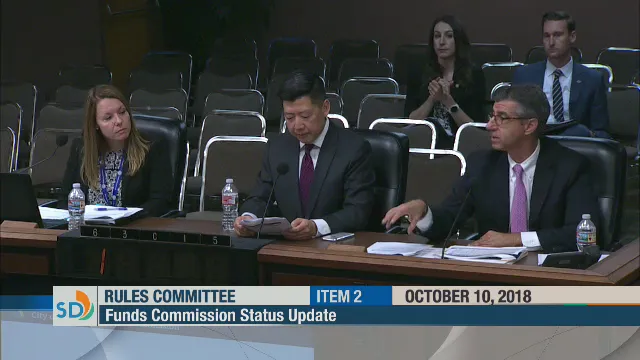
Item 2: Status Update from the Funds Commission
- Liz Correa (Deputy Director of Financial Operations), David Tam (Funds Commission Chair), and Mike Lavin (Canterbury Consulting) presented an overview of the six trust funds supervised by the Commission: Edwin A. Benjamin Memorial Fund, Fee Sergeant Memorial Fund, Los Penasquitos Canyon Preserve Fund, Gladness Edna Peters Memorial Fund, Jane Cameron Library Fund, and Mount Hope Cemetery Perpetuity Fund. Each fund has a long-term investment strategy; most are allocated 65% stocks and 35% bonds, except Mount Hope (65% bonds, 35% stocks) due to charter restrictions on income-producing securities.
- Performance: The Los Penasquitos Fund has compounded at just over 7% annually net of fees over 22 years, outperforming its benchmark by 0.7% and 80% of its peer group. Over the last decade, it compounded at just under 7%, outperforming 85% of peers. The Mount Hope Fund, with a different objective, has compounded at just over 5% since 1997.
- Discussion: Councilmember Kate asked about limitations and distributions. David Tam explained that the Los Penasquitos Fund distributes 5% of its market value quarterly (1.25% per quarter) for preserve maintenance. The IBA noted that in FY18, Mount Hope Cemetery operations were subsidized by the General Fund by approximately $580,000. The IBA also asked about active management; funds use institutional mutual funds except Mount Hope, which is managed by Northern Trust with individual securities. No action required, as this was an informational item.
Item 3: Get It Done Update
- Alex Hempton (Program Manager) and Sam Brummet (Program Coordinator) from Performance and Analytics presented. The Get It Done program launched as a pilot in May 2016 and expanded in October 2017 with a new contract. Expansion launched in summer 2018, adding services such as passport appointments, hazmat appointments, parking violations, missed trash collection, and other Environmental Services requests. Before expansion, average monthly reports were 12,700; after expansion, the average is 18,680 (a 47% increase). In September 2018, a record 22,540 reports were submitted. The city is on track to exceed 500,000 reports by the end of the fiscal year. Over 48,000 mobile app users have contributed to 332,000 total reports. Top reports include vehicles, graffiti, and illegal dumping. New internal systems replaced legacy applications. Future plans include online trash container purchases, Spanish language mobile app options, and additional code enforcement complaint types.
- Discussion: Councilmember Bree asked about frequent users and how many requests come via phone/email. Councilmember Kate asked about security for online transactions (testing underway), read-only access for council offices (exploring options), and data visualization tools. Vice Chair Kercy praised the app's growth and suggested clearer messaging for street repaving requests. Council President Pro Tem Bree noted illegal dumping on freeways and inquired about Caltrans coordination; staff indicated they refer issues but lack update tracking from external partners. No action required, as this was an informational item.
Key Outcomes
- Approved consent calendar (minutes from September 12, 2018).
- Forwarded Item 1 (grand jury response) to the full City Council with a unanimous vote.
- Received informational updates on Items 2 and 3; no votes taken.
Meeting Transcript
Good afternoon. I will now call the members committee meeting on Wednesday, October the tenth, twenty eighteen to order that the record reflect that committee members Bree, Kate, and myself. We're he all here. We're here. The committee record of actions from September twelfth, twenty eighteen will be approved by a roll call vote. Is there a motion to approve the minutes? We have a motion by uh committee member Bree, seconded by committee member Kate, and let the record reflect that Vice Chair Kercy is here. So we do have a motion by uh committee member Kate seconded by or is that backwards. Committee member Bree. Seconded by committee member Kate. All in favor. Any opposed? The motion passes with committee member Bree, Kate and Vice Chair Kirsty in favor, no one opposed, and um count committee member ward is absent. Do we have any members of the public who wish to speak to a non-agenda public comment? Thank you. Good. Okay. Are there any comments from the mayor's staff, committee members, city attorney or the independent budget analyst? None. We will now hear the first discussion item. Item number one, proposed response to grand jury report improving the San Diego Citizens Initiative process. Today I'm here to present the proposed response to the grand jury report titled Improving the San Diego Citizens Initiative Process. This grand jury report speaks to providing San Diego City Voters with adequate information regarding citizens initiative. It was filed on May 23rd. It includes four findings and one recommendation that are directed to the mayor, city council, and the city attorney. And the response is due to the presiding judge by November the 16th. The proposed joint council mayor city attorney response is included in attachment one to IBA Report 18-33. The City Attorney's Office as the subject matter expert assisted in its development with our office. And I'd like to give out a special thanks to a deputy city attorney, Sharon Speeback, for all her hard work on this. So our after the initial development, our office, the city attorney's office and the mayor's office collaborated to come with come to the final proposed response. As you know from prior grand jury reports, there are prescribed responses for each finding. You can either agree or disagree wholly or partially, which means that you can't partially agree. And then for each of the recommendations, you can choose one of the four responses that are listed on this slide. And additionally, you there you can provide additional supporting information as needed to back up what the response that you have chosen. We'll just turn right to the findings. Finding one says that the democratic process will work well when the voters receive a verifiable, reliable, and objective information. The proposed response to this finding is to agree, and the response also notes that the report does not consider the voter information that's already provided by the city. Finding two states that the California Election Code 9212 and the ballot initiative transparency act of 2014 provide an example of for municipal excuse me for municipalities in evaluating the potential impacts of the ballot measures. The proposed response is to partially disagree. The cited statutes do not apply to the city of San Diego as a charter city that has not adopted the California elections code as the elections laws for the city. And thus the city cannot be in a position to assess them as examples. Also, the city would need to amend its elections laws, or therefore the city would need to amend its elections laws and processes, including for early public comment period and additional analyses beyond the scope of what the city already provides. The county of registrar voters may be required to provide additional or earlier signature verification for these processes, and the city's elections timelines would not always be conducive to implement portions of these laws, including that 9212 analysis, which also may be superfluous to what is already provided to voters, which I'll go over in a little bit. Finding three states that the new California elections code provides a model of how an extended period of review and analysis can provide unbiased and educational information to the voting public. The proposed response is to partially disagree. The cited the cited statutes do not apply to San Diego again, and as alluded in in the response to the previous finding, the timing of the 9212 analysis may not synchronize with our elections laws and processes. So it could depend on when an initiative is submitted unqualified as compared to the next election date. Finding four is that the City of San Diego may use public funds to educate the voters in an unbiased and informative way on issues raised by initiatives. The proposed response is to partially disagree. While the city does agree that voter education is a critical and that the California government code does allow for public funds to be used for unbiased education.
openpublica.com