San Diego Rules Committee Meeting – March 13, 2019
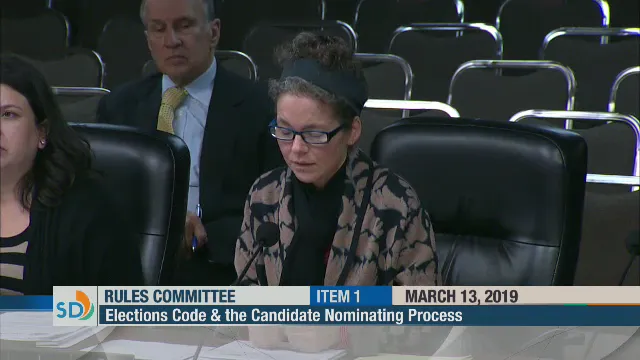
STREAMING COPY IN PREPARATION — RECORDING AVAILABLE FROM THE ORIGINAL SOURCE
San Diego Rules Committee Meeting – March 13, 2019
This meeting of the Rules Committee of the San Diego City Council convened at approximately 2:00 p.m. on March 13, 2019, with Council President Pro Tempore presiding and Councilmembers Ward, Kerr, Kate, and Kercy present. City Attorney Priscilla Degar, Philippe Monroy from the City Attorney's Office, Jeff Kawar from the Independent Budget Analyst's Office, and Ruth Martin (committee consultant) also attended. The committee addressed two main items: an update to candidate nomination fees and processes, and a proposal to mirror state law allowing proponents to withdraw initiatives or referendums. No agenda or minutes were provided.
Consent Calendar
- Approval of Committee Records: The minutes of the February 13, 2019 meeting were approved unanimously by voice vote (motion by Councilmember Ward, seconded).
Public Comments & Testimony
- Jeannie Brown (citizen, Voters Voice Coalition): Expressed support for a Democracy Dollar Program, citing Gallup and Pew polls indicating widespread concern about money in politics and low voter turnout.
- Amy Tobia (citizen, Voters Voice Coalition): Described how the Democracy Dollar Program would work: every registered voter would receive four $25 certificates; candidates would qualify by collecting signatures and small-dollar contributions (600 signatures and $10 each for mayor; 200 signatures and $10 each for city attorney/council). Candidates would agree to voluntary contribution limits and participate in debates. Funds would be administered by a democracy fund administrator. The program was projected to cost about $6 million per year based on Seattle's model.
- Edward Chaplin (citizen, Voters Voice Coalition): Highlighted three expected outcomes: increased citizen participation (every voter becomes a campaign donor), more qualified candidates able to compete without wealthy donors, and enhanced transparency through an updated campaign finance website. He referenced 2010 census data and Seattle's 2017 council race where a winning candidate raised 71% of funds from partial public financing and 77% of contributions were under $200. All three speakers requested that the Rules Committee and City Council study the proposal and consider placing it on the ballot.
Discussion Items
Item 1 – San Diego Municipal Code Update to Elections Code: Candidate Nomination Process
- City Clerk Liz Maland and Deputy Director Deanna Fuentes presented options for updating candidate filing fees (currently $500 citywide, $200 council), nominating signature requirements (200 citywide, 100 council), and candidate statement printing costs (currently free to candidates). They benchmarked against California Elections Code (requires $25 fee, 20 signatures, candidate statement printing fees) and other charter cities (e.g., Los Angeles charges $300, San Jose charges $25 plus printing costs; many cities charge for candidate statements). In 2018, printing a citywide statement would have cost ~$3,900; council statements $1,088–$1,281. The city subsidizes all printing costs.
- Councilmember Garsi (lead-off comment): Supported adjusting fees for inflation (last updated 1985) but did not see a need to adopt state law; favored retaining signatures in lieu and opposed charging full printing costs; asked about legal ability to offer free online statements while charging for paper copies.
- Councilmember Kerr: Supported updating fees, emphasized that the number of qualifying signatures should remain at least 100 (council) and 200 (citywide) because candidates should walk their districts. Noted that candidates who open a committee must raise $2,000; questioned printing charges but was open to both sides.
- Councilmember Ward: Supported a modest fee increase tied to CPI for future years; supported charging for candidate statement printing (benchmarked against other cities) and adjusting signatures in lieu proportionally. Asked about online options to reduce costs.
- Council President Pro Tempore: Leaned toward a percentage-of-salary method for filing fees (like San Francisco), supported partial recovery of printing costs to avoid deterring candidates, and wanted an updated signature requirement due to population growth. Asked for a proposed menu of options.
- Outcome: No formal motion; the committee provided input directing the City Clerk to return with proposals that include: updating the filing fee (e.g., based on inflation, salary percentage, or user fee study); adjusting signatures in lieu commensurate with any fee increase; increasing the number of nominating signatures; and considering partial or full charging for candidate statement printing (with possible online publication option). The City Attorney indicated that legal support would be provided.
Item 2 – Potential Amendment to San Diego Municipal Code: Withdrawal of Initiatives or Referendums
- City Clerk Liz Maland and Deputy Director Deanna Fuentes presented a request for direction to research mirroring California Elections Code §9604, which allows initiative/referendum proponents to withdraw a petition at any time before the elections official certifies that the measure has qualified for the ballot. Currently, San Diego has no such provision. The committee was asked for policy direction so the City Attorney could complete legal review, including whether charter amendments would be affected.
- Councilmember Ward (mover): Supported aligning city law with state law and requested additional legal analysis on allowing withdrawal even after certification (i.e., a later drop-dead date), because conditions may change. He acknowledged potential constitutional limits.
- Council President Pro Tempore: Preferred to first adopt state-law mirroring to avoid unnecessary work, then consider extended options later. He asked for benchmarking of other charter cities.
- Councilmember Kercy: Favored maximum flexibility for proponents, noting that city council often places measures on the ballot at the last minute; opponents should have similar opportunity to withdraw late in the process if practical. Supported the motion to include analysis of an extended window.
- Motion & Vote: Councilmember Ward moved to direct the City Attorney and City Clerk to: (a) prepare proposed legislation mirroring Elections Code §9604 for local measures, and (b) conduct legal analysis on whether a later withdrawal deadline (after certification) is feasible. The motion was seconded and passed unanimously by voice vote. The specific direction included not overextending analysis if clear constitutional issues arise.
Key Outcomes
- Item 1 (Nomination Process): No formal vote; the committee gave verbal direction for the City Clerk to develop a comprehensive proposal covering fee updates, signature requirements, signatures in lieu, and candidate statement charges (partial or full, with online alternatives). The City Attorney will support legal review.
- Item 2 (Initiative/Referendum Withdrawal): The committee unanimously approved a motion directing the City Attorney and City Clerk to prepare a draft ordinance that mirrors state law (withdrawal before certification) and to research the possibility of allowing withdrawal after certification. The outcome is subject to legal feasibility.
- Next Regular Meeting: Scheduled for Wednesday, April 24, 2019, at 2:00 p.m.
Meeting Transcript
Good afternoon. Welcome to the post committee of March thirteenth, twenty eighteen. This meeting is now in order. Let the record reflect a committee members Council President Pro Temprie is here, Councilmember Ward, Councilmember Kerr, Councilmember Kate, as well as Councilmember uh Kercy is here as well. We also have President Priscilla Degar with the city attorney, uh Philippe Monroy from this office, Jeff Kawar with the independent budget analysts, and Ruth Martin with my committee consultant. We will start with the approval of the committee records of action for in February thirteenth, twenty nineteen. You have a motion. Do you have a second? Councilmember uh Ward. All in favor, please say aye. Aye. Opposed? Moves unanimously. We will move to non-agenda public comment. You will have two minutes. I believe we have three requests to speak to us. So we have Jenny Brown. Good afternoon. I'm Jeannie Brown, and I'm here today as a citizen of the city of San Diego and a member of the Voter's Voice Coalition. Why the Voters Voice Coalition? A Gallup poll indicated that as many as 75% of people in this country think corruption by money is widespread in government. A pew study of registered voters who did not vote indicated that twenty-five percent said they did not vote because they did not like the candidates or the issues. Amy Tobaya, my name is Amy Tobia, and I am here as a citizen of San Diego and a member of the voters' voice coalition to tell you how the Democracy Dollar Program would work. Every registered voter in the City of San Diego would receive four $25 democracy dollar certificates in the mail. Candidates can qualify to receive these funds by showing grassroots support in collecting a threshold number of qualified signatures and small dollar contributions. For mayor, the candidate threshold would be a signature of in at least $10 from 600 eligible voters in the city. For candidates for city attorney and city council, the threshold would be a signature and at least $10 from 200 eligible voters. Candidates would also have to agree to new voluntary campaign contribution limits and participate in cable cast and live stream debates. Voters would assign democracy dollars to one or more candidate of their choice. A democracy fund administrator would verify the signatures and give each campaign the money corresponding to the democracy dollars assigned to the candidate. An updated city campaign finance website with easy to read graphic charts would provide transparency for the assigned democracy dollars and all campaign contributions and expenditures. And lastly, participating candidates can then use democracy dollar logo mark, a symbol signifying that they have met the program requirements on their printed literature and television media. The logo mark would be prominently displayed by the candidate's name on the ballot. And Edward Chaplin. Thank you. There are three expected outcomes from the program. More citizen participation in the Democratic process by making it possible for every voter to become a campaign donor. More qualified candidates can complete compete without resorting to wealthy donors or special interest money. The enhanced campaign finance site would provide more transparency around campaign financing. The first two outcomes will also generate more candidate voter interaction. Based on the 2010 census, the amount of democracy dollars a candidate could redeem per election cycle would be approximately 1.6 million dollars for the mayor, 1.35 million dollars for city attorney, $300,000 for city council. These numbers are in line with a similar program in Seattle. In 2017, the City Council race there, a winning candidate raised 71% of her funds from partial public financing, and 77% of her contributions were less than $200. Assuming the average number of candidates over the last two mayoral election cycles redeem the maximum amount of democracy dollars, which is unlikely. The program would cost approximately $6 million per year. One poll recently indicated that 95% of registered Democrats and 91% and independents and 91% of Republicans say they would support some form of campaign finance and anti-corruption measure. So to close, we are requesting the rules committee and then the city council and any city department as appropriate, study the proposal, give us feedback in order to how to improve it and consider it for placement on the ballot. We thank you for council council members for this consideration and time. Thank you. Do we have any comments from committee members?
openpublica.com