Special Rules Committee Meeting on Inclusionary Housing Amendments - May 15, 2019
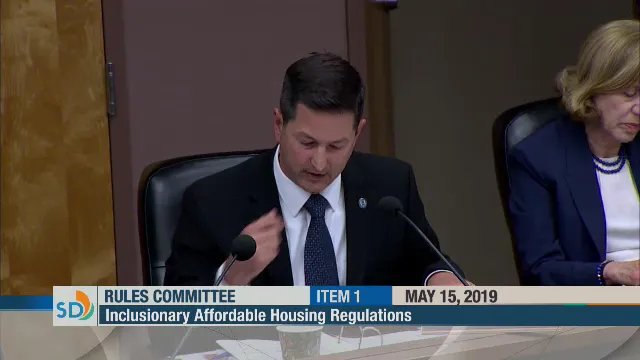
STREAMING COPY IN PREPARATION — RECORDING AVAILABLE FROM THE ORIGINAL SOURCE
Special Rules Committee Meeting on Inclusionary Housing Amendments - May 15, 2019
The San Diego City Council's Special Rules Committee, chaired by Council President Georgette Gomez and including Councilmembers Ward and Kate (joined late), convened on May 15, 2019, to consider proposed amendments to the City of San Diego's inclusionary affordable housing regulations. The amendments aim to require on-site affordable units in new residential developments, mixed-use projects, and condominium conversions, with a three-year phase-in. After a presentation by policy staff and the consultant KMA, extensive public testimony, and committee debate, the committee voted 2-1 to forward the proposal to the full City Council with modifications.
Public Comments & Testimony
- Opposition testimony (approximately 25 speakers, many with seated time):
- Dr. Lynn Reaser (economist) presented a study finding that increasing inclusionary requirements would reduce overall housing production by 13%, raising average rents by $255/month and home prices by 7%, while adding only 162 affordable units at a cost of 875 market-rate units (a 5:1 trade-off). She cited similar negative experiences in Portland, San Francisco, and San Jose.
- Matthew Adams (Building Industry Association) cited a 73% drop in San Diego housing permits in Q1 2019 and a 63% decline in Portland after its inclusionary program, arguing the policy would worsen the supply crisis.
- Multiple developers (Gilman Bishop, Ian Gill, Dave Hammer, Mike Mahoney, others) stated the proposed fee increase (from $10.82/sq ft to $25/sq ft) would make projects infeasible, push investment to other states, and not reduce land values as assumed. They urged protecting pipeline projects, reducing the fee, and extending the phase-in.
- Realtors and residents (Jessica Meshovik, Rebecca, John LaRai) expressed concern that costs would be passed to middle-income renters and buyers, making it even harder for young families and military personnel to afford homes.
- Jeanette Temple (Atlantis Group) and Jim Schmidt (Chelsea Investments) noted that very low-income housing developers rely on in-lieu fees from the current program to leverage other funding; raising the fee too high could reduce that funding source.
- Haney Hong (San Diego County Taxpayers Association) recommended varying requirements by submarket and including a sunset provision for accountability.
- Support testimony (approximately 10 speakers):
- Keith Maddox (San Diego & Imperial Counties Labor Council) argued the current in-lieu fee policy has failed to produce affordable units and a new baseline is needed for workforce housing. He supported increasing the fee to incentivize on-site construction.
- Carol Kim (San Diego Building and Construction Trades Council) urged requiring 10% at 50% AMI only (not the 15% at 80% AMI option) to target the deepest need.
- Richard Bates (Unite Here Local 30) stated the current $10.82 fee is woefully insufficient and a meaningful inclusionary policy is overdue.
- Arnulfo Manriquez (MAC) and others stressed the human impact, describing families living in overcrowded conditions and the need for affordable units for children and working families.
- Matthew Vossalakis (Climate Action Campaign) supported the policy for its potential to reduce vehicle miles traveled by promoting affordable housing near transit.
- Steven Russell (San Diego Housing Federation) offered recommendations: increase the in-lieu fee to $18–$22, allow a combination of on-site and fee compliance, and create a production bank. He also called for a housing bond on the 2020 ballot.
Discussion Items
- Presentation and staff report:
- Laura Gates (Chief of Policy for Council President Gomez) and Paul Maurer (KMA) presented the proposed ordinance, which would require rental developers to provide 10% of units at 50% AMI or 15% at 80% AMI (and for-sale: 10% at 100% AMI or 15% at 120% AMI). Developers could comply by building on-site, off-site within the same community, or paying an in-lieu fee (proposed at $25/sq ft, rising from the current $10.82). A three-year phase-in would apply.
- KMA’s financial feasibility analysis, based on 8 prototypes, showed that under the “District 9 proposal” (15% at 50% AMI or 20% at 80% AMI), many scenarios resulted in >30% reductions in residual land value (deemed infeasible). The alternative requirement (10% at 50% AMI or 15% at 80% AMI) had fewer infeasible cells, especially when combined with density bonus.
- Exemptions: projects under 10 units exempt (up from 2); on-site affordable units exempt from development impact fees and benefit assessment district fees.
- Councilmember Ward’s motion:
- Moved to adopt the staff recommendation with three amendments:
- Remove the 15% at 80% AMI option, keeping only 10% at 50% AMI as the on-site requirement.
- Reduce the maximum in-lieu fee from $25 to $22 per square foot.
- Expand alternative compliance to include rehabilitation of existing market-rate units, conversion of non-residential to residential (e.g., motel rooms), and preservation of at-risk affordable housing or SRO hotel rooms.
- Ward noted the middle-income density bonus ordinance will be brought to council concurrently to balance the impacts.
- Moved to adopt the staff recommendation with three amendments:
- Councilmember Kate’s concerns:
- Had just received KMA data and found the analysis showed up to a 55% reduction in residual land value for garden apartments under the density bonus scenario, which KMA itself said was infeasible. She questioned why the density bonus, intended to incentivize more units, actually made projects less feasible in this case.
- Stated she could not support the motion because the data did not demonstrate feasibility and the policy could suppress overall housing production, harming the middle class. She noted her own family is being forced to leave San Diego due to costs.
- Councilmember Bry’s remarks:
- Supported the motion, noting the three-year phase-in allows adjustments and developers have multiple compliance options (on-site, off-site, fee). She argued the Portland and San Jose comparisons were not apples-to-apples because their requirements are more stringent. She emphasized the need to produce housing for all income levels and that this is one part of a larger puzzle.
- Council President Gomez:
- Expressed commitment to affordable housing for very low-income families (50% AMI is above that, but a compromise). She highlighted other ongoing city efforts to streamline permitting, increase density near transit, and improve processes. She stated the policy is overdue and urged moving forward.
- City Attorney’s Office:
- Deputy City Attorney Sharon Spivak noted the ordinance is still under legal review and wording may change before full council.
- Independent Budget Analyst (Jeff Killar):
- Warned that exempting development impact fees for on-site affordable units could reduce funding for community infrastructure (traffic signals, parks, fire stations), potentially shifting costs elsewhere.
Key Outcomes
- Motion carried 2-1 (Councilmembers Ward and Bry in favor; Councilmember Kate opposed).
- The committee directed staff to forward the proposed ordinance to the full City Council with the following amendments:
- On-site inclusionary requirement: 10% of units at 50% area median income (AMI) for rental housing (removal of the 15% at 80% AMI option).
- Maximum in-lieu fee: $22 per square foot (down from $25), with a three-year phase-in (year 1: $8.33 but not less than $12.73; year 2: $16.67; year 3: $22).
- Alternative compliance methods expanded to include rehabilitation of existing market-rate units, conversion of non-residential to residential (e.g., motel rooms), and preservation of at-risk affordable housing or SRO hotels (with a 2:1 credit ratio for preservation projects in lieu of new units).
- The ordinance retains: exemption for projects under 10 units; exemption from development impact fees for on-site affordable units; ability for developers to combine on-site units with fee payments; and off-site production within the same community planning area.
- KMA will complete a formal economic feasibility study based on the revised requirements.
- The San Diego Housing Commission will update its implementation manual.
- The item is scheduled for Housing Commission Board on June 14, 2019, Planning Commission on July 11, 2019, and City Council on July 29, 2019.
- The middle-income density bonus ordinance will be brought to council at the same time to provide additional incentives for 80% AMI units.
- City Attorney will continue legal review and may make wording changes before final passage.
Meeting Transcript
Good afternoon, everyone. Thank you. We are going to call this special rules committee meeting of May 15, 2019 to order. This meeting is now in order. Let the record reflect the committee members, Council President Pro Temp Bree, Council Member Ward, and did see Councilmember Kate. But he would be joining us in a few minutes, hopefully. As well as uh Sharon Speedback with the City Attorney's Office, Elise Lowe with the Mayor's Office, and Jeff Killar uh with independent budget analysts and Ruth Martin with my committee, she's my committee consultant. Given that this is a special rules committee meeting, we are limited to cover what has been noticed. So with that said, we will now move on to item one, which is to propose some amendments to the City of San Diego's inclusionary affordable housing regulations. I will turn it over to Laura Gates, my chief of policy for my office for the presentation. Good afternoon, everyone, and thank you, Council President. Uh I'm here before you today with uh KMA and Housing Commission staff and other staff to present the proposed amendments to the City of San Diego's inclusionary affordable housing regulations. The purpose of the update is really to support new affordable housing growth by amending the City of San Diego's inclusionary housing regulations to require development of on-site affordable housing units as part of new residential development, mixed-use development, and condominium condominium conversions. Um and became legislation in 2018, which allows projects located within transit priority areas that provide 20% of their units, pre-density units at 50% AMI on site to use a floor area ratio bonus over dwelling units per acre, getting a little wonky there, sorry, uh, which may result in a significant increase in uh density on a site. I'm going to go over some of the milestones in the history of inclusionary housing. As many of you may know, our first inclusionary housing ordinance was brought forward and adopted by the city council in 2003 as a part of that. The on-site requirement was 10% at 65% area median income for as a rental requirement. And the for sale requirement was 10% at 100% area median income. Since that time, in 2009, there was a decision, the Palmer decision, that affected the rental residential development, which stated that it conflicted with the Costa Hawkins Rental Housing Act. The outcome of that was that the city suspended the on-site requirement and moved to a fee-based program in 2011. That fee has fluctuated over the years. Two years ago it was $7 in change. It went up to $10. It is slated to go to $12 and some change, and we'll be talking about that in a few moments. Since the time of 2011, we've seen AB 1505. This issue was brought forward as part of the Council President's housing action plan and also in relation to some other council initiatives that came forward in 2018. We formed a stakeholder committee in September of 2018. We held six meetings, which I'll briefly touch on in a moment. And we also engaged the consulting services of KMA to do a financial feasibility analysis and development per AB 1505. So again, the fee, the current fee for inclusionary is $10.82 a square foot. July 2019, the automatic calculation will take it to $12.73 square foot. So just quickly, the Palmer fix, AB 1505, which came from Bloom in 2017, clarified authority of local governments to apply inclusionary policies to rental housing. It reaffirms the ability of local governments to require the production of affordable housing as part of their inclusionary housing policies. It supersedes a 2009 California Court of Appeals decision, which found that inclusionary zoning for rental residential development conflicts with California's Costa Hawkins Rental Housing Act. It also requires that any local ordinance requiring on-site production provide alternative forms of compliance, including but not limited to in LU fees, land addiction, off-site housing production, and the acquisition and rehabilitation of existing housing units. All of those methods of compliance are contained within our proposal that will be discussed today. So just quickly, our inclusionary housing committee was about 25 folks. It was a very diverse group of stakeholders that we brought together. It included members of labor, the development industry, for-profit and nonprofit, affordable and market rate developers, lots of housing advocates and other interested nonprofits who wanted to have a say in the development of these regulations. We held six meetings. We discussed goals and objectives. We looked at many, many, many housing prototypes that were developed by KMA, and we also discussed potential incentives, which is an important piece of this. So just quickly, I'm going to hand it over to Paul here in a second to talk about the on-site affordable rental and for sale, the methods of compliance, and the timing of implementation. And then he'll give it back to me and I will discuss exemptions and additional incentives, and I will wrap it up. Thank you, Laura, and good afternoon, Council President Gomez and committee members. Paul Maurer with Kaiser Marston Associates, KMA. Pleased to be here to provide an overview of the process that we've gone through with City and Housing Commission staff, our methodology and our principal findings. Our assignment was to evaluate the impact of alternative inclusionary requirements on residential development. In doing that, we prepared financial performers for eight market rate residential prototypes. We also prepared an estimate for an in LU fee level sufficient to develop inclusionary off-site in other locations.
openpublica.com