Special Rules Committee Meeting – March 16, 2022: Hiring Reform, People's Ordinance, Energy Fund
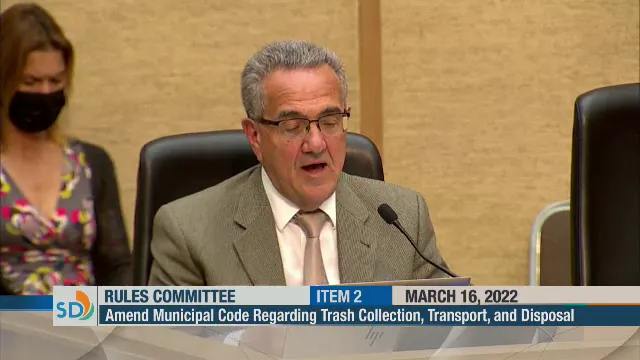
STREAMING COPY IN PREPARATION — RECORDING AVAILABLE FROM THE ORIGINAL SOURCE
Special Rules Committee Meeting – March 16, 2022
The San Diego City Council Rules Committee met virtually on March 16, 2022, to consider three major items: a proposed charter amendment to move the Personnel Department under the mayor to streamline hiring; a ballot measure to amend the 103-year-old People's Ordinance to allow cost recovery for residential refuse collection; and the creation of an Energy Independence Fund to study public power and support climate goals. The committee voted on all three items, with two passing 4–1 and one passing 4–0 (the energy fund).
Consent Calendar
- Approval of Committee Actions (February 16, 2022): Motion by Councilmember Campillo, seconded by Councilmember Kate. Passed unanimously.
Public Comments & Testimony
- Non‑Agenda Public Comment (four speakers):
- Kelly McCormick (public health educator, parent): Asked the committee to consider impacts on children when changing municipal code, noting the need for adequate outreach to families.
- Becky Rapp (parent, public health educator): Expressed concern about reducing marijuana production tax from 8% to 2%, stating it sends the wrong message to other struggling businesses.
- Alex Zukis: Argued that policies narrowing roads and eliminating parking favour only 2–6% of cyclists, disadvantaging the 94–98% who drive; urged that cyclists help pay for infrastructure.
- Rodney L. Fowler Sr. (first speaker, redirected to agenda item 2): Wanted to speak on the People's Ordinance but was told it would be heard later.
Discussion Items
Item 1 – Ballot Measure to Revise City Hiring/Recruitment Practices (Proposed Charter Amendment)
- Presenter: Councilmember Marni von Wilpert (District 5) via phone, and chief of policy Justin Garver.
- Proposal: Move the Personnel Director and Personnel Department from under the Civil Service Commission to under the mayor, consolidating hiring functions with existing HR and Risk Management to reduce the average 6–12 month hiring timeline and fill hundreds of vacancies.
- Personnel Director Doug Edwards (appointed by Civil Service Commission): Emphasized that only 20–30% of the hiring process is controlled by his department; the rest is in hiring departments or external checks. He noted budget cuts and a 63% increase in recruitment workload. He warned that removing independent oversight could weaken merit protections.
- Public comment: Rodney L. Fowler Sr. praised Personnel staff but cautioned against history of politicized hiring; urged addressing wages and remote work inefficiencies.
- Committee discussion: Councilmember Kate supported the move, saying it holds the mayor accountable. Councilmember La Cava had questions about how meet‑and‑confer would work and whether the change would truly solve inefficiencies. Councilmember von Wilpert clarified this proposal differs from an earlier one (that sought to eliminate Personnel) – it preserves the department but changes reporting structure.
- Motion: Councilmember Kate moved to direct staff to work with city attorney, IBA, and mayor’s office to draft charter revisions. Seconded by Councilmember Campillo. Vote: 4–0 (passed).
Item 2 – Ballot Measure to Amend the People’s Ordinance (Refuse Collection Cost Recovery)
- Presenter: Brendan Dentino, Rules Committee Consultant, on behalf of Council President Elo‑Rivera and Councilmember La Cava.
- Proposal: Ask voters to amend Municipal Code Section 66.0127 to allow the city to recover costs for residential refuse collection (not to impose a fee, but to permit future fees). Would preserve customer bases and city jobs; close loopholes for vacation rentals, ADUs, and mini‑dorms; and include bin costs in any future fee. The People’s Ordinance, passed in 1919 and last amended in 1986, prohibits cost recovery for single‑family homes, costing the general fund $43.2 million in FY22 and $173 million from FY17–21. It also prevents pay‑as‑you‑throw models needed for state SB 1383 compliance and climate goals.
- Independent Budget Analyst (IBA) / City Attorney: Noted that a fee would require Prop 218 compliance (community engagement, cost‑justified).
- Public comment (14 speakers, limited to 1 minute each):
- Kim Knox (League of Women Voters): Supported reform, noting inequity and $234 million cost over four years.
- Ron Askland: Supported amending to free up general fund and allow pay‑as‑you‑throw.
- Olivia Borak‑Bowden (Coastal Environmental Rights Foundation): Urged reform, said renters pay twice.
- Dana Givens: Suggested committee first consider alternative options from 2019 auditor report; concerned city may not control costs.
- Alex Zukis: Opposed blank‑check authority; wanted specific fee details in ballot language.
- Michael Zuquet (MEASan Diego): Strongly supported putting the measure on the ballot.
- Kiara O’Laughlin (Center on Policy Initiatives): Expressed concern about process; urged worker protections and stakeholder engagement.
- Lucera Sanchez (San Diego Coastkeeper): Supported amendment for equity and CAP goals.
- Daniel Orloff (Teamsters Local 911): Supported moving forward; said it will help fund city services.
- Mr. Smihowski: Offered metaphor, ended with support.
- Rodney L. Fowler Sr. (retired refuse collector): Disappointed council did not reach out to frontline workers; opposed the measure.
- Matthew Vostalakis (Climate Action Campaign): Supported reform as critical for CAP implementation.
- Alison Schlick (Zero Waste San Diego): Urged action to avoid SB 1383 penalties and address inequity.
- Richard Anthony: Thanked presenters; noted zero‑waste plan encourages wasting; supported amendment.
- Committee discussion:
- Council President Elo‑Rivera (moved): Emphasized the measure is only about allowing future cost recovery, not imposing a fee; cited broad coalition support; stressed worker protections.
- Councilmember La Cava (seconded): Supported as step to fairness, CAP goals, and modernizing government.
- Councilmember Campillo: Expressed concerns: November 2022 may be too soon; cost of ballot ($200–300K); risk of failure; need for polling and clear campaign strategy; questioned timing (non‑presidential election). He said he might change his vote later but needed more information.
- Councilmember Whitburn: Shared concerns about low voter turnout in midterms; failure could set back reform for years. Asked about path to success.
- Council President Elo‑Rivera responded: Outside research shows majority support; waiting two more years is not acceptable given budget deficits and worker strain.
- Motion: Council President Elo‑Rivera moved to direct city attorney to draft ballot language. Seconded by Councilmember La Cava. Vote: 4–1 (Councilmember Kate opposed).
Item 3 – Creation of an Energy Independence Fund
- Presenter: Brendan Dentino on behalf of Council President Elo‑Rivera and Councilmember La Cava.
- Proposal: Establish a fund to (1) cover potential prorated refund of SDG&E franchise bid amounts if the city terminates early, (2) pay for professional services studying public power/municipalization, and (3) support city‑controlled energy projects (solar, microgrids, etc.). At least 20% of franchise bid payments ($2.1M/year for first 5 years) should be allocated to the fund, but allocations are subject to annual budget process and may be waived by council. The fund is meant to give the city flexibility and leverage for its energy future.
- Public comment: J. Powell (Community Energy Action Network) supported, asked to include Sustainable Energy Advisory Board (SEAB) in oversight, filling vacancies, and suggested linking to existing energy trust fund.
- Committee discussion:
- Councilmember La Cava (moved): Called it a financial tool to reach clean energy goals and explore alternatives to investor‑owned utilities.
- Councilmember Campillo (seconded): Asked IBA capacity to analyze impact on general fund. IBA (Charles Modica) said they can. Asked City Attorney about legal efficacy – resolution is a goal, not a binding appropriation; majority vote to waive. Wanted to ensure the fund does not affect the separate SDG&E solar equity program (staff confirmed it does not).
- Councilmember Kate: Expressed concerns about the “should” language and its intent; worried the fund redirects money from other services. He said he would support using the fund as an escrow for potential franchise termination, but not for municipalization studies or city energy projects, which he argued are roles for the CCA (San Diego Community Power).
- Councilmember La Cava responded: CCA is focusing on large power purchases; local microgrids may need supplemental funding; intent is to maintain flexibility.
- Council President Elo‑Rivera supported: Stressed the fund prepares the city for future decisions and provides negotiating leverage with SDG&E.
- Motion: Councilmember La Cava moved to approve resolution authorizing creation of the fund. Seconded by Councilmember Campillo. Vote: 4–1 (Councilmember Kate opposed).
Key Outcomes
- Item 1 (Hiring Reform): Motion passed 4–0. Staff will draft charter amendment language for future Rules Committee consideration. Meet‑and‑confer process with unions will follow if the measure advances.
- Item 2 (People’s Ordinance): Motion passed 4–1. City attorney directed to draft ballot measure language for the November 2022 election; to return to Rules Committee for further review. Councilmember Kate voted no.
- Item 3 (Energy Independence Fund): Motion passed 4–1. Resolution adopted to create the fund; mayor to include recommended allocations in annual budget. Councilmember Kate voted no.
- Next Meeting: The Rules Committee is scheduled to meet next on Wednesday, April 20, 2022, at 2:00 p.m.
Meeting Transcript
Good afternoon. Per California government code section 54953 E added by Assembly Bill 361, which allows the city to use teleconferencing and to provide the public an opportunity to address the city council via a call in option or an internet based service option. No members of the public will be in attendance at the meeting in the interest of public health and safety. In addition, this meeting is being televised and live streamed on the city's website, and the council administration has made arrangements for the public to comment using the Zoom webinar platform. We appreciate the public's continued cooperation. We will go over the specifics of how to join the webinar and will give details on how the public can offer their public testimony. I will now call the special rules committee meeting of March 16th, 2022 to order. I will now call the roll. Present. Here. Councilmember Campillo. Here. And I am also present. Also attending the meeting are IBA representative Charles Motica. Leslie Reynolds from the City Attorney's Office. Mayoral Representative Christopher Ackerman Vila. Committee consultant Brendan Dentino. Brendan, can you please go over the instructions for joining the meeting? Excuse me, the public may view the meetings on public television on City TV Channel 24 for Cox Communication and Time Morner Cable or Channel 99 for ATT, or view the meeting online by going to the City Council Committee's homepage at Sandiego.gov and selecting the City TV Live Webcast. Blue button on the right hand side of the page. The committee meetings will be held virtually using the Zoom webinar platform. Members of the public can offer public comment on items by accessing the Zoom webinar online or uh online using a desktop computer, laptop, tablet, or smartphone, or by calling into the meeting using a smartphone, cellular phone, or landline. The link to join the meeting, webinar by computer, tablet, or smartphone is listed on the agenda. To join the Zoom webinar by telephone, please dial 1 669 254 5252 when prompted input webinar ID 161 7086946 pound. This information is also available on the agenda and will appear on the screen during the public comment period for each item. When I introduce the item you would like to comment on, please raise your hand by either tapping the raise your hand button on your computer, tablet, or smartphone, or by pressing star nine on your phone. You will be taken in the order in which you raise your hand. You may only speak once on a particular item. When I did when I indicate it is your turn to speak, I will call you by your name as it appears on the Zoom webinar webinar attendee list, or I will read out the first last four digits of your phone number if you have called into the meeting. That is how you will know it is your turn to speak. If you have joined the webinar by computer, tablet, or smartphone, you will receive a pop-up notice to select to unmute your device. If you have called into the meeting by cell phone or landline, press star six on your phone to unmute yourself. We will review these instructions briefly. Again, when the public comment period on an item is open, please wait until the item you wish to speak to has been called before raising your hand to speak. If you raise your hand during a non-comment period, your hand will be lowered. When you are announced as the next speaker, please unmute yourself and offer your comments. Also, please mute the volume on your TV or computer before you begin to speak. A quorum is now present. We will take up we will now take up the approval of the committee actions for the rules committee meeting on February 16th, 2022. Brendan, please proceed with public comment. The public comment period for this item is now open. If you have joined already joined the Zoom webinar online or by phone, please raise your hand if you wish to speak. If you're watching on City TV or the live stream online or would like to call into the meeting to speak, please call 1669-2545252. When prompted, input webinar ID 161-7086946 pound. As a reminder, please raise your hand to speak. You as a reminder, please raise your hand to speak. You can do so by selecting the raise your hand button or input star nine if by phone. So this is uh public comment for meeting minutes for February 16th, 2022. Uh Council President, I'm seeing no uh request to speak on this item. Thank you, Brendan.
openpublica.com