Sandy Planning Commission Meeting - April 3, 2025
STREAMING COPY IN PREPARATION — RECORDING AVAILABLE FROM THE ORIGINAL SOURCE
Sandy Planning Commission Meeting - April 3, 2025
The Sandy City Planning Commission held a regular session on Thursday, April 3, 2025, at 6:15 PM in the City Council Chambers. The meeting followed a field trip and executive session. The commission reviewed three land-use items: a subdivision preliminary review, a site plan for a convenience store, and a public utility station (site plan and conditional use permit). All items were approved with conditions. No public comments were made.
Public Comments & Testimony
- No members of the public spoke during the meeting. The chair called for public comments for each item, both in-person and via Zoom, and none were offered.
Discussion Items
-
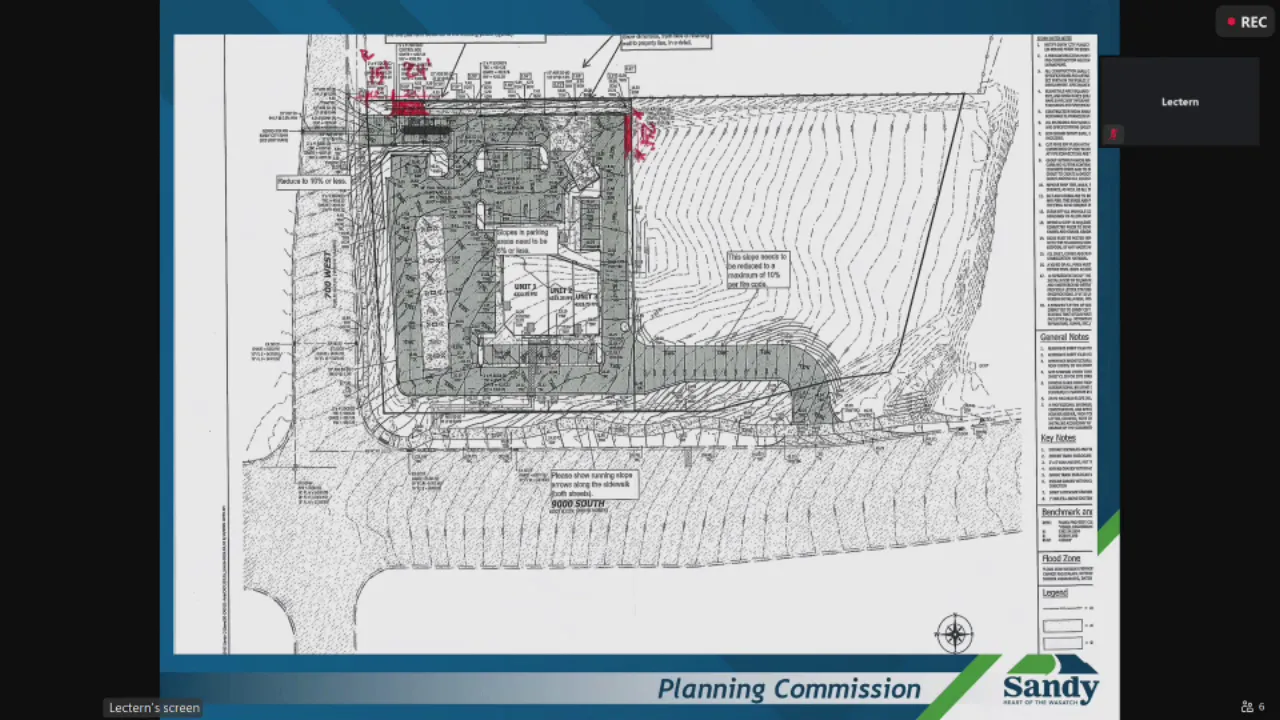
90th South Wadsworth Subdivision (Preliminary Review) – Staff presented a 3.37-acre undeveloped parcel at 694 W. 9000 S. St. The proposal would divide the lot into two: one for the adjacent convenience store and one for future sale. The site has significant grade changes (40 feet east to west) and access restrictions (right-in only from 9000 South, right-in/right-out from 700 West). Staff recommended approval with three conditions. Commissioner Kitterman noted that condition 2 and condition 4 appeared redundant; condition 4 was struck. The applicant, Elizabeth Cole of Wadsworth Development, confirmed the lot is developable. The commission approved the motion unanimously (7-0).
-
90th South C-Store (Preliminary Site Plan Review) – The site plan for a Chevron gas station and convenience store on the same parcel was reviewed. The design includes a right-in only access from 9000 South and a right-in/right-out from 700 West, with a 530-foot raised median on 700 West restricting southbound left turns. City Engineer Brittany Ward explained the median length is based on projected traffic from the Jordan Bluffs development (buildout by 2040). Commissioner Kitterman expressed concern that the median would force traffic to make U-turns or loop through parking lots, potentially increasing congestion. After discussion, the commission added a condition allowing the developer to shorten the median immediately, with the city retaining the right to reinstall it at its discretion. The motion also included a revised condition on parking stall count (remove four stalls or seek administrative approval for extra parking). The applicant, architect Gary Hunt and owner Kamal J, indicated the project has been 13 months in planning; EV charging (level 3) is being pursued with Tesla. The motion passed unanimously (7-0).
-
Enbridge Gas Public Utility Station (Preliminary Site Plan Review & Conditional Use Permit) – Enbridge Gas proposed an above-ground automatic shutoff valve station on a school district parking lot at 9725 S. State St. The station would be enclosed with an 8-foot precast concrete wall on the west, south, and part of the north sides, and wrought iron fencing on the remaining sides. Staff recommended a modification to the required 15-foot setback (reducing to 12.5 feet) due to site constraints. The applicant (Angela Barber, property agent) and engineer Chad Leah explained safety features: locked valves, chains, and secured electrical cabinets. Commissioner Kitterman asked about security against high school students; the engineer confirmed the facility is locked and protected. The commission approved both the site plan and conditional use permit unanimously (7-0 each), with a condition to coordinate landscaping with the existing parking lot plants.
Key Outcomes
- 90th South Wadsworth Subdivision – Approved (7-0) with conditions, with condition 4 struck as redundant.
- 90th South C-Store – Approved (7-0) with amended conditions: median on 700 West may be shortened at applicant's discretion, with city's right to reinstall; four parking stalls to be removed or administratively justified for up to 10% increase.
- Enbridge Gas Public Utility Station – Site plan approved (7-0) with landscaping coordination condition; conditional use permit approved (7-0) with two findings and one condition.
- Administrative Business – Minutes from March 20, 2025 were approved by voice vote. The next meeting (April 17) was canceled; the next regular meeting is May 1, 2025. Staff noted that the city's stationary plans were certified by Wasatch Front Regional Council, and code updates for those plans will begin after July 2025 budget finalization.
Meeting Transcript
Yep. Put the problem on them, put them all back. Three inches. But that's what it was supposed to do. It's exactly what it's supposed to be. So I guess I guess we designed it for like five. I guess it's like a price point. Um so this one is brought to us by voluntal land use institute. It's based off of um the ground rules and with Craig Hall presenting along with the round table. You guys aren't familiar familiar with Craig Hall. He literally wrote this book. And it's been involved in uh land use for basically his entire career in the state of Utah. And he's actually retired now. Um sponsorship speaking gigs and things like that. But I don't think he practices. Whenever I see a name with JD after that states for land button, but all on downhill from there after developer and provocate the downtown center there. It's also tied in with uh the maverick by agree, the call family. Yeah. So this isn't just intended to just be a long, you know, just watch it, don't say anything. If there are questions or if there's discussion that we've that come up as part of that, we can pause. This is a much longer video that we're gonna get through today. So even at uh increased the we'll we won't get through it, but nor do I want anybody to be subjugated to that level of just watching a show to help uh especially as as riveting as land use discussions can be. So um if anybody has a question, we can hit pause and dialogue about it and go over any question. Just wait right up to try it after that. How long we were watching this was recorded, I believe it's flat here. Okay, I believe could be wrong. Let me double check that out. Yep, this was two years ago, not last year, but like 2023. Okay. But fairly recent. So we'll uh kick this off and tell me if there's any questions. We'll be quoting uh extensively today from this book, uh ground rules, published uh just last November, it's available on at Amazon.com for anyone who would like to have it. And we are pleased to announce that from the onbestment's office that will allow us to see to provide free copies of this book to members of planning commissions and city councils around the state. So uh that effort is ongoing. We hope to have those out in a few months and and hope that it provides a good basic understanding of how to how to get uh your hands around the concepts of Utah land use law. So to get started, um you know when our cities were founded in Utah, there weren't that many people, and we really didn't have much need for zoning law. The uh the couple of Europeans who uh might have lived in one of our valleys could pretty well handle their own land use issues without a lot of interference. Then more people came, and of course, more people came, and then a whole lot of people came, and by this time the decision was made that we needed to uh create some kind of organization. So we created local government, of course the territorial and the state government came first, and that's kind of the the center point, that's where the local power flows is from the state government from the state legislature and the Utah State Constitution. But we decided we didn't want all those people making all the decisions, so we selected a few of them, usually five or seven, and we put them in a city council. That's called a representative democracy. So then the city council meets, and that's who makes land use decisions. At least that's who sets the policy. They are the ones who write the rules and and pass the legislation. And when they do land use issues, of course, they always say yes and everything's fine. Um no problems, no issues, life is calm and easy, except sometimes all those people show up again. And then we have reasons for dispute. And when we have disputes, then we have to resolve them somehow, and we turn to a few authorities that kind of provide again the milmar, the guidelines, the guardrails that that limit local discretion and land use. And when we when we go to court or otherwise try to figure out how to resolve matters, we usually refer to the basic ground rules, the laws that govern the land use regulation process in Utah. Because sometimes when all those people show up, then the council splits, we have no votes and yes votes, and then we have land use disputes.
openpublica.com