San Francisco Budget and Appropriations Committee Meeting - May 5, 2021
STREAMING COPY IN PREPARATION — RECORDING AVAILABLE FROM THE ORIGINAL SOURCE
San Francisco Budget and Appropriations Committee Meeting - May 5, 2021
The Budget and Appropriations Committee, chaired by Supervisor Matt Haney, met remotely on May 5, 2021, to receive mid-cycle budget updates from four city enterprise departments (Public Utilities Commission, Airport, Port, and Municipal Transportation Agency) and to hear a presentation on small business relief programs and the Office of Economic and Workforce Development (OEWD) equity plan. The meeting lasted approximately seven hours. All five hearing items were filed or continued to the call of the chair.
Public Comments & Testimony
- Item 1 (PUC): One caller, Marshawn Tadman from the San Francisco Marin Food Bank, urged the committee to prioritize food insecurity and reduced funding, noting that the need for food persists beyond the pandemic and that the food bank faces a potential loss of 40% of its food supply due to the federal food cliff.
- Item 2 (Airport): No public comment.
- Item 3 (Port): No public comment.
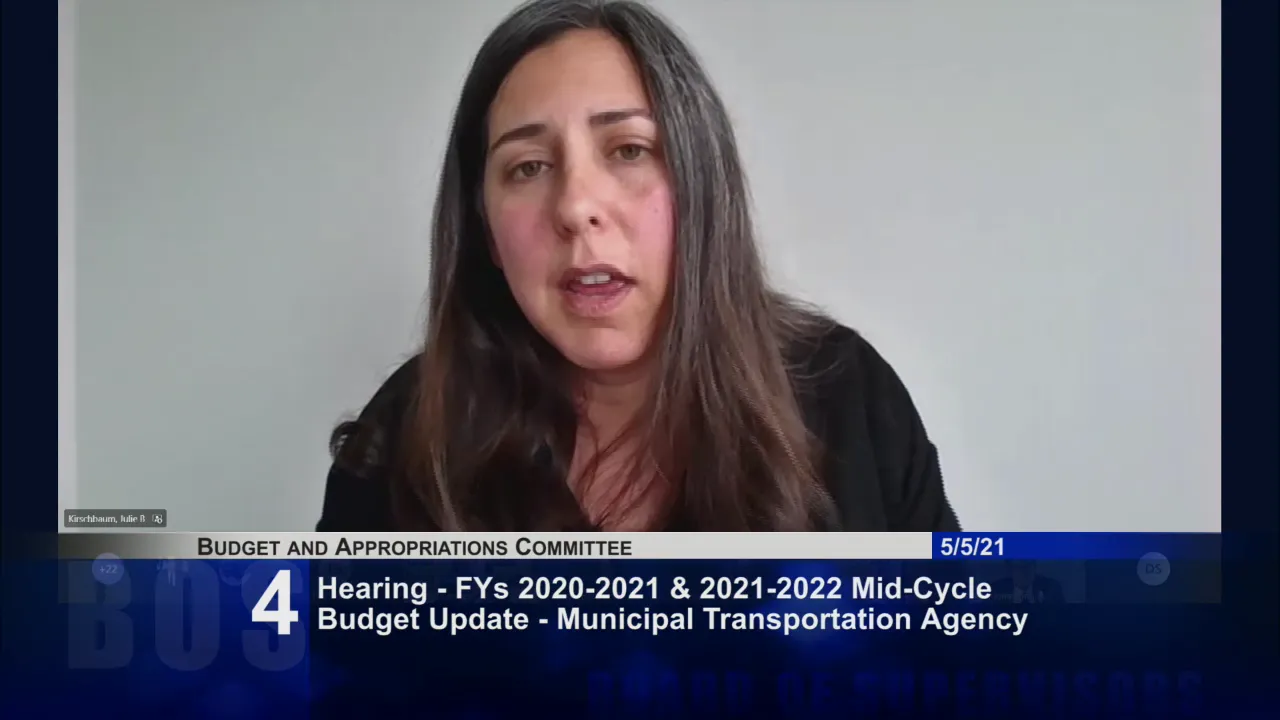
- Item 4 (MTA): Two callers spoke. The first urged the MTA to prioritize free Muni and shared spaces over unnecessary projects. The second criticized the MTA's budget process as confusing and suggested that funds spent on parking meters should be redirected to community priorities.
- Item 5 (Small Business Relief): Two callers testified. Carla Garcia, a small business owner in the Mission District, described difficulties applying for grants, including complicated applications, language barriers, and requirements for credit reports that many struggling businesses cannot meet. She also noted that some applications received no response. A second caller, who started a business in 2019, reported that grant applications were either ignored or rejected without explanation, and urged the city to revisit selection criteria.
Discussion Items
PUC Mid-Cycle Budget Update (Item 1)
- Acting General Manager Michael Carlin presented the SFPUC's budget update, highlighting priorities of impeccable stewardship, economic recovery, and racial equity. The budget amendment includes $19.5 million in operating increases (primarily for staffing, power procurement, and racial equity initiatives) and approximately $230 million in capital increases (mainly for accelerating the Southeast Water Pollution Control Plant and other infrastructure projects).
- Carlin noted that the PUC has saved more than $1.2 billion by securing low-cost state and federal loans for capital projects. The PUC also created an audit director position and initiated a third-party audit of the Social Impact Partnership Program to improve transparency.
- Committee members expressed appreciation for the PUC's focus on racial equity, local hiring via project labor agreements, and accelerated infrastructure spending. Chair Haney asked about specific transparency measures; Carlin described forming a working group with the Controller's Office, scheduling a series of audits, and reporting to the commission and advisory bodies.
Airport Mid-Cycle Budget Update (Item 2)
- Director Ivar Sotero reported that SFO has been more severely impacted than other large hub airports due to its heavy reliance on international and business travel. Pre-pandemic enplanements were 29 million; FY21 is forecast at 8.5 million. The airport's annual service payment to the city's general fund dropped from $49 million to $13.2 million.
- SFO has received $232 million in federal relief and expects another $200–$250 million from the latest stimulus. The airport deferred $2 billion of its $8 billion capital program. Sotero presented a conservative recovery forecast: 40% of pre-COVID enplanements by July 2022 and 60% by July 2023.
- Committee questions focused on the recovery timeline, support for furloughed workers (75% of the private workforce, largely from disadvantaged communities), and efforts to rebuild travel confidence (e.g., air bridges, testing sites, working with airlines).
Port Mid-Cycle Budget Update (Item 3)
- Executive Director Elaine Forbes and CFO Katie Petruccioni described a dire financial situation: port revenues fell nearly 50%, a loss of $60 million in the last year, projected to reach $80 million over two years. The port has provided $13.7 million in tenant relief, deployed 90% of maintenance staff as disaster service workers, and cut its capital budget to minimal levels.
- The port is pursuing a five-part economic recovery strategy: tenant relief, seeking state/federal assistance (including a request for $60 million from the American Rescue Plan), an internal Economic Recovery Initiative, a supplemental appropriation cutting $27 million in capital projects and $2.4 million in operating costs, and a request for a $20 million interfund loan from the city with a 20-year repayment term to avoid layoffs.
- Committee members praised the port's creativity and leadership during the crisis. The motion to file the hearing passed unanimously.
MTA Mid-Cycle Budget Update (Item 4)
- Director Jeffrey Tumlin and colleagues presented the MTA's budget update, emphasizing that the pandemic has been the toughest period in Muni's 109-year history. COVID wiped out 40% of service hours and 70% of capacity. The MTA rebuilt the system four times, prioritizing equity: neighborhoods like Bayview, Excelsior, and Chinatown now have faster, more frequent service than pre-COVID.
- The MTA has received $1.1 billion in federal relief across three packages. Despite this, the agency faces a structural deficit that will outpace recovery by FY24 unless new sustainable revenues are found. The MTA plans to restore service to 85% of pre-COVID levels by early 2022, but 15% of service will not be restored immediately. Key trade-offs include funding for subway renewal, parking meter replacement ($22 million project funded by revenue bonds), and shared spaces.
- Committee members asked about the driver shortage, late-night service, school reopening, the equity of service restoration, and the impact of shifting capital funds to operations. The MTA acknowledged that long-term capital needs (e.g., train control, track replacement) will be affected if new revenue is not secured.
Small Business Relief and OEWD Equity Plan (Item 5)
- Supervisor Peskin introduced the hearing, noting the lack of formal oversight for OEWD and the need for equitable distribution of relief. OEWD Acting Director Ann Topier and Diana Ponce de Leon presented data on COVID relief programs: OEWD repurposed baseline funds and accepted $65 million in new funding, distributing over 3,500 grants to small businesses and 20,000 individuals. Key programs included the Resiliency Fund, mini-grants in equity-focused neighborhoods, and the SF Shines for Reopening grant.
- Data showed that 72% of grant recipients were minority-owned, 52% women-owned, and 42% immigrant-owned. Grants reached top neighborhoods: Mission, Bayview, Tenderloin, Chinatown. However, only 28% of applicants received funding in the second round (lottery-based). The latest round (closing May 7) had 809 applications for 1,430 available grants.
- Legacy business program director Regina Dick-Endrizzi reported that the program has 283 businesses on the registry, with 44 active rent stabilization grants. The $1 million annual grant fund is projected to be fully obligated by FY22, and additional FTEs may be needed to expand.
- Committee members raised concerns about underrepresentation of District 11 (Supervisor Safai), the need for transparency in application scoring and rejection reasons, the digital divide, and the importance of the permanent shared spaces program. Supervisor Ronan requested a moratorium on nitpicky citations for shared spaces. The hearing was continued to the call of the chair to allow the new OEWD director, Kate Sofis, to present her vision.
Key Outcomes
- All five hearing items were filed or continued to the call of the chair unanimously by roll call votes (5-0).
- Item 1 (PUC): Hearing filed. The PUC will proceed with the budget amendment and focus on audit transparency and racial equity.
- Item 2 (Airport): Hearing filed. The airport will continue to manage through the pandemic with conservative recovery projections and ongoing federal relief.
- Item 3 (Port): Hearing filed. The port will pursue its five-part recovery strategy, including the $20 million loan request and federal stimulus allocation.
- Item 4 (MTA): Hearing filed. The MTA will restore service to 85% by early 2022, continue hiring and training, and seek sustainable revenue sources to avoid a fiscal cliff in FY24.
- Item 5 (Small Business Relief): Hearing continued to the call of the chair. The committee will reconvene to hear from the incoming OEWD director and discuss further improvements to equity in relief programs, legacy business funding, and oversight.
Meeting Transcript
Meeting will come to order. This is the May 5th, 2021 Budget and Appropriations Committee meeting. I'm Matt Haney, Chair of the Budget and Appropriations Committee. I'm joined by committee members, President Walton, Supervisors Ronin, Safai, and Marr. Our clerk is Ms. Linda Wong. I want to thank Kalini Mendoza and Javier Barreto from SFGov TV for broadcasting this meeting. Madam Clerk, do you have any announcements? Yes, Mr. Chair. Due to the COVID-19 health emergency and to protect board members, city employees, and the public, the Board of Supervisors, Legislative Chamber, and Committee Room are closed. However, members will be participating in the meeting remotely. This precaution is taken pursuant to the various local, state, and federal orders, declarations, and directives. Committee members will attend the meeting through video conference and participate in the meeting to the same extent as if they're physically present. Public comment will be available on each item on this agenda, channels 267899 and sfgtv.org, streaming the number across the screen. Each speaker will be allowed two minutes to speak. Comments are opportunities to speak during public comment period available via phone call by calling 415 655 0001 meeting ID 18707 6356, then press pound twice. When connected, you will hear the meeting discussions, but you will be muted and in listening mode only. When your item of interest comes up, the start three to be added to the speaker line. Best practices are to call from a quiet location, speak clearly and slowly, and turn down your television. Alternatively, you may submit public comment in the following way. Email to myself, the budget and appropriations committee clerk at L I N D A dot W O N G at SFGOB.org. If you submit public comment via email, it will be forwarded to the supervisors and will be included as part of the official file. Mr. Chair, this concludes my announcement. Great. Thank you so much. Uh, Madam Clerk. Uh will you please call item one? Yes. Item number one hearing on the fiscal years 2020 to 2021 and 2021 to 2022 fixed two year budgets and to receive a mid-cycle budget update from the public utilities commission. Members of the public who wish to provide public comment on this item should call 415 65501. Meeting ID 18707 6356, then press pound twice. If you have not already done so, please dial star three tonight to speak. Assistant prompt will indicate you have raised your hand. Please wait until the system indicates you have been unmuted and you may begin to comment. Great. Thank you, Madam Clerk. I will now turn it over to Michael Carlin from the PUC, who is here with his team to present on this item. Good afternoon, Chair Haney, President Walton, Supervisors Maher, Ronan, and Safey. I'm Acting General Manager Michael Carlin. I'm joined by my colleague Eric Sandler today, our chief financial officer, who is available to answer any questions the committee may have. Thank you for taking the time to schedule in here our mid-cycle budget update. Next slide, please. I'd like to begin by setting the scene for fiscal year 21-22 SFPEC budget update. This is an unusual year for us. We are at the midpoint of the two-year budget cycle. With COVID-19 impacts predominating in the past year, we have made some revisions to our budget that I'll detail here. During the spring and summer of 2020, we retooled our budget and financial plan due to recession effects with significant cost savings over night of over 90 million dollars over the two-year budget period due to reduced revenue production projections from COVID-19 impacts. In fiscal year 2122, we have only allowed for critical agency changes where funding allows.
openpublica.com