October 28, 2024 Land Use and Transportation Committee Meeting
STREAMING COPY IN PREPARATION — RECORDING AVAILABLE FROM THE ORIGINAL SOURCE
October 28, 2024 Land Use and Transportation Committee Meeting
The San Francisco Board of Supervisors Land Use and Transportation Committee met on October 28, 2024 at 9:45 AM. Chair Mirna Melgar presided, joined by President Aaron Peskin and Vice Chair Dean Preston. Two items were heard: an ordinance to allow increased AMI eligibility for certain below-market-rate (BMR) owned units, and a special use district (SUD) for a new senior affordable housing project in Chinatown.
Public Comments & Testimony
- Item 1 (BMR ordinance): John Abolos (Council of Community Housing Organizations) expressed support, noting the focus on real households and urging no delay.
- Item 2 (Asia Senior Housing SUD): Multiple speakers voiced strong support, including Alan Lowe (Perkins CUI, representing Chinatown Community Development Center), Sharon Lai (former city planner and Chinatown member), Saol Ling Chiang (Pingyun Resident Improvement Association), and a representative of CCHO. They highlighted the 40-year need for affordable senior housing, the preservation of the New Asia Banquet Hall, and the project's community and cultural benefits.
Discussion Items
- Item 1: BMR Ordinance – Chair Melgar introduced an ordinance to fix a discrepancy between maximum resale price and affordable price for a small number of BMR homeownership units, triggered by a family (the Jansucks) facing loss of equity. Amendments were proposed: annual reporting to the Inclusionary Housing Technical Advisory Committee, Planning Commission, and Board after 10 adjustments and every 12 months. Concerns were raised about a potential “slippery slope” (President Peskin) and the unknown universe of affected units (estimated from a handful to as many as 100). A 36-month sunset was discussed but deferred to a duplicated file to allow further review. The Mayor's Office of Housing (MOHCD) clarified that only one unit currently qualifies, and the affordable price is calculated at resale based on current costs (HOA, interest, insurance). The committee approved the amendment and moved the original file forward with recommendation, while duplicating the file for continued consideration on November 18, 2024.
- Item 2: Asia Senior Housing SUD – President Peskin presented the ordinance to create a SUD at 758 and 772 Pacific Avenue, enabling a 15-story, 175-unit affordable senior housing project (targeting extremely low-income at 30-40% AMI) and preserving the New Asia Banquet Hall. MOHCD confirmed $7.1 million in commitments and plans to use LOSP and SOS subsidies. The Planning Commission recommended approval unanimously. The project would be the first new affordable senior housing in Chinatown in 20 years. The committee added Supervisor Preston and Chair Melgar as co-sponsors and voted to forward with recommendation as a committee report.
Key Outcomes
- Item 1: Motion to amend the ordinance (adding reporting requirements) and motion to duplicate the file (to allow potential sunset clause) passed 3-0. Motion to recommend the amended ordinance to the full Board as a committee report passed 3-0. The duplicate file will be continued to the November 18, 2024 meeting.
- Item 2: Motion to recommend the Asia Senior Housing SUD ordinance to the full Board as a committee report passed 3-0. The item is expected to appear on the Board's agenda on November 5, 2024.
Meeting Transcript
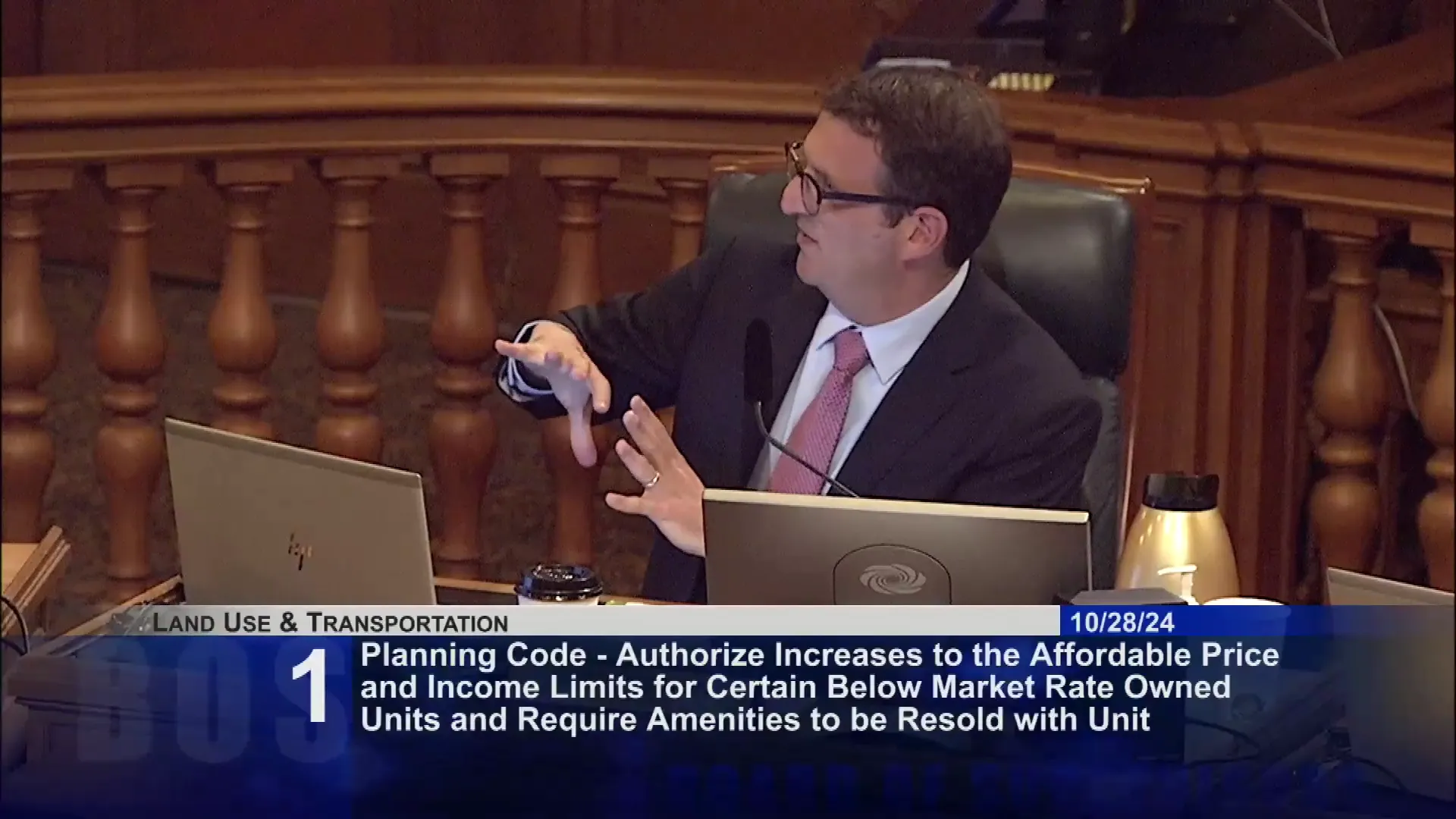
Okay, good afternoon everyone. This meeting will come to order. Welcome to the October 28th, 2024 regular meeting of the Land Use and Transportation Committee of the San Francisco Board of Supervisors. I am Supervisor Mirna Melgar, Chair of the Committee, joined by Board of Supervisors President Aaron Paskin, and the Vice Chair, Supervisor Dean Preston. The committee clerk today is John Carroll, and I'd also like to thank Sus Enos from SFGov TB for broadcasting this meeting and making it available to the public. Mr. Clerk, do you have any announcements? Yes, thank you, Madam Chair. Please ensure that you've silenced your cell phones and other electronic devices that you've brought with you into the chamber today. Public comment will be taken on each item on today's agenda when your item of interest comes up and public comment is called. Please line up to speak along your right hand side. Alternatively, you may submit public comment in writing in either of the following ways. First, you may email your comments to me at J-O-H-N period C-A-R-R-O-L-L at SFGOV.org. Or you may send your written comments via U.S. Postal Service to our office in City Hall. The address is one Dr. Carlton B. Goodlit Place, room 244, San Francisco, California 94102. If you submit public comment in writing, I will forward your comment to the members of this committee and also include your comments as part of the official file on which you are commenting. Items acted upon today are expected to appear on the Board of Supervisors' agenda of November 5th, 2024, unless otherwise stated. Thank you so much. Agenda item number one is an ordinance amending the planning code to allow certain below market rate owned units to be resold at a price affordable to households at an increased area median median income level. Increase the qualifying AMI limit for BMR purchasers and require BMR owned units originally purchased with parking spaces and other amenities to be resold with the same parking and amenities. It affirms the planning department's secret determination and makes findings of consistency with the general plan and the eight priority policies of planning code section 101.1 and findings of public necessity, convenience, and welfare pursuant to planning code section 302 by arrangement between the chair and the clerk's office. This item is on our agenda as a potential committee report. It may appear, I'm sorry, it may be acted upon at tomorrow's board meeting, October 29th, 2024. Thank you so much, Mr. Clerk. Um colleagues, uh, this is my legislation. Um I do have some amendments uh stemming from uh the feedback that we got from the planning commission uh when this went in front of them uh and some from some of the advocates and members of the public. But I just wanted to uh back up and uh tell you where this uh came from a little bit. Um this seeks to uh fix a very small thing uh within our inclusionary homeownership BMR program. Uh President Peskin, you will remember that uh many years ago uh we had issues with um some of the below market rate units that were produced through the subdivision code um when the condo conversion ordinance was codified many, many years ago. Uh and I'm reminding you of this because um we didn't always know how to administer BMR units in San Francisco. So before 2002, when then Supervisor Leonard codified um our inclusionary uh program into the planning code, we had played around with that idea of uh below market rate units. Um we did it when we uh did the subdivision code through DPW, and then with development agreements for several buildings before 2002. Um and you know, when the procedures manual was written, um the first time it's been amended several times since then. We didn't quite get every detail uh because we just didn't know. And I think that's the evolution of government. It's always been that way. So uh what um this legislation is trying to fix is that at one time um the affordable the maximum affordable price and the area median income eligibility were not one and the same. And so at the beginning, that may have been okay, but over time, the maximum resale price for some units, a very small minority of units, um, is higher than what the area median income is uh for those units. And over time that has grown. So about a year and a half ago, there was a article in Mission Local about this family, the Jansucks, who had bought their unit at the maximum resale price, they had bought it. They did not know that the maximum resale price and the affordable price were not the same for their unit. And when they got a new job, they tried to reset, you know, they had to sell, they had to do something about their situation. Um they came across this problem and facing, you know, having to lose about a hundred thousand dollars uh of their equity, their income. And you know, I say this because uh it's very different with a down payment assistant loan program than it is with a BMR program, that when inclusionary units um are created, they're done so through the entitlement process. And so the developer um, you know, sort of it meets this obligation to the city by making these units. The city doesn't pay for this.
openpublica.com