SFPUC Special Commission Meeting on Budget Priorities and Proposed Bureau Operating Budgets - January 22, 2024
STREAMING COPY IN PREPARATION — RECORDING AVAILABLE FROM THE ORIGINAL SOURCE
SFPUC Special Commission Meeting on Budget Priorities and Proposed Bureau Operating Budgets - January 22, 2024
The San Francisco Public Utilities Commission (SFPUC) held a special meeting on January 22, 2024, to conduct a public hearing on proposed budget priorities for FY2024-25 and FY2025-26, and to discuss the two-year operating and capital budgets, ten-year capital plan, ten-year financial plan, and proposed bureau operating budgets. The meeting was the first of four budget hearings scheduled over the following weeks, leading to budget adoption on February 13, 2024.
Public Comments & Testimony
- Item 3 – Budget Priorities:
- Peter Dreckmeyer (Tuolumne River Trust): Cited that FY2022-23 water deliveries were 172 million gallons per day (MGD), the second lowest on record. He noted that Slide 43 projects 202 MGD in sales by 2034, a 14 MGD increase over last year's projection of 188 MGD for the same year. He expressed concern that overprojecting water sales could undermine affordability, noting that the FY2023-24 first quarter budget report already shows water sales $25 million below projections and sewer $26 million below.
- Dave Warner: Supported Commissioner Ajami's and Stacy's concerns about declining sales and increasing spending. He urged the commission to request a sensitivity analysis showing what affordability would look like under lower demand scenarios, potentially necessitating capital spending reductions. He emphasized the need for transparency about the risks.
- Nicole Sankula Bosca (CEO): Stressed the importance of ensuring that staffing progress (temp-to-permanent conversions) is sufficient to execute the capital program. She also urged the commission to understand the full cost of projects beyond the 10-year capital plan horizon.
- Item 4 – Bureau Operating Budgets: No members of the public provided comments.
Discussion Items
1. Budget Priorities and Financial Overview (Item 3)
- Presenters: General Manager Dennis Herrera, Chief Financial Officer Nancy Hom, Deputy CFO Laura Bush, and Financial Planning Director Aaron Corvinova.
- Three Core Priorities: Affordability, responsible management, and investing where it matters.
- Operating Budget: $1.99 billion for FY2024-25, growing to $2.1 billion in FY2025-26. Growth is 18% ($323 million) over two years. Two main cost drivers — capital costs (36% of budget) and power purchase/distribution (26%) — account for 83% of the growth. New proposals represent only $33 million (9% of growth).
- Capital Budget and 10-Year Capital Plan: The proposed 10-year capital improvement plan (CIP) is $11.8 billion, the largest ever and 34% larger than the prior plan. Key drivers include the $1.5 billion Nutrients Reduction Project (wastewater), Moccasin Penstock Replacement, and water main replacements. The plan is expected to sustain over 50,000 jobs, with two-thirds in construction. It also prioritizes union labor, local hiring (37% of SSIP construction hours by San Francisco residents), and projects in historically disadvantaged communities.
- Financial Plan and Rates: Combined single-family water and sewer bill is projected to rise 8.1% annually (from $142/month now to $238/month in 10 years, to $436/month in 20 years). This is within the affordability policy targets adopted in November 2023. Hetch Hetchy power rates are forecast to increase 14% in the next year but remain 30% cheaper than PG&E. CleanPowerSF rates are forecast to increase 12% next year, then flat for the following nine years. Assumes 6% interest rate on new debt.
- Debt: Total existing debt is $12.1 billion ($8.5 billion outstanding). The 10-year CIP would require an additional $11.1 billion in debt issuance over 10 years. Wastewater will carry the heaviest debt burden.
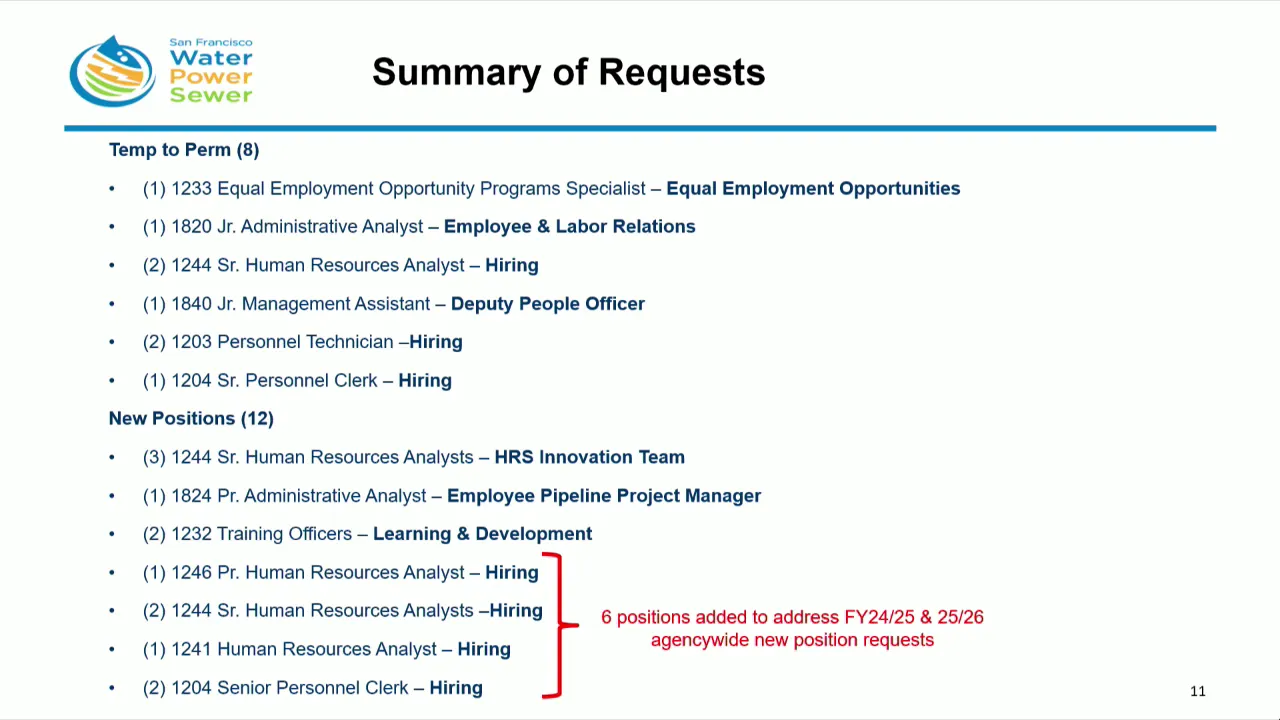
- Staffing: Requesting 171 new permanent positions, of which 87 are conversions of existing temporary staff to permanent. Net increase of 73 FTEs over two years, or about 2% net growth. Attrition savings increased from 11% to 15% to offset costs.
- Racial Equity: For the first time, the budget process included a racial equity lens: a scoring rubric of five questions applied to all budget proposals, led by Chief DEI Officer Dr. Christian Bijou.
- Commissioner Questions and Comments:
- President Paulson highlighted the importance of temp-to-permanent conversions and union jobs. Commissioner Ajami raised concerns about demand forecasting (decoupling rates, sensitivity analysis for lower consumption), the wastewater debt burden, and the need for innovation in rate design and enterprise synergy. Commissioner Maxwell questioned the rigor of the capital planning process and sought clarification on salary savings. Commissioner Stacy emphasized concerns about wastewater debt and declining usage.
2. Proposed Bureau Operating Budgets (Item 4)
- 4a. Business Services (Nancy Hom): Budget of $98.4 million. Largest driver is labor (IT and finance). Requesting 12 new positions (2 off-budget), 21 temp-to-permanent conversions, and 19 substitutions. IT budget includes $1.4 million in capital funding for cybersecurity and SCADA upgrades. Key new positions: senior data analysts for financial forecasting and grant support.
- 4b. External Affairs (Masood Ardakani): Budget of $11.5 million. No new positions; 14 temp-to-permanent conversions and several substitutions to align positions with actual duties. Focus on retaining communications, community benefits, and policy staff.
- 4c. Human Resource Services (Wendy Macy): Small budget increase. 4 net new positions (after offsetting attrition) including an HRS innovation team, two additional trainers, an apprenticeship pipeline coordinator, and a hiring analyst. Emphasized need to support agency-wide recruitment and retention, especially converting temps to permanent.
- 4d. General Manager (Dennis Herrera): Budget grows from $16.9 million to $18.5 million. Requesting 4 new positions: a data analyst and management assistant for racial equity, an innovations program director (to coordinate enterprise-wide innovation, technology, and partnerships), and a records retention manager (position unfilled for three years). Also two substitutions in real estate and emergency planning.
- 4e. Infrastructure (Stephen Robinson): Budget (overhead recovery) currently ~$100 million. Current vacancy rate 30.9%, but 63 positions are in active hiring, yielding a flexible vacancy of ~11%. Requesting 8 new positions and 29 substitutions to match capital plan demands. New positions include: contract support staff (admin analysts for online bidding), a program controls data analyst, an HR business partner, and a public information officer. Capital Planning Improvement Initiative (CPPI) has standardized processes and improved deliverability. Infrastructure recovers costs through an overhead multiplier of 2.79, competitive with industry.
- Commissioner Comments: Commissioners appreciated the emphasis on innovation, temp-to-permanent conversions, and the Capital Planning Improvement Initiative. Commissioner Maxwell asked about the meaning of "substitutions" and the risk of unmet goals. Commissioner Ajami urged using climate change as an overarching lens across all bureaus. Commissioner Stacy praised the focus on collaboration and learning.
Key Outcomes
- No formal decisions were taken on the budgets (discussion only). The commission will continue budget hearings on January 26 (Wastewater Enterprise), January 29 (Water Enterprise), and February 2 (Power Enterprise).
- Motion to continue the meeting to a special meeting on Friday, January 26, 2024, at 9:00 a.m. Passed on a unanimous roll-call vote (President Paulson, Commissioner Maxwell, Commissioner Ajami, Commissioner Stacy — all ayes).
- The commission's regular meeting is scheduled for January 23, 2024.
- Budget adoption is anticipated at the regular meeting on February 13, 2024.
Meeting Transcript
So the SFPUC Commission has called to order for the for the um budget hearings that we are starting here today at 9 o'clock. So could we have a roll call, please? President Paulson. Vice President Rivera. Here. Commissioner Jamy, she'll be here shortly. Commissioner Maxwell? Commissioner Stacy? Here. And you have a quorum. So before we call the first item, I'd like to announce that the San Francisco Public Utilities Commission acknowledges that it's own, owns and are stewards of the unceded lands located with the in the ethnohistoric territory of the Moleculalone tribe and other familiar descendants of the Federally Historic Recognized Mission San Jose Verona Band of Olamita County. The SFPUC also recognizes that every citizen residing within the Greater Bay Area has and continues to benefit from the use and occupation of the Molecula Alone tribe's aboriginal lands since before and after the San Francisco Public Utilities Commission's founding in 1932. It is vitally important that we are not only recognize the history of the tribal lands on which we reside, but also we acknowledge and honor the fact that the Molecula Ohlone people have established a working partnership with the SFPUC and our productive and flourishing members within the greater San Francisco Bay Area communities today. So as I said, we are here for the uh budget hearings, and so um can we have the first item? Item number three public hearing and discussion of the proposed budget proport pro budget priorities, administrative code section 3.3b, fiscal year 24-25, and fiscal year 25-26, SFPUC operating budget, tenure capital plan overview, and 10-year financial plan overview. Good morning, Commissioners. We're very pleased to be with you this morning to present our proposed budget for the next two fiscal years, fiscal year 2024-25 and fiscal year 25-26. I'm joined this morning by Nancy Haum, our Chief Financial Officer and Assistant General Manager for Business Services, Laura Bush, Deputy Chief Financial Officer and Aaron Corvinova, Financial Planning Director. We're going to walk you through our proposed two-year operating budget, two-year capital budget, ten-year capital plan, and our 10-year financial plan. As part of that, we'll lay out the priorities that guided our decision making and helped to shape these budget proposals. Next slide, please. Here's a quick overview of today's agenda. I'll be going over our budget priorities in just a few moments. But I'd like to note that this is a public hearing under Administrative Code Section 3.3B, and it provides the public an opportunity to hear about our proposed budget and weigh in on priorities. We'll then discuss our budget approach before going into more specifics about our operating budget, capital budget, ten-year financial plan, and debt outlook. This will be followed by operating budget presentations for our different bureaus. For reference, it's business services, external affairs, human resources services, my uh office and infrastructure will present their proposed budgets as well. Next slide, please. First, while I know you're familiar for the public, I think it's important to highlight what we do. The SFPUC is a not for private not-for-profit public utility that delivers high-quality drinking water to 2.7 million people in the Bay Area. Our sewers and wastewater treatment plans serve San Francisco and they are on the front line protecting public health and the health of the Bay and the Pacific Ocean. And we generate clean power and serve electricity to over 385,000 residential business and municipal customers in San Francisco. In fact, for our own power generation and the electricity procured through the Clean Power SF, we currently provide about 75% of the electricity that's used in San Francisco today. Next slide, please. Here you see a high-level overview map of our facilities that I know many of you have had the opportunity to visit. As you know, our operations span nearly the width of the entire state. We have more than 2300 employees operating from the Pacific Pacific Ocean to the high Sierra. They are as diverse in their backgrounds and life stories as they are in their skills. SFPUC workers are testing water quality, keeping branches away from power lines and upgrading wastewater treatment plants. They're answering questions from customers in their preferred language. They're providing rebates for water efficient washing machines, helping to train the utility workers of tomorrow and protecting the environment to benefit native species and their habitats. Next slide please we are determined and committed to continue our work building the utility of the future and that is reflected in our commitment to protecting the environment, serving as an economic engine and lifting up the diverse communities that we serve. You'll see that throughout this proposed budget. In our consultations we were guided in our work by three overarching priorities affordability, responsible management, and investing where it matters. As for affordability, the choices we made in putting together this budget were done with a keen eye toward how they would affect our customers. We prioritize keeping our rates competitive part of that meant improving how we plan for and fund our capital projects which is our biggest cost driver. Another critical component was the affordability policy that you adopted in November which established metrics to assist in evaluating the impact of operating and capital budget increases on future rates particularly for our most vulnerable residents. We also must be responsible stewards of the tremendous assets entrusted to our care. That means leading with integrity and transparency in our business decisions, meeting all of our regulatory requirements, maintaining our solid financial standing, completing smart and timely system maintenance to assure maximum benefits for ratepayers and investing in our workforce who are the ones who make it all happen. We also undertook a top to bottom review of our capital plan.
openpublica.com