SFPUC Special Budget Hearing on Wastewater Enterprise - January 26, 2024
STREAMING COPY IN PREPARATION — RECORDING AVAILABLE FROM THE ORIGINAL SOURCE
SFPUC Special Budget Hearing on Wastewater Enterprise - January 26, 2024
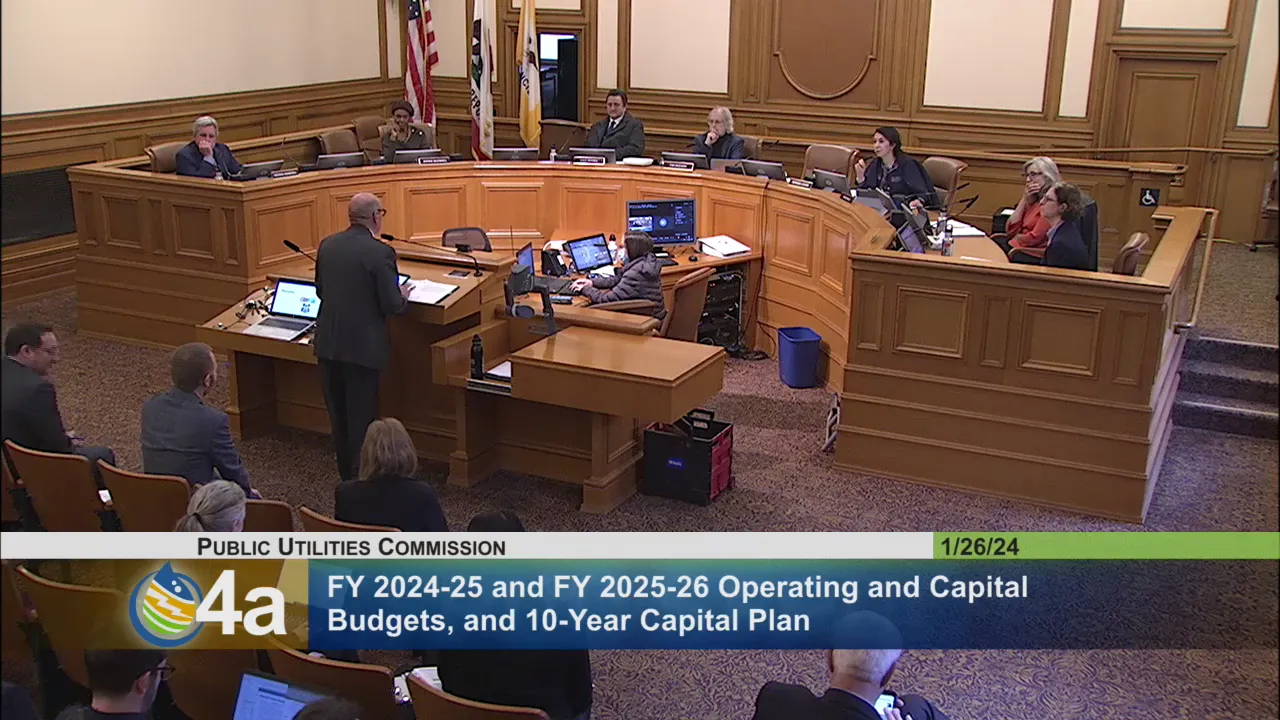
The San Francisco Public Utilities Commission held a special budget hearing on January 26, 2024, to discuss the proposed Wastewater Enterprise (WWE) operating and capital budgets for fiscal years 2024-25 and 2025-26, and the 10-year capital plan. Commissioners reviewed detailed proposals, heard public testimony, and voted to continue the meeting to January 29, 2024. No final budget approvals were made.
Public Comments & Testimony
- Jennifer Vataru (Marina resident): Expressed strong opposition to the closure of the Pierce Street Outfall, stating that its decommissioning caused sewage backups in October 2021 and December 2022, displacing her family and endangering the community. She called on the commission to add repair of the outfall to the current budget for health and safety. Staff clarified that the outfall closure was studied and was not found to be the cause of the flooding, but agreed to provide additional information to the commission.
Discussion Items
3. Summary of Budget Hearing Questions
- Commissioners acknowledged a thorough response to prior questions; no further discussion. Commissioner Stacey thanked staff for addressing concerns about the loss of a school program.
4. Proposed Bureau Operating Budgets for FY2024-25 and FY2025-26 (Wastewater Enterprise)
- Joel Prater (Acting WWE AGM) presented the $428 million budget growing 23% to $525 million over two years. Key drivers: debt service and capital projects. Proposed 10 new positions and 4 temp-to-perm transitions, with 28 substitutions to minimize costs.
- Operating budget requests included:
- 25% insurance cost increase (risk management).
- $1 million for UC Berkeley Center for Smart Infrastructure ($500K from WWE).
- Expansion of residential green infrastructure grant program (300 interested residents).
- New positions for green infrastructure maintenance, gardeners, operations (chemicals and sludge removal), collection system (asset management, laterals, pre-treatment), and lab (business analysts and chemists).
- Overtime budget increase to avoid mid-cycle supplements (requesting $600K for current year).
- Southeast Community Center: converting temp positions to permanent recreation facility assistants and adding admin support; continuing digital inclusion program funded by adbacks.
- Commissioner Ajami urged using climate change as a primary lens across all budget lines, not merely a bullet point. She stressed the need to aggregate climate-related costs and risks.
- Commissioner Maxwell questioned the green infrastructure pilot uptake and overtime policy.
- Commissioner Stacey praised materials and endorsed the smart infrastructure investment, racial equity in hiring (e.g., eliminating unnecessary education requirements for community center roles), and requested updates on sedimentation studies.
- Commissioner Rivera supported the green infrastructure program and asked about potential resident engagement growth.
4. Capital Budget Presentation
- WWE presented a 10-year capital plan driven by operational reliability, seismic resilience, safety, and stormwater management (1.3 inches / 5-year storm).
- Major projects:
- Biosolids Digester (BDFP): $2.6B total, 45% complete, cost increases from single bidders and material costs.
- Folsom Stormwater: $430M total, to upgrade combined sewer in Mission District (flood mitigation).
- Lower Alemany: $300M pipe project (mandated by regional board after green infrastructure alternative rejected due to timeline).
- Nutrient Removal: $1.47B placeholder; planning to begin now, with pilot side-stream treatment underway.
- Southeast Outfall Replacement: $2.9B (mostly beyond 10-year plan), $80M in 10-year plan for planning/env review. Staff noted complexity due to multiple jurisdictions and potential alignment with waterfront adaptation.
- Green Infrastructure: $100M capital plan shift to performance-based approach, targeting 65 acres of drainage management in 10 years.
- Commissioners raised concerns about integration of nutrient removal and outfall projects, regional collaboration (e.g., with water agencies on recycled water), and long-term affordability. Finance staff mentioned seeking federal grants to offset ratepayer burden.
- Commissioner Ajami expressed disappointment that the regional board forced a pipe over green infrastructure for Alemany, but praised interagency collaboration (MTA, SFUSD, Rec Park).
- Commissioner Maxwell asked if nutrient removal could include recycled water production; staff noted this will be evaluated during planning.
- Commissioner Stacey highlighted the complexity of the Southeast Outfall and the importance of recycling for bay health.
Key Outcomes
- No votes on budget items were taken; the hearing was purely informational and for public input.
- Motion to continue the meeting to Monday, January 29, 2024, was approved unanimously (5 ayes).
- Staff agreed to provide the commission with additional information on the Pierce Street Outfall closure rationale and potential budget implications.
Meeting Transcript
Meeting is called to order. This is a continuation of the budget hearings. Roll call, please. President Paulson. Here. Vice President Rivera. Here. Commissioner Jamy. Here. Commissioner Maxwell. Commissioner Stacey. Here. You have a quorum. Thank you. I'd like to announce that the San Francisco Public Utilities Commission acknowledges that it owns and are stewards of the unceded lands located within the ethnohistoric territory of the Moekla Ohlone tribe and other familiar descendants of the historic federally recognized Mission San Jose Verona Band of Alameda County. The SFPUC also recognizes that every citizen residing within the Greater Bay Area has and continues to benefit from the use and occupation of the Moequa Ohlone tribe's aboriginal lands since before and after the San Francisco Public Utilities Commission's founding in 1932. It is vitally important that we not only recognize the history of the tribal lands on which we reside, but also we acknowledge and honor the fact that the Molecula Ohlone people have established a working partnership with the SFPUC and our productive and flourishing members within the greater San Francisco Bay Area communities today. There was an omission of reporting following the closed session. So I'd like to announce right now that the commission recommends that the Board of Supervisors approve the settlements referenced in agenda items number six. Excuse me, 16 and 17 on the January 23rd agenda. So can we call the first and um only uh item? Uh well item number three is a summary of the budget hearing questions. Um and we will so we will introduce um can we have self-introductions? Let's start that way. I'm sorry, uh Mr. President. Uh the summary of budget hearing questions was distributed uh uh for discussion if the commission has any questions, or we can move on to item number four, which is the wastewater enterprise. Got it. So so uh commissioners, are there any discussions or questions? Okay, and then we will read it. I do I just wanted to say thank you for answering the question very thoroughly. I have been concerned about the loss of the school program, and it was uh your response was very helpful. So thank you. Thank you, Commissioner Stacy. Are there any other questions or comments? Items okay. Let's go to the next item. Item four is a wastewater enterprise fiscal year 20 okay. Fiscal year 2425 and fiscal year 25-26 operating and capital budgets and 10-year capital plan. Good morning, Commissioners. Uh, I'm Joel Prater. I am the acting uh wastewater AGM. Can I have the slides, please? So we'll go over a quick agenda for today's presentation. Uh we'll have an organizational overview, um, go over our operating budget requests, our capital budget planning, and then a QA session at the end. Overview of our system. Uh we operate and maintain three wastewater treatment plants, one wet weather facility, 28 individual pump stations, 1,900 miles of sewers, and mains and laterals, and 216 and growing green infrastructure assets. We maintain 25,000 catch basins um to protect the health and public health and the environment, and then WD processes approximately 60 million gallons per day of rail weather flows, and we have a maximum capacity of 565 million gallons a day. Our budget is divided up into a few different divisions. Um we have some managers here today to represent those divisions.
openpublica.com