SFPUC Special Meeting on Water Enterprise and Hetch Hetchy Budgets - January 29, 2024
STREAMING COPY IN PREPARATION — RECORDING AVAILABLE FROM THE ORIGINAL SOURCE
SFPUC Special Meeting on FY 2024-26 Budgets and 10-Year Capital Plan
On January 29, 2024, the San Francisco Public Utilities Commission held a special meeting to review the Water Enterprise and Hetch Hetchy Water operating and capital budgets for fiscal years 2024-25 and 2025-26, along with the 10-year capital plan. The meeting began with a land acknowledgment and roll call establishing a quorum. No new budget hearing questions were presented. The bulk of the meeting was a presentation by Assistant General Manager Steve Ritchie, followed by commissioner questions and public comment. The meeting concluded with a unanimous vote to continue the budget discussion to a special meeting on February 2, 2024.
Public Comments & Testimony
- Nicole Sandkulla (Bay Area Water Supply and Conservation Agency – BAWSCA): Expressed support for the proposed budgets and 10-year CIP. Highlighted concerns about project delivery delays due to staffing, requested closer involvement in the PUC's capital planning improvements initiative, suggested including delivery metrics for commission tracking, and recommended that the PUC proactively document its history of funding the first two years of the CIP with past appropriations to avoid public perception of inability to deliver. Also noted that BAWSCA's demand projections differ from the PUC's financial planning assumptions, urging clarity on the purpose of each.
Discussion Items
- Water Enterprise Operating Budget Overview (FY 2024-26): The total water budget is projected to grow from $674.5 million in FY 2023-24 to $765.5 million by FY 2025-26, driven primarily by capital improvements. Key operating requests include:
- Conversion of 12 temporary positions to permanent for staff stability.
- Three new positions for lead-in-school monitoring (new state regulations requiring sampling at over 200 San Francisco schools).
- Two positions for enforcing new hydrant meter regulations to address abuse.
- Staffing for the Alameda Creek Watershed Center and native plant nursery.
- Moving alternative water supply program staff from temporary to permanent.
- $1.5 million increase for treatment chemicals (sodium hypochlorite) due to nationwide supply chain volatility.
- Funding for equipment and fleet modernization (including electric vehicle conversion).
- Programmatic requests shifted from capital to operating budget, netting a slight decrease.
- Hetch Hetchy Water Operating Budget: Growth similarly driven by capital projects, increasing from $95 million in FY 2023-24 to $116 million in FY 2025-26. Highlights include:
- Temporary-to-permanent conversions (4 positions) and one new position for a Native American Cultural Resources Management Program to improve tribal relations in the Sierra region.
- $2+ million for environmental review of O'Shaughnessy Dam in-stream flow management plan (in collaboration with National Park Service).
- Increases for MOAs with National Park Service, Turlock, and Modesto Irrigation Districts for Don Pedro relicensing and habitat improvement.
- WECC/NERC compliance upgrades for power infrastructure.
- Water Enterprise Capital Programs (10-Year Plan): Three separate programs totaling $3 billion (local water $1.3B, regional water $1.6B, Hetch Hetchy water $1.5B). Key projects:
- Local: $604 million for main replacement (including 2000 Marin headquarters construction starting August 2024, $400M project); lead service line replacement program.
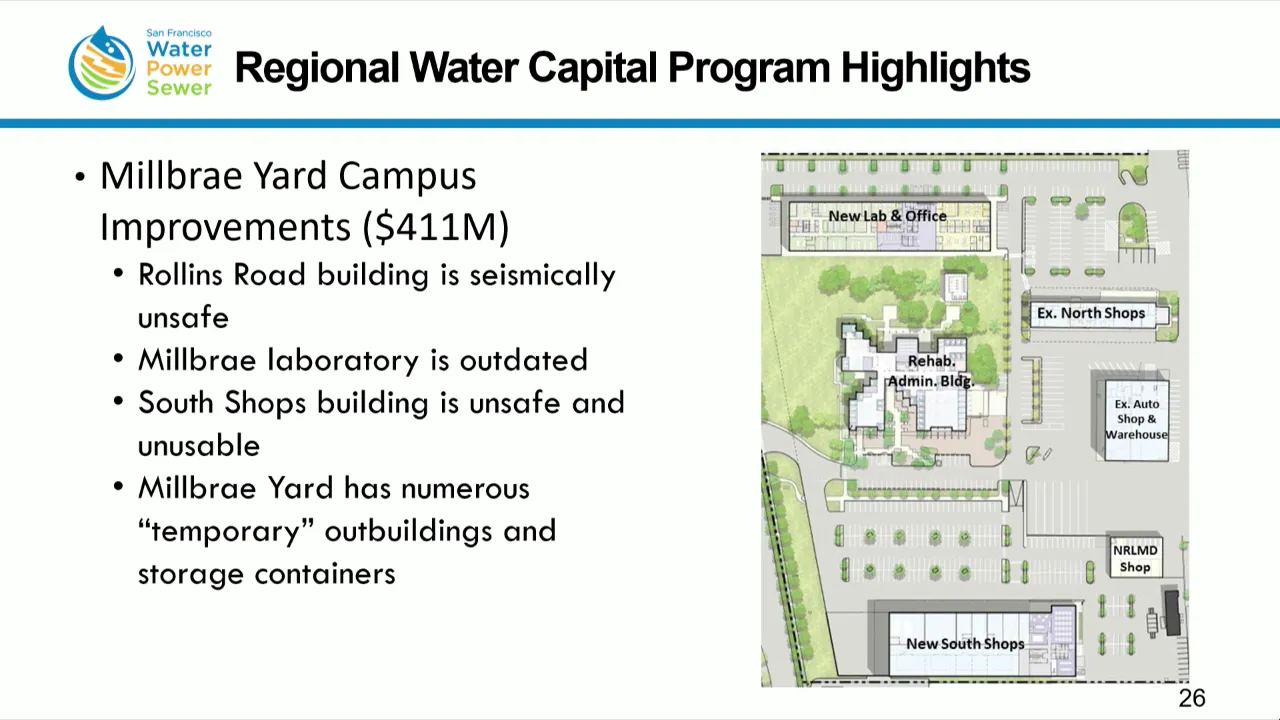
- Regional: Millbrae Yard campus improvements ($411M) including new lab and office, shops relocation; Snow Valley Water Treatment Plant ozone project ($175M); five major transmission main projects ($196M) to replace aging prestressed concrete cylinder pipe; Los Vaqueros Reservoir Expansion (institutionally complex, with decision pending); four purified water projects (including partnerships with San Mateo, Alameda County, San Jose/Santa Clara, and a San Francisco project coordinated with Wastewater Enterprise).
- Hetch Hetchy: Moccasin Penstocks replacement project ($322M, 100-year-old pipelines, leading option is deep shaft and tunnel); Mountain Tunnel improvements; Moccasin Powerhouse generator replacements; San Joaquin Pipeline valve and safety projects; transmission line clearance mitigation.
- Commissioner Questions and Feedback:
- Commissioner Ajami: Inquired about systematic approach to future contaminant monitoring; chemical cost volatility and implications for alternative water supplies; drought response staffing (half FTE for outreach, now ended); and Native American cultural resources position hiring strategy. Also asked about alignment of recycled water staffing between Water and Wastewater enterprises.
- Commissioner Maxwell: Stressed hiring a Native American person for the cultural resources position. Questioned the correlation between 23% vacancy rate and contracting out; requested further information on contract vs. in-house workforce. Sought details on affordability as a service goal (noted under sustainability). Asked about youth programs ($1.3M contribution) and wanted to ensure racial equity is explicitly addressed. Inquired about innovative features of the 2000 Marin project (community layout, solar, hydrogen readiness).
- Commissioner Rivera: Supported youth employment and requested a presentation on PUC youth programs. Suggested including a hydrogen fueling station in new facilities, noting successful city-run stations.
- Commissioner Stacy: Emphasized collaboration and overlap among divisions, particularly asset management. Asked about classification of operating vs. project positions; clarification on programmatic requests (shift from capital to operating budget); Treasure Island position reduction (system transfer); and landscape conservation program (grant reduction). Noted that WECC/NERC compliance items appear in Hetch Hetchy water budget but are power-funded.
- President Paulson: Thanked staff for the comprehensive presentation. Highlighted the importance of investing in aging infrastructure (e.g., penstocks, tunnels). Requested a tour of Alameda Creek Watershed Center and Pillar Citos facilities. Wanted to understand how contract vs. in-house decisions are made. Asked about institutionalized coordination with MTA/Public Works for joint transit projects (response described monthly meetings and successful examples like Taraval and Geary).
Key Outcomes
- The commission took no vote on the budgets at this meeting; discussion will continue.
- A motion to continue the meeting to a special session on Friday, February 2, 2024, at 9:00 AM in Room 416 was moved, seconded, and approved unanimously (5-0).
Meeting Transcript
A roll call, please. President Paulson. I here. Vice President Rivera. Here. Commissioner Jeremy. Here. Commissioner Maxwell? Commissioner Stacy? Here. You have a quorum. Thank you. So before calling, um, the first item I'd like to announce that the San Francisco Public Utilities Commission acknowledged that it owns and are stewards of the unceded lands located within the ethnohistoric territory of the Moequa Alone tribe and other familiar descendants of the historically federally recognized Mission San Jose Verona Band of Alameda County. Excuse me. The SFPUC also recognizes that every citizen residing within the Greater Bay Area has and continues to benefit from the use and occupation of the Molequa Ohlone tribes aboriginal lands since before and after the San Francisco Public Utilities Commission's founding in 1932. It is vitally important that we not only recognize the history of the tribal lands on which we reside, but also we acknowledge and honor the fact that the Mullah Alone people have established a working partnership with the SFPUC and are productive and flourishing members of the Greater San Francisco Bay Area communities today. So uh Donna, can you read the first uh item? Item number three, the summary of the budget hearing questions. So are there any new summaries or questions that have come in or that we have since last Friday's meeting? No, there are no no update at this meeting. Okay, so let's get in. Seeing none um getting into the meet. Um, can we call item four? Item four is a water enterprise and Hetchichi Water, fiscal year 2024, 25 and fiscal year 25-26 operating in capital budgets and tenure capital plan. Welcome, Mr. Ritchie. Uh good morning, Commissioners. Steve Ritchie, Assistant General Manager for Water. Um, and I'm happy to present on our biennial budget uh for the next two years. If I can have the slides, please. So I always have uh a couple of reminder slides up front, again pointing out that uh our water system really does span the width of California, so it's uh it's a much bigger deal than uh uh other things that that you've heard. Uh this is the third largest water utility in California, so it's uh uh a major, major part of the state's water infrastructure. Um and we have customers that are outside of San Francisco, uh but San Francisco is shown here. Our water system customers include San Francisco, most of San Mateo County, uh, the northern part of Santa Clara County, and up into uh Alameda County. Uh and just for reference here, the darker the blue, the greater the percent that that community relies on San Francisco for its water forests. So, for example, Hayward is the darkest blue because they are 100 percent of the San Francisco customer, and just south of there is the Alameda County Water District, which actually only relies for about 20 percent on us, except when the State Water Project can't supply them, and then they come back to us looking for more water. So it's uh we are a more reliable supply than the State Water Project. Um this is the more routine map uh that we show of the system, a schematic uh that includes the major elements, our three reservoirs uh in the Sierra, uh Lake Lloyd and Lake Eleanor and Hatchetti Reservoir, uh, and then the tunnels uh and facilities coming down from that, the powerhouses uh and operating reservoirs, then crossing the San Joaquin Valley for uh again ultraviolet treatment uh that provides the treatment for our Hetchetse supply that is so pure, it does not need to be filtered uh then crossing through the Coast Range Tunnel where it is joined by water from the two uh Alameda County, Santa Clara County reservoirs, uh San Antonio and Calaveras, uh, and then again through the uh Irvington tunnels to get into the Bay Area proper. And then you see the the gold area is our service area, um, and then there are the three uh uh peninsula reservoirs, Crystal Springs, Pilarcitos, and San Andreas. Uh so we have those eight major water supply reservoirs in our system. Uh and just one note about them is these are all very old dams. The oldest dam in the system is Pillar Citos, which was constructed in 1866, uh, and except for the newly rebuilt Calaveras Dam. The youngest dam in the system is Turner Dam at San Antonio Reservoir, which was constructed in 1964. So that 1964 dam, which is already 59 years old, is the youngest dam in the system. So it's a very old system, and that's part of what we're talking about here in the budget is we have a lot of ongoing repair that needs to be done there. Uh and one other key thing about this is that uh our system is really storage reliant more than anything else. And this is mostly driven by our water rights and how they've developed over time and the fact that we are junior to uh the irrigation districts uh on the Tuomney River. But that uh that uh large amount of storage is really an advantage for us, and I know we started to talk about climate change a fair amount. That amount of storage is really helpful for us because uh it is in addition to the snowpack. So, as snowpack might be down at different times, uh, we have the ability to capture water that is precipitation as rain or carry over precipitation from prior years.
openpublica.com