SFPUC Special Meeting on Power Enterprise & CleanPowerSF Budgets – February 2, 2024
STREAMING COPY IN PREPARATION — RECORDING AVAILABLE FROM THE ORIGINAL SOURCE
SFPUC Special Meeting on Power Enterprise & CleanPowerSF Budgets – February 2, 2024
The San Francisco Public Utilities Commission held a special budget hearing on February 2, 2024, to review the Power Enterprise and CleanPowerSF fiscal year 2024-25 and 2025-26 operating and capital budgets, as well as the 10-year capital plan. The meeting included a response to a prior commissioner's question on contracting out, a detailed presentation by Assistant General Manager Barbara Hale, and extensive commissioner discussion on workforce vacancies, recruitment challenges, climate adaptation, and major capital projects.
Summary of Budget Hearing Questions (Item 3)
- General Manager Dennis Herrera addressed Commissioner Maxwell's prior question about the correlation between contracting out and staff vacancies. He stated there is no correlation and that consultants augment staff only for specific approved reasons under a documented procedure with union notice and civil service oversight. He provided ratios: professional services contracts to PUC staff are 13% for water, 7% for wastewater, and 9% for power. Of these, only a very small fraction replace vacant positions: 9 staff in wastewater (5 in collections, 4 in planning), 4 in power (high voltage crew, not professional services), and 34 in water (6 in city distribution, 28 at Hetch Hetchy Water and Power). Commissioner Maxwell expressed appreciation for the clarification.
Discussion Items – Power Enterprise & CleanPowerSF Budgets
Overview and Context
- Barbara Hale, Assistant General Manager for Power, introduced the organizational structure and noted that Power Enterprise operates two retail electric programs: Hetchy Power (publicly owned, serving about 6,300 accounts, mostly city departments) and CleanPowerSF (community choice aggregation, serving about 380,000 accounts). Together they serve 75% of electricity consumed in San Francisco. The Hetchy Power budget is approximately $220 million and CleanPowerSF about $370 million in the current year.
- She highlighted savings to customers: Hetchy Power saved city departments over $50 million in FY2023-24 and other customers over $70 million, while CleanPowerSF saved residents and businesses more than $50 million in calendar year 2023, relative to PG&E rates.
- Total proposed PUC operating budget is $2 billion (FY24-25) and $2.1 billion (FY25-26), with Power ratepayers funding $623 million and $658 million respectively (about 31% of the agency total).
Budget Drivers and Position Requests
- The primary cost driver is the purchase of power and delivery costs, which have increased steeply since 2020 due to higher wholesale energy prices and increased customer demand.
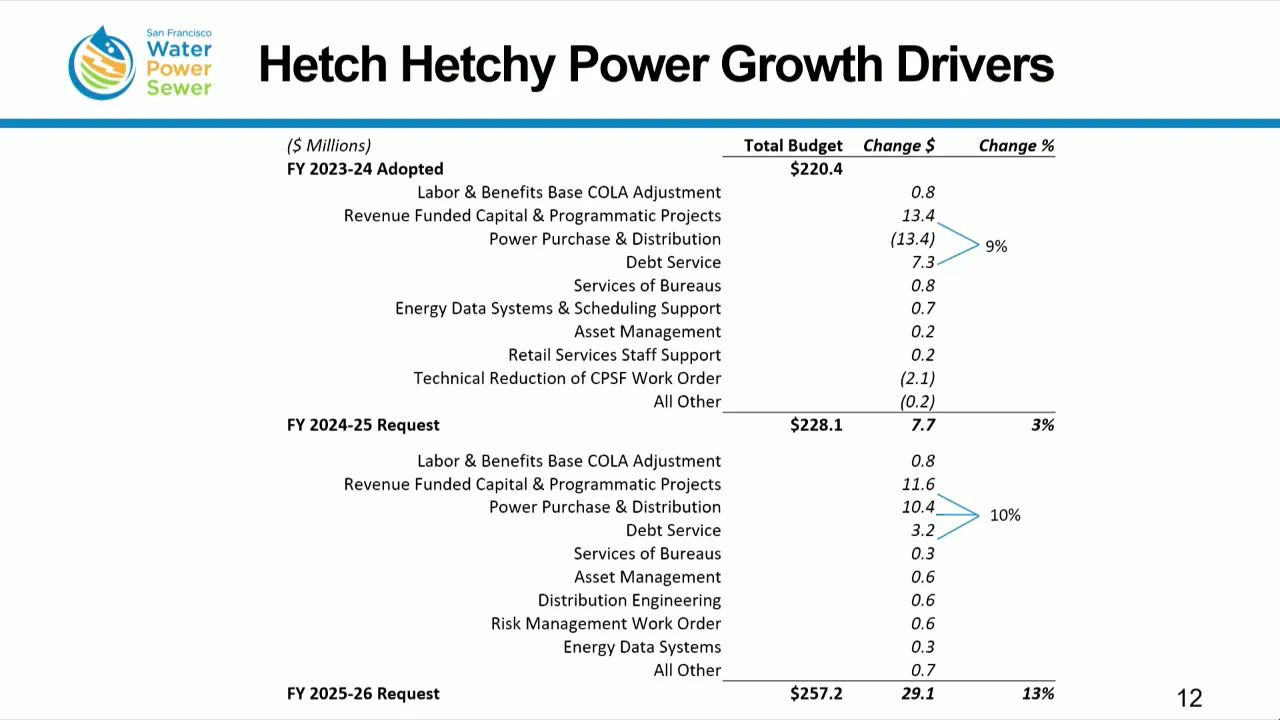
- For Hetchy Power, the proposed operating budget grows 3% in FY24-25 and 13% in FY25-26, driven by capital needs, debt service, and increased power purchase/distribution costs. Staffing requests: 17 new positions and 9 temporary-to-permanent conversions over two years.
- For CleanPowerSF, the budget grows 22% in FY24-25 (driven by power purchases) and 1% in FY25-26. Staffing requests: 5 new positions and 7 temporary-to-permanent conversions.
- Commissioner Maxwell noted the current vacancy rates: 27.4% for Hetchy Power and 14.6% for CleanPowerSF as of December 2023. Hale explained recruitment challenges for specialized classifications (e.g., high-voltage line workers, utility specialists) and competition from other utilities and CCAs.
Commissioner Questions on Communications and Adaptation
- Commissioners urged better public communication of the PUC's services and savings, suggesting ongoing advertising rather than only during crises. Commissioner Jamy proposed dedicating budget resources to continuous communication. General Manager Herrera noted the agency is already expanding outreach but would consider the suggestion.
- Commissioner Jamy also emphasized the need for intentional climate adaptation planning, noting that resilience (e.g., insurance costs, load management, workforce) affects all pillars. He encouraged cross-enterprise collaboration on adaptation and urged the power team to explicitly link budget items to adaptation efforts.
Capital Projects (Hetchy Power and CleanPowerSF)
- The Hetchy Power 10-year capital plan totals $1.2 billion, with major projects:
- SFO Substation Improvements: Increased scope to support airport electrification and decarbonization.
- Carbon Free Steam Project (Cordia): Partnering with Cordia (the district steam franchisee) to electrify steam generation. Cordia would become a Hetchy Power customer, supporting San Francisco's climate action plan. The PUC would build transmission connections.
- Port of San Francisco Electrification: Over 80 megawatts of new load expected; funding for transmission to serve ferry electrification and port growth.
- Redevelopment Projects: Funding for electrical duct banks serving large developments (e.g., Mission Rock, Pier 70, Parkmerced, Balboa Reservoir).
- Reliability and Continuity: Improvements to Treasure Island switchyard (remote monitoring, generator connections) and Bay Corridor transmission.
- Streetlight Repair and Enhancement: Covers about 25,500 streetlights, including LED conversions and pole assessments.
- Public Power Expansion: Continuing efforts to acquire PG&E's San Francisco grid; funding for planning, CPUC valuation, and CEQA environmental impact report.
- Municipal Solar and Energy Efficiency: $40 million for rooftop solar and efficiency at municipal facilities.
- The CleanPowerSF 10-year capital plan totals $48 million, funding larger-scale renewables and battery storage, including solar on water reservoirs.
Cordia Franchise and Treasure Island Updates
- Commissioner Maxwell asked about the franchise agreement with Cordia. General Manager Herrera and Ron Flynn explained that the franchise is granted by the Board of Supervisors, allowing use of public rights-of-way in exchange for a share of revenues. The PUC assists the Controller's office in auditing remittances.
- Commissioner Rivera requested an update on Treasure Island power reliability. Hale acknowledged ongoing outages but said connecting legacy customers to new switchgear and funding remote monitoring should improve reliability. She committed to providing a timeline in writing after consulting with TIDA.
Key Outcomes
- Commissioners received the budget presentations and provided substantial feedback and questions. No formal votes were taken at this special meeting; it was a workshop to inform the final budget proposal.
- The next regularly scheduled meeting is in two weeks (week of February 12, 2024). General Manager Herrera noted that commissioner comments would be incorporated into the budget planning document for future consideration.
- No public comments were offered.
Meeting Transcript
Commission is called to order. This is the uh last of the meetings of the last and continuation of the la of the uh budget hearing. Um so can we have a roll call, please? President Paulson. Here. Vice President Rivera. Commissioner Jamy. Yeah. Commissioner Maxwell. Commissioner Stacy? Here. You have a quorum. All present. Okay. So I'd like to announce that the San Francisco Public Utilities Commission acknowledges that it owns and are stewards of the unceded lands located within the ethno historic territory of the Moekla Olonee tribe and other familiar descendants of the historically federally recognized Mission San Jose Verona Band of Alameda County. The SFPUC also recognizes that every citizen residing within the Greater Bay Area has and continues to benefit from the use and occupation of the Muekla Wellone tribe's aboriginal lands since before and after the San Francisco Public Utilities Commission's founding in 1932. It is vitally important that we not only recognize the history of the tribal lands on which we reside, but also we acknowledge and honor the fact that the Mooleca Aloney people have established a working partnership with the SFPUC and our productive and flourishing members within the many grade area San Francisco Bay Area communities today. So let's call the first item number three, which is a summary of the budget hearings. And if there are any questions. Donna, can you read it officially? Yes, item number three is a summary of budget hearing questions. Okay. Madam Secretary, um, there was one question that came up uh last week uh last meeting from um Commissioner Maxwell that I wanted to address, and it had to deal with the issue of um contracting out and correlation of um uh staff vacancies. Um I just want to make clear that there is no correlation between contracting out and staff vacancies. Consultants are not replacing silver service staff, but are at most augmenting PUC staffing and only for specific approved reasons. To receive an exception to the general rule that services are to be provided by employees, there are specific specific criteria that are applied. A documented procedure, notice to our labor partners and oversight by the city's civil service commission. Anyone looking to contract work out must answer whether civil service classes can perform the work. Reasons to allow generally fall into three categories. Number one, immediate needs and emergencies to address unanticipated or transitional situations or emergency situations, two, short-term or capital projects for projects requiring diverse skills, expertise or knowledge, and three, as needed, intermittent or periodic services when services are required sporadically or during peaks in workload. With the exception of infrastructure, which, due to the nature of its work, uses many professional services contracts. The amount of contracts in the agency is very small. Looking at the ratio of professional service, this is consultants to PUC staff, is about 13 percent for the water enterprise, 7 percent for wastewater, and 9 percent for power. Infrastructure has a clear process to work through contracting needs to ensure that the SFPUC gets the expertise it needs to deliver on its projects, but still ensures city workers perform as much work as possible. Of those, only a very small fraction of these are actually doing work that city staff could do, but we contract out due to vacancies. For wastewater, it's nine staff, five of which are in the collections systems division, and four in the planning and regulatory compliance division. For power, it's four staff, which forms a high voltage crew, not a professional services contract. And for water, it's 34, six of which are at uh uh city distribution division, and 28 are at Hetchethi Water and Power. Bottom line, there is a process, very well defined and public, with notice to our labor partners, and our numbers show that it is used very sparingly. The contract, the contract form is posted for all union classifications related to the scope of work, and unions have an opportunity to review and object to the posted form. So I know that we have uh Wendy Macy, our Chief People Officer here to answer any questions, but I wanted to make sure that we answered that question about correlation up front so that we could uh ensure that um you were confident that most of the work being done here is being done by our city staff. Thank you, Mr. Herrero, for that clarification and for the fast answer and uh Commissioner Maxwell uh comment. I know that you had initiated that uh question. Yes. Thank you, and I'm glad to hear it. And I am also, and again, thank you for um responding so quickly. I know that uh as I was coming up here today, it's it's clear that uh the entire city coalition from all departments, you know, all city employees are in bargaining right now as we speak. And I know that the issue is that people are uh very always very nervous that you know you know with layoffs and budget crunches that people are going to get squeezed out, and it's glad to be reminded that this city does have a policy about contracting out. It's very specific in which city workers I prioritize.
openpublica.com