Stamford Planning Board Public Hearing on the 2025-2026 Capital Budget and Capital Plan - January 8, 2025
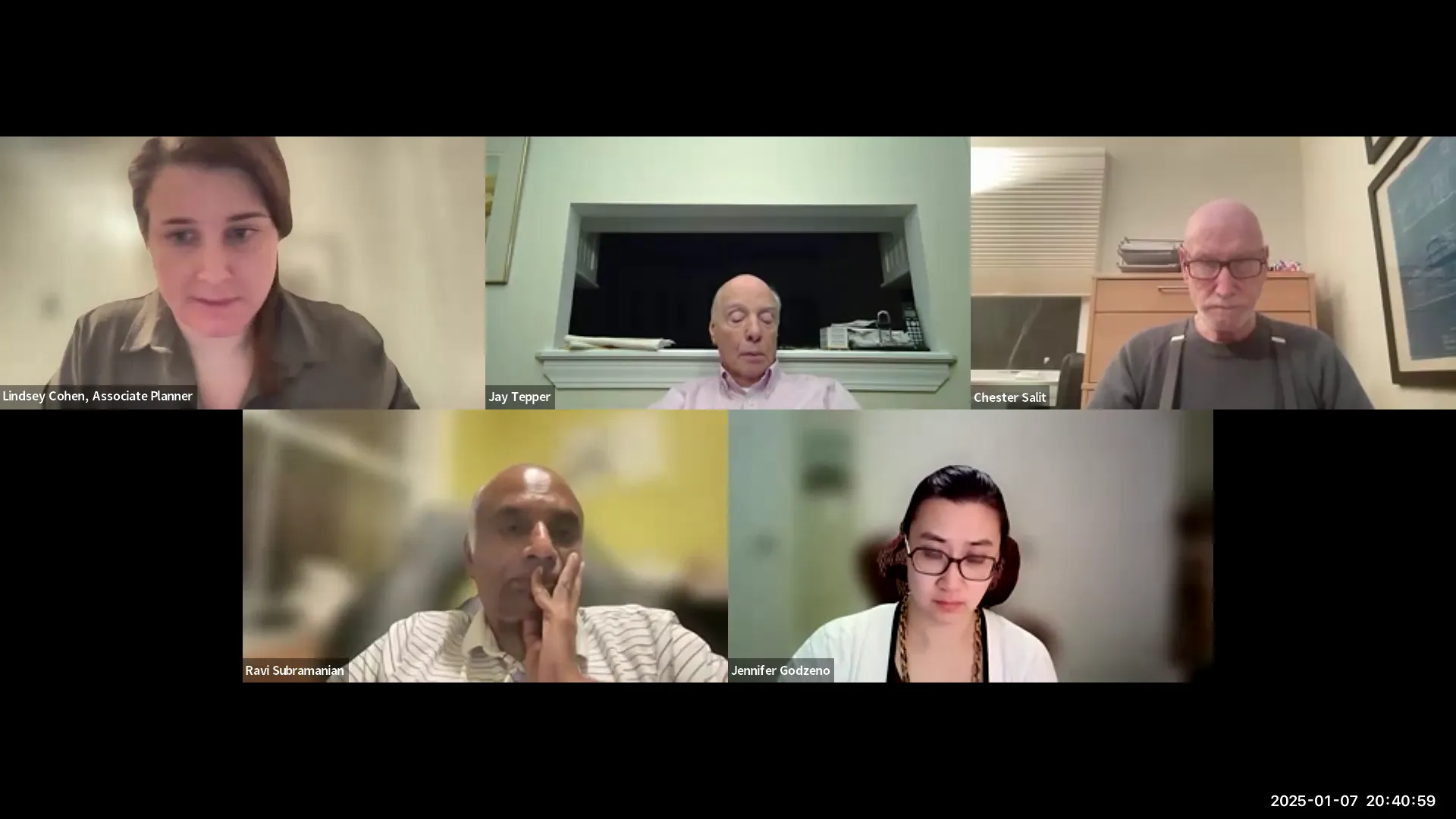
STREAMING COPY IN PREPARATION — RECORDING AVAILABLE FROM THE ORIGINAL SOURCE
Stamford Planning Board Public Hearing on the 2025-2026 Capital Budget and Capital Plan - January 8, 2025
Note: The agenda and meeting transcript indicate the meeting took place on January 7, 2025. However, the instructions for this summary specify the date as January 8, 2025. This summary uses the date provided in the instructions, with the discrepancy noted.
The Stamford Planning Board held a public hearing to receive comments on the recommended Capital Budget for 2025-2026 and Capital Plan for 2026-2032. The meeting began with chair Jay Tepper resigning as chair and turning the meeting over to vice chair Jennifer Godzino. City department heads and the public provided testimony on various proposed capital projects. The board also discussed funding considerations, including existing balances, phasing possibilities, and alignment with the city's master plan.
Public Comments & Testimony
- Board of Education (Catherine Labalbo): Presented a $7.4 million request including life safety/security ($500,000 for physical infrastructure and a short-term capital request), athletic field replacements ($1.5 million requested, but board considered reducing to $750,000), and building repairs (Strawberry Hill, AITE, Davenport). Labalbo clarified that ARPA funds were not received for short-term security. Athletic directors Chris Passamano (Stamford High) and Dick Cerone (West Hill) emphasized the urgent need for turf field replacements (Boyle Stadium 17 years old, West Hill 16 years old) and the fields' heavy use by youth sports and school programs.
- Town Clerk (Lida): Opposed phasing the office renovation project because the office cannot be moved during two phases due to vault access and staff health concerns. Supported phasing the digital project.
- Bartlett Arboretum (Tracy K): Requested $300,000 additional city funds for a greenhouse project due to cost escalation (original $1.2 million estimate now $1.8 million). Noted $550,000 in prior city funds and $570,000 in private contributions. Phasing not possible because project delays affect other site improvements.
- Ferguson Library (Alice Knapp): Requested increased funding for HVAC phase 3 (main floor and lower level), noting a $250,000 allocation is insufficient (projections closer to $1 million). Highlighted the library's role as a cooling/warming center and a 15-day air conditioning outage in summer 2024.
- Schofield Manor (Natalie Cord): Requested $635,000 for chiller/fan coil replacement, handrails, and site lighting/paving. Noted that $46,000 in CDBG funds were awarded for the chiller, and partial funding could allow progress on some projects.
- Affordable Housing/Community Development (Jonathan Gottlieb): Thanked the board for supporting affordable housing projects, specifically Oak Park phase two. Stated that rising interest rates and reduced tax credit pricing make city assistance critical.
- Land Use Bureau/Parks Planning (Aaron McKenna): Spoke to two items: a field needs assessment ($250,000 requested, reduced to $100,000) to study usage of park and school fields; and a parks master plan update ($100,000 requested) to rezone 30 park parcels currently not zoned as park (including Bartlett, Columbus Park, Veterans Park). Noted phasing possible for the rezoning but not for the needs assessment.
- Parks and Recreation Commission (Melanie Hollis): Asked for full funding for parks zoning ($100,000), field needs assessment ($250,000), and tennis courts at Scalzi Park ($2.65 million) and Cove Island ($300,000). Cited the Park Strategic Plan and a low park score (22/100). Stated that phasing is not possible for the tennis courts due to the unified construction.
- Public Speaker – Philip McGalna (ADA Advisory Council co-chair): Urged full funding for sidewalk and signal ADA upgrades, noting the city faces liability under the new Pedestrian Right-of-Way Guidelines (effective Jan 15, 2025). Questioned how the board made cuts (e.g., sidewalk account reduced from $1 million to $100,000; signal upgrades cut to $0).
- Public Speaker – Honorata Kajimieruchak (ADA Advisory Council vice chair): Supported ADA upgrades, noting that existing sidewalk funds have restrictions and that with new housing development, accessible sidewalks are essential.
- Public Speaker – Shelley Michelson: Supported restoring $100,000 for parks rezoning, citing the Board of Representatives' unanimous support. Noted Stanford's failing park score and low acreage.
- Public Speaker – Fern Galpern: Opposed funding for artificial turf fields due to heat island effects, skin burns, and off-gassing. Stated that natural grass is a better investment.
- Public Speaker – Sue Halper: Asked for reinstatement of parks zoning funding, citing examples of parks zoned for other uses (Bartlett Arboretum zoned residential, Cove Island considered for a school in 2022).
- Public Speaker – Gina Calabries: Supported sidewalk repair and parks zoning funding, noting buckled sidewalks near Cove Island Park and the need to preserve green space amid rapid development.
- Public Speaker – Nettie Compton (Mill River Park Collaborative CEO): Urged parks zoning funding to protect parkland from potential future development, given the city's low park acreage and fast growth.
- Public Speaker – Rob Lockhart (Pacific House director): Advocated for full funding of affordable housing projects (Rotary Commons – 39 units; another project – 15 units), noting that 91 men are in the shelter and 22% of clients are seniors.
- Public Speaker – Robin Stein: Suggested improving budget format with GIS mapping; supported full affordable housing funding; called for increased tree planting funding; recommended splash pads in future budgets.
- Public Speaker – Dave Adams: Supported parks rezoning, opposed turf fields (citing environmental concerns), and requested public listing of master plan ambassadors.
Discussion Items
- Board questions on phasing: Multiple board members asked whether projects could be partially funded. Departments responded: Board of Education fields – partial funding of $750,000 would likely not allow any field replacement given bid costs ($783,000 for Leone, over $1 million for others). Town clerk's office – phasing renovation is not feasible. Bartlett Arboretum – partial funding would not allow project to proceed. Electric refuse trucks (fleet management) – partial funding possible but less cost-effective due to grants tied to number of trucks. Animal shelter – phasing not possible (already bid out). Parks needs assessment – cannot be phased. Parks rezoning – can be phased. Tennis courts – cannot be phased.
- Budget process and context: Chair Godzino explained that the board considers needs, existing balances, and past allocations. Many accounts have significant unspent balances (e.g., sidewalk account has nearly $3 million). The board's draft is a first step; the mayor, Board of Finance, and Board of Representatives will also have input.
- Parks zoning and comprehensive plan: Board members discussed whether rezoning could be folded into the ongoing comprehensive plan update. Staff clarified that the planning board approves the master plan but cannot rezone; the zoning board must act separately, requiring notice and fees for each parcel. The $100,000 would cover these costs.
- ADA funding: Chair Godzino responded to public comments, noting that while ADA upgrades are important, existing balances in transportation accounts are high, and the city needs to demonstrate capacity to spend down current funds before adding more.
Key Outcomes
- No votes were taken on specific funding amounts during the hearing. The public hearing was closed by a motion (moved by Ravi, seconded by Chet, all in favor).
- The board will continue to deliberate on the capital budget at its upcoming meetings on January 28, 2025, and February 11, 2025.
- Written public comments will be accepted via email to lcapp@stamfordct.gov as the board finalizes its proposal to the mayor.
- The board noted the need to consider all testimony, existing balances, and phasing possibilities before issuing its recommended budget.
Meeting Transcript
Good evening. This is oh, sorry, Jay, go ahead. I'd like to call call to order the planning board meeting of January 7th. My name is Jay Tepper. I'm the chair. Also in attendance are Jennifer Godzino, regular member, Rafi Subramanian, uh regular member and Chet Sellett, alternate member and Lindsay Cohn are more than capable staff person. Um with that, I would like to tender my resignation as chair of the planning board, not from the planning board entirely, and turn the meeting over to our very able vice chair Jennifer Godzino. Thank you very much, Jay, for all of your service and look forward to continuing to have you on the board as a resource. Thank you. Um Ravi, why don't we go ahead and read the public notice in for the hearing? Yes. So the legal notice of the planning board of the City of Stanford in accordance with Section C 611.3 of the Stanford Charter. The Stanford Planning Board will hold a public hearing on Tuesday, the 7th of January 2025 at 7 p.m. via phone and internet video conference to hear public comments on the recommended budget for 2025 26 and capital plan for 2026 to 2032. Copies of the documents are available on the planning board website at www.stanford ct.gov slash government slash boards. IFON commissions slash planning board. This meeting is accessible to the physically impaired, before hearing impaired persons wishing to participate in this meeting and who requires special assistance may make arrangements by contacting the Department of Social Services Administration Office at 2037 4050, at least two working days prior to the meeting. Over to you, Jason. So before we open uh public comment for the hearing, um, well, one, we will walk through procedure for public comment and then uh I'll offer a few um uh contextual uh bits of information as well as some updates that we received from the various city departments um to add a little bit of of context on um some of the items where we were deliberating on amounts. Um so Lindsay, um believe the procedure is just for folks to raise their hand and then we'll establish an order for people to speak. Uh yes. So since there were um a number of questions to city departments um and a number of city department heads are here to respond um to those questions. I will be front loading the city departments in case any of their responses um might inform some of the public comment that we're here um to hear tonight. Um so going, let's see. And I'll be starting um from the top of the draft budget book and going down. Um so this top of that book starts with uh the board of education. Uh so I'll bring forward Catherine Labalbo. And um if she has anybody else supporting with her with on those comments, I can um bring Oh uh Lindsay, I was gonna go ahead and do a little bit of context first. Okay. Um so if you don't mind, I'll just leave Catherine here. She'll be unmuted and and you can do your thing. Um any other questions that I can answer while I'm still talking. Um so uh for our um city department staff as well as the public. Um first just want to situate where we are in the capital budget process. Um so the planning board is charged with coming up with basically a first draft proposal of the capital budget based on requests that we receive from the various departments um and agencies in town. Um we then submit that budget to the mayor. The mayor makes amendments that then goes to the Board of Finance, which is allowed to remove items from the budget. And then finally it goes to the Board of Representatives, which again in its approval process can decide to eliminate items from the budget. So this is a months-long process. And this is our first point for public input on the budget. So what we're not doing is saying, you know, we should pave three miles of this specific street. So if you are here with a very specific request like that, I would encourage you to instead uh get in touch with the appropriate agency and feel free to ask in the comments if you're unsure how to go about that. Um the other bits of context that I just want to add is that uh the um the charge of the planning board is to uh assess all of the needs that have been put before us um and to uh certainly make sure they're um in alignment with uh the master plan, but also that we are um also looking at you know what funding uh already has been allocated in in recent years uh to the agencies and what balances they still have. Um and so in in many cases there are uh projects or line items where um we may not have allocated much uh in this fiscal year, but not because these are not important priorities, but because um either there's a very high existing balance within the account, and we want to have want the department to have the opportunity to spend that down before we add. Um, and then one thing that is unique this year is that um because the city received a lot of federal funding, um uh ARPA funding, um, a lot of departments received allocations from those funds because we had to spend them down uh within this uh fiscal year. And so many departments have actually received allocations of funding, but they're not reflected in this capital budget because it's a separate stream of funding. Um I I offer that all just to give a little bit of context on process and our uh how we've come to this draft. And of course, the purpose of this hearing is to uh receive further feedback on budget. Um with that um I will go ahead and hand it and uh invite uh Catherine to speak. Good evening, members of the planning board, um, Chair Tepper.
openpublica.com