Browse by city
Date range
Search help

Search titles, summaries, topics and stored transcripts together. Keywords may match separately; put the whole query in double quotes for a phrase. Matching follows word analysis, so punctuation is not exact. Both dates are included. Documents are not searched.

SHOWING 1–10 ENTRIES
01
NEWOCT 29, 2026 · STAMFORD, CONNECTICUT · BOARD OF REPRESENTATIVES
Public Safety & Health Committee Meeting - October 29, 2026

The Public Safety & Health Committee of the Stamford Board of Representatives met remotely on Thursday, October 29, 2026, at 6:32 p.m. The meeting covered three agenda items: a review of blighted property procedures (recommitted to steering), an overview of e-bike laws and enforcement, and an update on the Stamford air quality monitoring program. Discussions highlighted enforcement challenges, the need for education, and potential local ordinances. Consent Calendar - None. No routine approvals or unanimous actions were taken outside of the main agenda items. Discussion Items 1. PS32.010 – Review of Blighted Property Procedures - Chief Building Official Sean Reed was unable to attend. The committee voted unanimously (voice vote) to recommit the item to steering for further review. 2. PS32.014 – Overview of E-Bike Laws and Regulations - Presentation: Sgt. Jeff Booth (Stamford Police Department) presented state laws effective July 2025. Key points: - E-bikes exceeding 28 mph or 750 watts are classified as motor-driven cycles requiring a driver’s license; over 3,500 watts are motorcycles requiring license, registration, and insurance. - No local ordinances currently exist; enforcement is challenging due to riders fleeing (90% of stops result in flight). - The police department uses a fusion center to track offenders via cameras. - Helmets are required by state law but enforcement is prioritized for moving violations. - Discussion: - Rep. Blank proposed a local ordinance requiring reflective vests and other safety measures, and volunteered to lead a subcommittee to draft it. Director Lou DeRubeis supported a comprehensive approach, including education and partnerships with the Board of Education. - Rep. De La Cruz raised the possibility of stricter local regulations (e.g., sidewalk prohibitions, seizure authority for repeat offenders). Sgt. Booth confirmed the city can pass ordinances to ban bicycles on sidewalks and allow seizure of illegally operated e-bikes, similar to existing ATV/dirt bike ordinances. - Rep. Adams suggested requiring sellers to verify driver’s licenses for high-speed bikes, but enforcement was questioned. - Rep. Walston expressed concern about very young children on e-bikes; state law prohibits class 3 e-bike operation under age 16. - Director DeRubeis emphasized the goal of education over punitive measures, noting that state statutes already cover reckless driving. - Outcome: The committee agreed to conclude discussion and move to item 3, with Rep. Blank leading the ordinance development effort. 3. PS32.015 – Review of Stamford Air Quality Monitoring Program - Presentation: Jody Bishop-Pullan (Director of Health and Human Services) and Dibica Khushalani (Manager of Public Health Programs) presented the program: - Started in 2021 with 10 PurpleAir monitors (low-grade, measuring PM2.5). Now 7 comprehensive monitors deployed across the city, with data displayed on a public dashboard. - Community engagement in South and West End guided monitor placement. Materials provided in English, Haitian Creole, and Spanish. - Data shows generally good air quality, with slightly higher readings in the west side. Monitors provide real-time alerts for sensitive groups. - The program is funded by an EPA grant and presented at the American Public Health Association conference. - Discussion: - Rep. Adams requested a monitor closer to industrial areas (e.g., Cornell Street) but was informed of mounting and electricity constraints. - Rep. De La Cruz raised concerns about monitor height (15-20 feet vs. EPA breathing zone of 3-6 feet) and that the monitors are not enforceable quality. He referenced a prior board resolution requiring a state-approved enforcement plan, which has not been submitted. He promised to share historical documents. - Chair Bouchard noted the program is for baseline data, not enforcement, and suggested future collaboration with schools and students. - Outcome: The committee received the update and will follow up on Rep. De La Cruz’s historical resolution. The meeting was adjourned at approximately 7:47 p.m. Key Outcomes - Blighted Property Procedures: Recommitted to steering (voice vote, unanimous). - E-Bike Regulations: Rep. Blank will lead a subcommittee to draft a comprehensive ordinance focusing on education, safety (vests, helmets, sidewalk restrictions), and potential seizure authority. Input will be sought from all board members, the Board of Education, and community stakeholders. - Air Quality Monitoring: The program continues to expand data collection and public outreach. Rep. De La Cruz will provide historical documentation on the enforcement plan resolution. No formal vote was taken.

02
OCT 28, 2026 · STAMFORD, CONNECTICUT · PLANNING BOARD
Stamford Planning Board Regular Meeting and Capital Budget – October 28, 2026

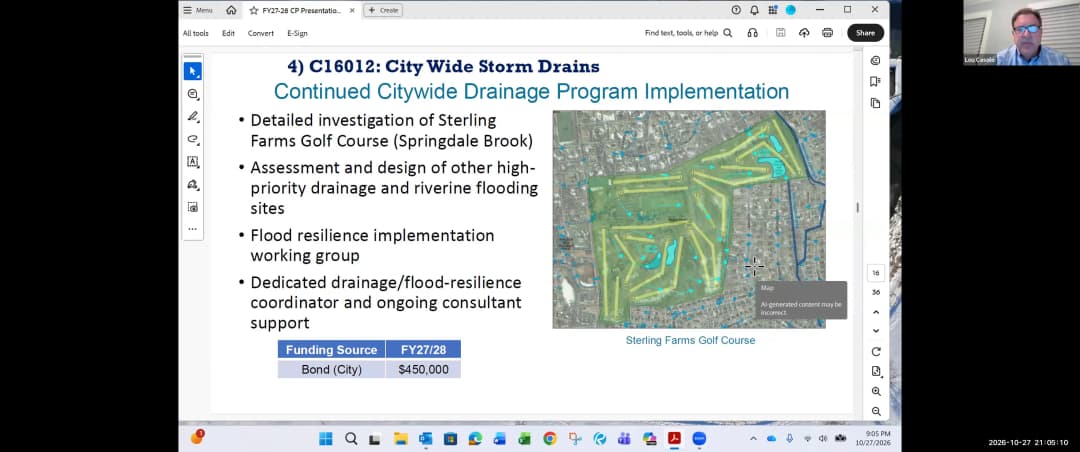
The Stamford Planning Board convened for a regular meeting and capital budget review. Chair Jennifer Gadzeno presided. The board welcomed new alternate member Peter Janoff (nominated by Mayor Simmons), acknowledged Drew McKay's recent promotion from alternate to full member by the Board of Representatives, and noted the absence of Secretary Ravi Supermanian. Board of Representatives member Zachary joined to observe the capital budget presentations. The meeting included two supplemental appropriation votes and department-by-department capital budget presentations for FY 2027-28 and out-year forecasts. The transcript states the meeting occurred Tuesday, October 27th; the date provided for the record is October 28, 2026. The board adjourned at 9:48 PM. Consent Calendar - The October 13, 2026 meeting minutes were approved unanimously (motion by Chet Salad, second by Drew McKay). Supplemental Capital Project Appropriations - SEMS Vine Road Trailer (CP4000) – $33,913, approved unanimously. Public Safety Director Lou DeRubis and Chief Ed Brown presented the replacement of the Medic 4 trailer on Vine Road, manned 24 hours per day and in severe disrepair. The project began in 2018 but was derailed by COVID; bids exceeded available funding, and a $33,913 donation filled the shortfall to fund the full $287,000 project (new trailer, removal of the old, concrete piers and utility connections). Motion by Jeremy Linder, second by Drew McKay; Ashley Wye voted. - Stamford Forward Microtransit Program (CP400030) – $2,314,195.34, approved unanimously. Senior Transportation Planner Luke Button presented additional state grant funding to continue the existing service area. Since launching in November 2024, the service has completed about 145,000 rides within Stamford (roughly Bullshead southward), operating Monday-Sunday, 6 a.m.-8 p.m., with a $1.75 fare. Button noted expansion scenarios (Clembrook, Springdale, Long Ridge/High Ridge) would require additional funding, and the city is exploring private corporate contributions. Motion by Drew McKay, second by Chet Salad; Peter Janoff voted. Public Comments & Testimony - No formal public testimony was taken. A resident sent photographs to planning board members and district representatives documenting trash and debris (including at an old iron bridge), failed solar lights, and potholes at Cosquiesco Park, and expressed support for investment in the park. The chair forwarded the message to staff as part of the record; Parks and Recreation Director Kevin Murray committed to an on-site follow-up. Capital Budget Presentations Office of Public Safety, Health and Welfare – Public Safety Complex - Lou DeRubis presented Phase 2 of a three-phase project to consolidate Fire Headquarters (Main Street) and Station Five (in a flood zone) into a new city-owned site. The request is approximately $1.469 million toward a $2.5 million architectural and engineering design phase, with $1,031,000 already secured via a federal earmark from Congressman Himes. The facility would add a cybercrime/digital forensics/fusion center, an EMS footprint, a new primary 911 center (the current one is over 50 years old), and a regional emergency operations center. - The $66 million out-year hard and soft cost estimate was pushed from 2029-30 to 2030-31 to avoid conflicting with school building investments. Board member Chet Salad requested the feasibility study, conceptual designs, and project cost worksheet (costs increased 6% over last year); DeRubis committed to distributing the packet. DeRubis stated he was confident roughly one-third of costs could come from grants and estimated $10-15 million in savings from avoiding major capital work at the two old fire facilities, with the old sites available for other uses. Operations Short-Term Financing – Fleet and Equipment - Fleet Manager Jason Thurman presented priority-ranked requests. The fleet account balance is expected to be nearly fully depleted by fiscal year-end. - Vehicle replacement: a leaf vac truck (one-person operation, reduces CDL and manpower needs); 2-3 HD plow trucks annually to correct a 10-year spending gap; a stormwater vector truck (sole-source vendor; one of two is inoperable); Ford F-250 supervisor trucks with plows and lift gates (rotated to day-to-day operations after 4-5 years); a Freightliner 114SD hook lift for leaf vac containers; and a marina utility body pickup truck ($65,000; current truck is rotted and smoking). Thurman noted repairs to eight Mack trucks cost $250,000-260,000 annually, roughly the cost of a new truck. - Equipment replacement: OSHA-regulated safety equipment ($7,182; wheel chalks, drip pans, fire extinguishers, triangles, first aid kits); cab heaters for 100 HD plow trucks (the highway fleet logged 9,017 idling hours during snowstorms; heaters run on 0.01 gallons/hour versus 1 gallon/hour); conversion to battery-powered parks equipment (backpack blowers, grass trimmers, hedge trimmers, mowers, battery banks) required by state legislation (chapter 211.3) with about a year left to comply; highway wheel loader bucket replacements; and enclosed leaf vac catch containers. - Board member Andrew flagged math errors in the spreadsheet (battery banks listed as 6 x $900 = $54,000, corrected to $9,000 per unit; line 22 listed 2 x $44,000 = $132,000, corrected to 3 units), and noted row 15 also appeared incorrect. Ashley Wye confirmed the blowers and trimmers are battery-powered electric, consistent with the city's EV conversion ordinance. - Fleet management facilities: a hydraulic room tooling package to bring hydraulic repairs in-house (last winter a payment dispute left 14 plow trucks down mid-storm); North Bay tooling to separate heavy truck and equipment mechanics for safety and production; vehicle maintenance equipment; and fuel island upgrades including a centralized DEF (diesel exhaust fluid) dispensing system, replacement of rotted fuel pump dispensers, fire suppression system electrical work, and sensor upgrades. Fuel islands were confirmed as priority 1 over vehicle maintenance equipment. Special Revenue – Terry Connors Rink and Marina Fund - Parks and Recreation Director Kevin Murray requested $105,000 for the Terry Connors Ice Rink low-E high-ceiling reflective ceiling system (last replaced in 2011; 15-20 year lifespan). As special revenue, it counts against the bond limit but is repaid by rink operating revenue. - Murray requested $1 million from the marina fund for CZIC Marina dock replacements (pilings and decking), following the recent Cove Island Marina project. Funded by marina bonds and repaid by marina revenue. Murray cited safety, legality, and permit obligations for the "mandated legal" justification; the chair noted the term is usually reserved for specific external mandates. Operations Maintenance – Parks - Cosquiesco Park – $500,000 for design/concept plans for the parking lot, drainage, pedestrian pathways, and park lighting. The park sits on a landfill, requiring DEEP approvals that drive costs (a water main break repair cost up to $75,000 and closed bathrooms for three months). Lighting design will address failed solar lights and upward fixtures that blind boaters entering the harbor; Murray said the engineering department would specify downward LED fixtures. Ashley Wye asked whether lighting would be dark-sky compliant (3,000 Kelvin or less) and less impactful to migrating birds; Murray committed to including those specifications. Trash and debris cleanup would be an operating, not capital, expense. - Cummings Park – $2.5 million total ($1.25 million bonds + $1.25 million anticipated federal ORLP grant) for basketball court and playground design and completion. The grant is not yet in hand; fallback options include contributions through the Stamford Park Partnership. The grant design funds must be spent down by 2027. - Seasonal accessible park bathrooms – $5,000 request with a sizable unfunded balance earmarked for the Cove Island Red Brick Building ADA-compliant bathroom facility as part of the "365 bathrooms" program. Future sites include K Park, Courtland Avenue, Barra Park, Cummings Pavilion, and West Beach Pavilion. Murray acknowledged operating cost increases and noted savings from removing portable toilets; the chair encouraged adding out-year forecasts. - Revolving accounts (expected to be zeroed out by fiscal year-end): park amenities ($75,000; benches, bleachers, signage, picnic tables), park fencing ($100,000), playground rehabilitation ($75,000), and paving and drainage ($100,000; including a new catch basin at Cove Island between Terry Connors and Troy Field). - Northrop Park – $75,000 request plus $125,000 unfunded (about $200,000) for design/concept plans to relocate the basketball court and playground adjacent to Stark School; the city is applying for a $2 million state grant. - Rosa Hartman Park (Phase 2) – $150,000 for walking paths connecting to Greenwich's upgraded park side, with landscaping and amenities. - Baseball/softball field upgrades – $250,000 out-year (FY 2028-29) for Grother Field at Springdale School, followed by a girls' softball field. - The chair explained the out-year capital forecast process for new members. Operations – Solid Waste and GIS - Josie Carpentano (solid waste lead) requested $560,000 for transfer station safety upgrades: replacement of the Holloway scale ($410,000), inbound scale concrete repairs, safety lighting, cameras for DEEP compliance monitoring, two-way speakers so residents need not enter the scale house, and perimeter fence repairs. Current funding will complete a misting system and jersey barriers within the next month. - 200 Big Belly pedestrian receptacles to replace open toters and metal-framed receptacles. Small openings (less than 12 inches) would prevent commercial dumping that drives up tonnage; embedded software would optimize collection routes and reduce summer overtime. Carpentano cited Philadelphia's 70% reduction in public receptacle tonnage after adopting Big Belly units. - Waste diversion roll-off containers and a metal-separation magnet to sort glass, clean wood, and construction debris, enabling the city to secure better hauling pricing and pull materials out of the municipal solid waste stream; an RFP for a waste characterization study is underway. - GIS revitalization – enterprise ESRI platform migration. The current platform is set to sunset at fiscal year-end, creating liability. A three-month citywide needs assessment was completed; funds would cover migration to an online platform and LIDAR scans providing four-dimensional data (topography and buildings). Carpentano said the GIS team would move under Operations administration. Ashley Wye asked about network upgrades; Carpentano said the hosted online model avoids bogging down systems. The full amount is needed in one phase to avoid running unsupported software. Land Use Bureau - Ralph Blessing (Land Use Bureau chief) presented: - Courtland Park comprehensive plan – out-year request to support improvements, including a possible library branch. - Citywide invasive species plan – $200,000 to continue work from the completed plan covering 32 parks of one acre and larger; work is underway at Cove River Park, Scalzi Park, and K Park, with funds supporting both professional contractors and neighborhood groups. - Housing growth plan – legally mandated by Public Act 25-01, due June 2029; would build on the city's prior housing plan work (Blessing referenced both 2023 and 2022 at different points) and implement comprehensive plan goals. Scheduling it in the 2027-28 budget would allow completion by 2029. - East Main Street land use and zoning study – $200,000. Following the Cove neighborhood study, this would create a comprehensive zoning concept for the corridor amid development activity (WWE building conversion, Lafayette apartments, McDonald's site zoning change) and complement a separate transportation department traffic safety project. Blessing confirmed the study is land-use only, not traffic modeling; Ashley Wye and the chair suggested the price seemed high without traffic modeling. Luke Button confirmed the transportation project includes a full traffic study. - Open space acquisition and flood control – $1 million to begin acquiring frequent-loss properties and converting them to parkland for flood storage. Three flood resiliency studies (coastal resiliency, Toilsome Brook, Springdale) will help identify target properties; a list has not yet been established. Peter Janoff asked about eminent domain; Blessing said it would be a last resort and the process would be collaborative. The chair noted the cost-savings rationale versus culverts and hard infrastructure. - Historic preservation trust fund – $50,000 to jump-start the fund created with the Board of Representatives but never capitalized; funds would support historic signage and voluntary cultural resources inventory listings. The historic zoning bonus fee, which feeds the fund, may need to be increased. - Sleepy Hollow Park master plan – Springdale conservation-area park (mostly wetlands) with an active friends group; focus on walking trails and interpretive signage about wetlands and flood protection. - Overall needs assessment for city fields – additional funding on top of last year's $500,000 request, which the Board of Finance cut to $250,000; the balance sits as unfunded bond authorization and cannot be spent until the full amount is funded. The study would holistically assess city and Board of Education athletic fields, lighting, drainage, bathrooms, and changing demographics (e.g., pickleball demand, aging population). Operations – Engineering - City Engineer Lou Castle presented nine FY 2027-28 projects totaling $7.9 million, of which $3.4 million (about 43%) is grant-funded; most grants are anticipated or submitted but not yet confirmed. - Municipal bridge replacement and rehabilitation – approximately $1.1 million for design of three aging structures: Cascade Road (100 years old), Farms Road (76 years old), and Bridge Street (about 75-76 years old; state inspection found deteriorated girder ends, deck, bearings, and abutments, with one of four lanes closed). Rather than submitting separate applications, design funds are pooled until the state selects which project receives aid; Castle will return for construction funding once awarded. If grants fall through, fallbacks include interim repairs and traffic reductions; the bridges are past their useful life and deteriorating annually. - Citywide seawall replacement – Cove Island revetment failure along roughly 1,000 feet, exposing utility conduits; design is underway with bidding next summer. Funding was partially received last year. - John Buccutsi Park Phase 2 – completion of the South End park with baseball fields, tennis/basketball courts, splash pad, protective fencing along private property lines, and soil remediation. Phase 1 (Soundwaters education building, parking, access road aligned with Congress Street, trails) is complete. A National Park Service grant supports the request; design completion is targeted for July, with construction beginning early 2028. - Citywide storm drains – $600,000 for compound flood modeling plus $450,000 for drainage assessment recommendations and $200,000 for fix-it drainage complaints. The city submitted a roughly $5.9 million US DOT grant. Modeling identified Sterling Farms golf course as a contributor to Old Colony and Minivale flooding; pond dredging and storage options are being evaluated. - Briarwood and Pheasant Lane – prior year request was zeroed out; steep topography causes runoff impacting four properties and the roadway drainage system. A design is proposed. - Drainage design completion – $100,000 to finish a design from the ARPA-funded citywide drainage assessment (Holliwell area pipe network to a golf course pond); the project did not clear the state bond commission for construction funding. - Resiliency and climate adaptation implementation – federal grant funding for backflow preventers on storm lines outfalling to Long Island Sound and a real-time flood sensor network, both priorities from the coastal resiliency study. The coastal flood resiliency plan will be presented to the board in November/December. - Toilsome Brook – $650,000 state grant request to complete evaluation of the upper watershed riverine flooding and the lower urbanized pipe network; a prior DEEP grant was pulled back at the state bond commission. A public meeting was held the prior week; a website and QR code provide study information. - Bridge safety repairs and design – a small emergency account for urgent bridge evaluations and repairs. - Environmental assessments – for soil testing under Connecticut's new release-based soil regulations (replacing the transfer act). - Out-year requests include Cummings Marina (lost during Hurricane Sandy), Stillwater/Progress Drive, and Leone Park underground detention. Operations – Facilities - Facilities Director Scott Butch presented: - Citywide facilities lifecycle planning and assessment (department priority 1): a 10-year strategic capital plan modeled on the schools' effort; an RFP is currently out. Last year's request was cut by the Board of Finance; the department is seeking the funds again. - Heating system replacement: end-of-life units replaced with high-efficiency systems; Eversource incentives up to $200,000 remain available. Funds would cover an entire building (potentially South End Fire Department 2) plus reactive replacements; 30 units have been replaced in three years, and a boiler control replacement at Government Center was funded this year. - Citywide building and energy management systems (BMS): continued Siemens partnership expansions at Government Center, police, central fire, Lathan Wider, Yearwood Center, and potentially the historical society center. - Government Center renovations: the 1986 building has spaces untouched for 40+ years; funds would add touchless weapons detection/magnetometers, MEP upgrades for first-floor cashiering/permitting and town clerk areas (not designed as office space), and fourth-floor board chambers/multi-purpose space renovation (design funds already in hand). - Citywide floor replacement: 40-year-old flooring at Government Center, expanding to Old Town Hall and Lathan Wider. - Buildings and utilities: CCTV installation at outer facilities (highways fleet, Schofields, Hague Town Yard) for safety and liability reduction. Operations – Transportation - Transportation Director Thomas Turk presented routine accounts: environmental compliance ($100,000 this year, $50,000 out-years) due to new state permits for five regulated sites (about $15,000 registration fee each); citywide manhole and basin repairs (emergency account, about 200 outstanding issues); street patch and resurfacing ($10 million requested) for the top-200 road list (10 roads currently being paved); citywide sidewalks; utility paving to coordinate curb-to-curb completion with utility trenching (expected spent down); and guardrails (minimum request; hit-and-run damage is a safety priority). - Luke Button presented traffic engineering accounts: - Roadway design and reconstruction (CP1281): city design funds prime the pump for roughly $50 million in state infrastructure investment, including pedestrian/cycle upgrades at about 40 signalized intersections, six new signals (CMAC Phase H), McGee Avenue design ($3 million grant), and Lockwood Avenue safety improvements ($6 million state grant; the corridor was the site of a recent fatality and supports a new elementary school). The balance will be spent down. - Citywide signals (CP56174) – $1 million: $800,000 for Lafayette Street signal replacement, $100,000 for ADA signal upgrades, and $100,000 for communication upgrades. Stamford operates 211 traffic signals (second-largest system in the state); $3 million of the account balance is state grant and private contributions earmarked for specific intersections. - Vision Zero action plan: Stamford was the first city in the state to adopt Vision Zero (eliminating serious and fatal traffic fatalities by 2032); $800,000 will be spent spring/summer 2027 and $500,000 for spring 2028 on high-injury network projects. - Bicycle and pedestrian master plan – $250,000 focused on bike facilities; a citywide bike parking plan is being developed in-house. - ADA transition plan – $750,000 to begin a cycle of pedestrian ramp upgrades once the legally mandated plan is complete (in about a month); the city will use a state contract for ramps. - Transportation facilities (new project): upgrades at Hague Avenue town yard, including a salt shed past its useful life and WPA-era garages not built for modern equipment. Losing the salt shed would remove about one-third of salt capacity; last winter the city nearly exhausted its supply. Asked to quantify ongoing maintenance costs, Button said facilities staff would provide the numbers. - CT Transit upgrades: about 3 million bus rides per year on CT Transit; 76% of parcels are within a 10-minute walk of a bus stop. Bus shelter ad revenue now only covers maintenance; capital funds would support shelter replacements (e.g., at Old Town Hall), with the state partnering on shelters along state roads. Key Outcomes - Minutes (October 13, 2026): approved unanimously. - SEMS Vine Road Trailer supplemental appropriation ($33,913): approved unanimously. - Stamford Forward Microtransit supplemental appropriation ($2,314,195.34): approved unanimously. - The capital budget presentations were informational; no votes were taken. Departments committed to follow-ups including: distributing the public safety complex feasibility study packet, correcting spreadsheet math errors, adding out-year capital forecasts, quantifying salt shed maintenance costs, and presenting the coastal flood resiliency plan in November/December. - The next meetings are November 4 (Wednesday, due to Election Day on Tuesday), November 10, and November 17 (capital budget callback) for follow-up questions to presenters.

PARKS AND RECREATION 13% · VEHICLE MAINTENANCE 10% · ENGINEERING AND INFRASTRUCTURE 10% · FLOOD MANAGEMENT 7%
03
OCT 28, 2026 · STAMFORD, CONNECTICUT · BOARD OF REPRESENTATIVES
Appointments Committee Meeting - Board of Representatives - October 28, 2026

The Appointments Committee of the Board of Representatives met on October 28, 2026. The meeting was scheduled for 6:30 p.m. but was called to order at 6:31 p.m. by Co-Chair Felix Gardner in the Democratic Caucus Room and remotely via Zoom. Members present included Representatives Carl Weinberg, Weathers, Camporeale, Bradford, and Hyatt. Co-Chair Steven Shore and Representative Pavia were absent. The committee interviewed eight candidates for various boards and commissions and voted on nine appointments, all passing unanimously with a 6-0-0 vote. One applicant (Michael Miller for the Stamford Golf Authority) was absent and will be rescheduled. Interview and Discussion Items Zoning Board – William Morris (Reappointment) William Morris, a 76-year resident with over 22 years of experience on the Zoning Board, discussed the board's work on affordable housing and sustainability. Morris stated the board had increased affordable housing units to between 10 and 12 percent of the housing stock, adding approximately 650 affordable units financed by roughly $38 million in CNL funds. Regarding the tree canopy, Morris noted recent text changes requiring developers to inventory and replace removed trees. He expressed strong support for Mayor Caroline Simmons' comprehensive plan and sustainability goals. Representative Weinberg encouraged Morris to be less supportive of tree removals conducted solely for construction equipment convenience. Personnel Commission – Isobel Bonar (Reappointment) Isobel Bonar, serving seven months on the commission, shared her background in human resources. She praised the city's HR team for thorough research and compensation analysis. Bonar noted the commission's role in approving reorganizations and position changes, mentioning recent adjustments in the Town Clerk's office. Representative Weinberg complimented the institutionalization of strong HR processes under directors Clement Williams and Dr. Russell. Personnel Commission – Stuart Adelberg (Reappointment) Stuart Adelberg highlighted the collegiality and efficiency of the commission. He noted that the commission frequently pushes back on HR proposals, requesting earlier documentation and challenging above-midpoint salary hires. Adelberg cited a recent case where the commission turned down a request and later approved a compromise at a lower salary level. Representative Weinberg contextualized the commission's reactive role per the city charter, while Adelberg described the high quality of departmental reorganization proposals. Personnel Commission – Susan Johnson (New Appointment) Susan Johnson, an HR professional with both private and public sector experience, expressed her desire to listen and learn before proposing changes. Representative Weinberg challenged Johnson to use her expertise in culture change to help shift city government from a technocratic to a client-centric viewpoint, which Johnson acknowledged as a significant but worthwhile challenge. Patriotic and Special Events Commission – Melissa Fay (New Appointment) Melissa Fay, a new appointee, shared her interest in modernizing event outreach. She discussed standardizing communications through schools and diversifying veteran representation at parades to include younger and more diverse veterans. Representative Weinberg highlighted Fay's community work and her free CPR training event on Saturday, November 14, 2026, at Third Place by Harbor Point. Representative Camporeale asked about outreach strategies to draw larger crowds. Stamford Golf Authority – Michael Miller (Absent) No action taken. The applicant was not present and the item was rescheduled. Stamford Golf Authority – Duffy Sasser (Reappointment) Duffy Sasser discussed operations at Sterling Farms. He noted that the authority recently approved new app-based booking software to address scheduling challenges. Sasser expressed pride in the course's affordability, with resident rates averaging around $10 per hour and reduced fees for seniors and juniors at $26. Representative Bradford raised concerns about historic buildings on the property, such as the milk barn, encouraging collaboration with HPAC for preservation. Representative Camporeale inquired about pesticide use following state bans; Sasser stated he would provide a list of chemicals used. Sasser described challenges with the city's backpack blower ordinance and battery-powered equipment limitations, noting that current battery technology is inadequate for the course's needs. Zoning Board of Appeals (ZBA) Alternate – Izabella Parillo (New Appointment) Izabella Parillo, a tax accountant with EY, framed her approach around strictly following the zoning "rulebook" to balance competing property owner and neighbor interests. The committee discussed the emotionally charged nature of ZBA cases and the importance of listening to applicants. Parillo expressed her intention to learn from fellow board members regarding how to interpret the gray areas of the code. Key Outcomes All votes were taken by voice vote and passed unanimously (6-0-0) with Co-Chair Gardner, and Representatives Bradford, Camporeale, Hyatt, Weathers, and Weinberg in favor. - A32.066 Zoning Board – William Morris (Reappointment): Approved. - A32.069 Personnel Commission – Isobel Bonar (Reappointment): Approved. - A32.070 Personnel Commission – Stuart Adelberg (Reappointment): Approved. - A32.071 Personnel Commission – Susan Johnson (New Appointment): Approved. - A32.072 Patriotic and Special Events Commission – Melissa Fay (New Appointment): Approved. - A32.074 Stamford Golf Authority – Duffy Sasser (Reappointment): Approved. - A32.075 Zoning Board of Appeals Alternate – Izabella Parillo (New Appointment): Approved. - A32.076 Zoning Board of Appeals – Enton Nikaj (Promotion to Full Seat): Approved (Interviewed on July 29, 2026; vote only). - A32.073 Stamford Golf Authority – Michael Miller: No action taken. Applicant was absent. The meeting was adjourned at 8:01 p.m.

PERSONNEL MATTERS 26% · PROCEDURAL 18% · ZONING BOARD 11% · HISTORIC PRESERVATION 9%
04
OCT 27, 2026 · STAMFORD, CONNECTICUT · BOARD OF REPRESENTATIVES
Stamford Legislative & Rules Committee: Window Safety & Grocery District (Oct 27, 2026)

The Legislative & Rules Committee of the Stamford Board of Representatives met on Tuesday, October 27, 2026, at 7:01 p.m. in the Democratic Caucus Room and via Zoom under Chair Michael McKeown (Vice Chair Karen Camporeale presided over the second item). The committee considered two items: an amended resolution urging the Connecticut General Assembly to enact municipal-opt-in window safety legislation, and a proposed ordinance establishing an urban grocery store development district. Both items were recommitted for further revisions and stakeholder input. Discussion Item: LR32.021 – Statewide Window Safety Resolution This resolution, submitted by Rep. Stone and others, aims to urge the Connecticut General Assembly to pass legislation regarding window safety devices in multi-family dwellings to prevent child falls. The discussion centered on a substituted version that moved from a broad state mandate to a municipal opt-in framework and specified temporary or removable window stops (limiting openings to four inches) rather than bars or guards. Substitute Amendment Debate: Rep. Stone expressed support for the substituted version, arguing a municipal opt-in allows flexibility for different housing stocks and incorporates local public safety expertise. The amended version reflected changes circulated to the committee. Expert Testimony: - Chief Rex Morris (Stamford Fire Department) expressed significant concerns about restricting firefighter access and egress, noting windows are critical for rescue and ventilation in high-rise buildings. He called the shift from window bars to removable window stops an "improvement" but remained concerned about maintenance and long-term enforcement, stating that any permanent restriction is still a restriction. He preferred local educational initiatives and code enforcement over a broad state mandate. - Director Lou DeRubeis (Public Safety) cautioned the committee against unintended consequences of well-intentioned state legislation. He emphasized supporting public education campaigns and exploring local solutions, noting Chief Morris’s national expertise and the risk of Stamford’s fire chief testifying against the city’s own legislative request in Hartford. Committee Positions: - Rep. Hughes voiced strong support for the resolution. He argued the issue disproportionately impacts urban families and that education alone is insufficient. He expressed willingness to disagree with the public safety officials on this issue to achieve tangible action and legislative momentum. - Rep. Weinberg strongly opposed the resolution. He argued it cedes local control to the state and puts the Board in opposition to its highly regarded public safety experts. He advocated for local action, such as a budget allocation for purchasing and distributing window stops. - Rep. Boudreau expressed reluctance to vote for the resolution without a thorough committee investigation. The resolution presupposes a specific solution that the committee has not fully studied. - Rep. LePine deferred to the expertise of Chief Morris and Director DeRubeis, stating their expressed concerns were decisive for his opposition. - Rep. Lynch supported the resolution, citing state-level preemption constraints that limit the city's ability to legislate directly on the matter without state authorization. - Clerk Johnson argued the resolution was premature, stating the committee lacks consensus and should not advocate for a specific state outcome without broader agreement. Vote on Substitute Amendment: Passed 8-1-0 (Rep. Boudreau abstained). Recommittal: Following extensive debate on the merits of the amended resolution, a motion to recommit was made and passed 9-0-0. The item was sent back to committee for further revision, with members requested to submit proposed amendments within one week for aggregation and discussion with the fire department and corporation counsel. Discussion Item: LR32.023 – Urban Grocery Store Development District Ordinance This ordinance proposes a fixed assessment agreement (tax abatement) to incentivize full-service grocery retailers to open in underserved areas. Legal Analysis: Attorney Cynthia Anger stated that the city-drafted version applied citywide because no rational basis could be found to legally support designating specific tax abatement districts for grocery stores outside of the zoning code. She suggested zoning regulation might be a path forward, but the current statute for this tax abatement did not support the targeted district model outlined by the sponsors. Committee Positions and Debate: - Director Leah Kagan described the city draft as a work-in-progress. She explained the incentive is structured for mixed-use developments, where a symbiotic relationship is created by tying the developer's abatement to the operational status of the grocery retailer. She noted further due diligence with grocers and property owners is needed. - Rep. Hughes (Sponsor) strongly criticized the citywide approach, arguing it fails to change grocery retailer market behavior, which concentrates in suburban, car-centric areas. He stressed the need to target specific neighborhoods (Downtown, East Side, South End) lacking access and pushed back against the idea that more data is needed before acting on a recognized inequity. He supported the targeted district model. - Rep. Pelicci proposed using USDA food access data and census tract analysis (urban low-access thresholds, car ownership data) to legally define and justify target districts geographically. She committed to providing this research. - Rep. Adams endorsed the tax abatement incentive, citing the successful South End tax abatement program (BLT) that spurred development where none occurred before. - Rep. LePine advised caution, reminding the committee that an earlier grocery store (Sutton Shop) on the West Side failed despite significant investment, suggesting the specific barriers (rent, loading, zoning) must be identified. He urged testing the theory with robust data. - Rep. Blank raised a critical procedural point, arguing the committee cannot craft an effective solution without a formal definition of "equitable access" for Stamford. He emphasized the need to scope the problem (type of store, access barriers) before legislating. - Rep. Boudreau supported the conceptual goal but agreed with the need for better problem definition and data analysis. - Rep. Weinberg emphasized the need to understand why grocers are not entering the market beyond the financial incentive. - Rep. Johnson questioned the legal distinction between this proposed district and existing special districts (like the Downtown Special Services District). Recommittal: A motion to recommit the ordinance to committee for further work on data-driven definitions, stakeholder engagement, and legal review was made and passed by voice vote. Key Outcomes - LR32.021 (Window Safety Resolution): The substitute amendment was adopted 8-1-0. The main motion was subsequently recommitted 9-0-0 for revision and coordination with the Fire Department and Corporation Counsel. Deadline for committee member input was set for one week. - LR32.023 (Grocery Development District): The ordinance was recommitted by voice vote. Sponsors and economic development staff will work on legally defensible, data-backed definitions of target districts and conduct further outreach to grocery retailers and property owners to refine the incentive structure.

PROCEDURAL 21% · PUBLIC SAFETY 21% · FIRE SAFETY 19% · FOOD ACCESS 12%
05
OCT 27, 2026 · STAMFORD, CONNECTICUT · ZONING BOARD
Zoning Board Meeting – October 27, 2026

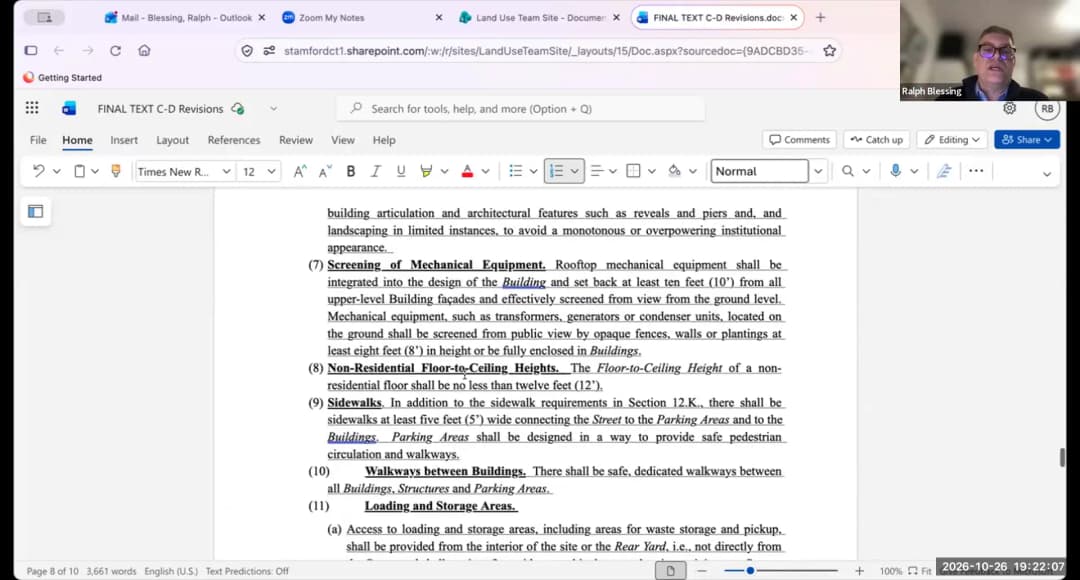
The Zoning Board of Stamford, Connecticut, met on October 27, 2026, at 6:32 PM via Zoom. Chair David Stein presided. The meeting focused on several continuances, approvals of zoning map and text changes, and a discussion on updated regulations for the former CD (now CMC) district. All votes were unanimous (5-0). Consent Calendar - Minutes from October 19, 2026: Approved 5-0 without changes. Discussion Items - Application 226-27 (City Transportation Dept. Zoning Text Change): Continued to November 9, 2026, pending completion of board assignments and applicant obligations. - Application 226-20 (Zoning Text Change): Continued to November 9, 2026. - Applications 226-09 & 226-10 (McDonald’s Drive-Through – Map Change & Special Permit): Continued to November 9, 2026 at applicant’s request. - Application 226-26 (Text Change related to 226-20): Continued to November 9, 2026. - Application 226-25 (Map Change companion to 226-26): Continued to November 9, 2026. - Application 226-29 (110 High Ridge Road Map Change): Continued to November 9, 2026 to allow applicant to respond to public comments. The Planning Board had unanimously recommended approval on September 22, 2026, finding the change in harmony with the 2035 Comprehensive Plan (MU3). - Application 226-23 (CSC District Map Change): Approved 5-0. This rezones the only CSC district (Ridgeway Shopping Center) to CL (Limited Business) as well as a small CN lot (currently a daycare). Board discussion noted that the CN property owner had not been notified, but the change does not restrict their existing use. - Application 226-24 (CSC District Text Change): Approved 5-0. Removes the CSC district from regulations, with clarifying language requested by the shopping center owner ensuring non-conformities may continue. - Application 226-28 (CSPR Text Change): Approved 5-0. Simplifies exemptions from seven categories to four main ones, deleting the exemption for single-family homes outside flood hazard areas (based on state statute change). - Application 226-14 (CD/CMC Text Change): Added to agenda and approved 5-0 after discussion. Key changes include renaming CD to CMC, adding a purpose section, updating designation criteria, and introducing townhouse development options with adjusted residential density divider (RDD) from 2000 to 1750 square feet. The board also added site design requirements, including architectural standards, screening, and sidewalk requirements. All new development in the district will require a special permit with public hearing. Key Outcomes - Approvals: Applications 226-23, 226-24, 226-28, and 226-14 were all approved 5-0. - Continuances: All other listed applications were continued to the next meeting on November 9, 2026 at 6:30 PM. - Next Meeting: The November 9 agenda will include all continuances plus two new applications: 780 Summer Street (conversion/expansion of vacant office) and the final site plan for Stamford Hospital parking lots.

PLANNING AND ZONING 61% · PROCEDURAL 23% · URBAN DESIGN 6% · SENIOR HOUSING 6%
06
OCT 26, 2026 · STAMFORD, CONNECTICUT · BOARD OF REPRESENTATIVES
Fiscal Committee Meeting – October 26, 2026

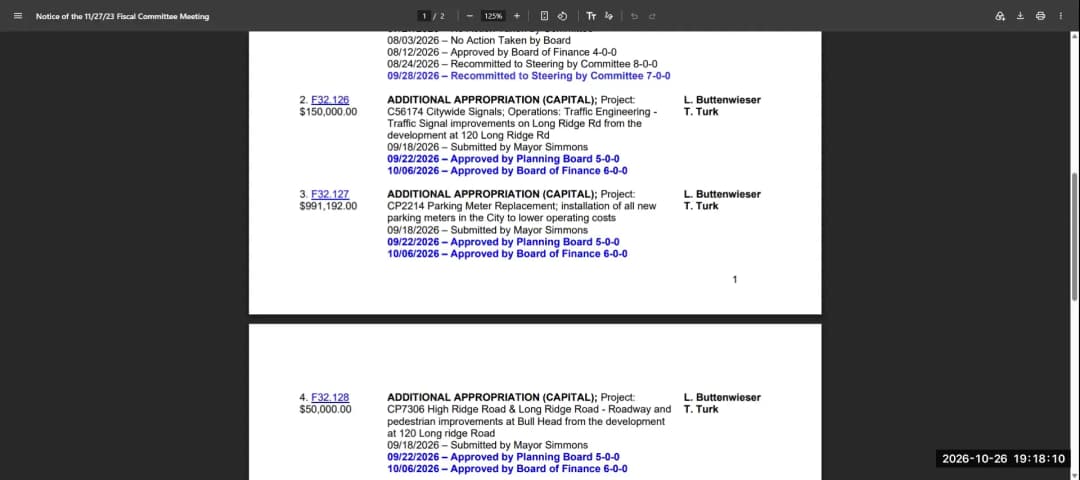
The Fiscal Committee of the Stamford Board of Representatives met on Monday, October 26, 2026 at 7:00 P.M. in the Democratic Caucus Room, 888 Washington Blvd, and remotely via Zoom. Co-Chair Andrew Zachary presided. Present were Representatives Bouchard, de la Cruz, Goldberg, Johnson, and Lapine. Co-Chair Morson, and Representatives Dorsey and Graham were absent. The committee considered four agenda items and took the following actions. Discussion Items Item 2 (F32.126) – Traffic Signal Improvements on Long Ridge Road ($150,000) Luke Buttenwieser, Senior Transportation Planner, explained that the funds are for traffic signal upgrades at the intersection of Long Ridge Road and the site driveway of 120 Long Ridge Road, related to the zoning approval of that development. The improvements are part of a negotiated traffic mitigation package. Representative Lapine asked about jurisdiction since Long Ridge Road is a state road; Buttenwieser clarified that the city controls its traffic signals but state permitting is required. The item was approved unanimously. Item 3 (F32.127) – Parking Meter Replacement ($991,192) Buttenwieser presented the project to replace Stamford’s approximately 600 parking meters, which are about 10 years old and at the end of their useful life. The funds are surplus from the Parking Fund. The project aims to lower operating costs by transitioning from single-space meters to multi-space pay stations over a multi-year phased plan. Key discussion points included: - Expected lifespan of new equipment is 10 years. - All pay stations will accept coins, credit cards, and phone payments (ParkMobile). Buttenwieser confirmed that options for cash and coin payments will be maintained, and ADA considerations (free on-street parking for disabled permit holders) will continue. Some garage pay stations may be credit card only to reduce operating costs. - Representative Camporeale asked about the percentage of single-space meters to be phased out; Buttenwieser stated that a detailed transition plan is being developed as part of an upcoming vendor contract, with implementation anticipated to begin in 2027. - Representative de la Cruz expressed support for the direction toward pay stations but requested a clearer return-on-investment analysis when the contract is presented. He also asked about concrete work costs, which are included in the $991,192. - Representative Bouchard raised constituent concerns about payment methods for those without smartphones; Buttenwieser assured that cash and credit cards will be accepted at all pay stations. - A question about leaving meter poles as barriers was discussed; the Department stated that full removal is preferred for ADA compliance and sidewalk clearance. The item was approved unanimously. Item 4 (F32.128) – Pedestrian Improvements at Bull Head ($50,000) Buttenwieser noted this item is paired with Item 2, also from the 120 Long Ridge Road development. The funds are for design of roadway and pedestrian improvements at the Bull Head intersection (Cold Spring, Long Ridge, etc.) to help secure state grants. Representative Lapine inquired about a previously authorized $2.9 million project; Buttenwieser clarified that it is not yet obligated. The item was approved unanimously. Item 5 (F32.129) – Parking Garage Capital Upgrades ($1,000,000) This appropriation replenishes the capital account for parking garage improvements, using surplus from the Parking Fund. Buttenwieser indicated that the city recently started a $2.5 million upgrade at Bell Street Garage, and the funds will be available for other garages, likely Bedford Street. Representative Lapine confirmed that the funds are not earmarked for a specific project but serve as a reserve for future capital needs. The item was approved unanimously. Key Outcomes - Item 1 (F32.092) – Held by the Administration (no action). - Item 2 (F32.126) – Approved (6-0-0). - Item 3 (F32.127) – Approved (6-0-0). - Item 4 (F32.128) – Approved (6-0-0). - Item 5 (F32.129) – Approved (6-0-0). - Item 6 (F32.130) – Withdrawn by the Administration prior to the meeting. The meeting adjourned at 7:25 P.M.

PARKING 67% · TRAFFIC 13% · BUDGET EQUITY ANALYSIS 13% · PROCEDURAL 7%
07
OCT 22, 2026 · STAMFORD, CONNECTICUT · BOARD OF REPRESENTATIVES
Operations, Parks and Recreation Committee Meeting – October 22, 2026

October 22, 2026 – 7:00 PM The Operations, Parks and Recreation Committee of the Stamford Board of Representatives met remotely on October 22, 2026, at 7:00 PM, chaired by Dan Sanford. The committee approved two resolutions establishing cost-recovery fee models for electric vehicle chargers at city garages and conducted a review of the city's noise ordinance for potential revisions. Public Hearings & Approvals - OPR32.018 – EV Chargers at Bell Street Garage: The committee held a public hearing where two residents (Dave Adams and Jeffrey Maron) opposed the chargers, arguing the city should not operate a fueling business. After discussion, the committee voted unanimously (8-0) to approve the cost-recovery fee model. - OPR32.019 – EV Chargers at Government Center Garage: A second public hearing was held; Dave Adams reiterated his opposition. The committee again voted unanimously (8-0) to approve the identical fee model. Discussion – Noise Ordinance Review (OPR32.020) The committee reviewed Chapter 164 (Noise Ordinance) for the first time in over 40 years. Director of Health Jody Bishop reported 241 noise complaints in 2025-26 and 79 so far in 2026-27, with downtown areas being the most common source. Enforcement challenges include limited inspectors (5 trained, 2 calibrated meters), difficulty isolating noise sources, and the complexity of the 20+ page ordinance. Key points raised by committee members and administration: - Director of Public Safety Lou DeRubeis advocated for streamlining the ordinance and emphasized the need to balance city functions (construction, events) with resident peace. - Representative Policia suggested adopting a "plainly audible" standard (like Norwalk) to reduce reliance on decibel meters. - Representative Boudreau noted that permanent events are currently exempt and should require variances. - Representative Hughes questioned early morning refuse pickup (4 AM start); Director Quiñones (Operations) cited traffic and worker safety as reasons. - Ben Pomerantz (Parks & Recreation Commission) noted that park rules currently prohibit amplified music; a clearer ordinance could allow more flexible park events. The committee will collect feedback over the winter and reintroduce a revised ordinance in spring 2027. Key Outcomes - Items OPR32.018 and OPR32.019 were approved unanimously (8-0 each). - No formal action was taken on the noise ordinance review; the chair will gather input and reintroduce the item as an ordinance for future approval.

NOISE POLLUTION 60% · ELECTRIC VEHICLE INFRASTRUCTURE 16% · PROCEDURAL 7% · PUBLIC SAFETY 6%
08
OCT 21, 2026 · STAMFORD, CONNECTICUT · BOARD OF REPRESENTATIVES
Stamford CHESS Committee Meeting on Affordable Housing Trust Fund Reforms (October 21, 2026)

Note: The official meeting minutes date this meeting as Tuesday, October 20, 2026, at 6:30 PM. The metadata provided specifies the meeting occurred on October 21, 2026. This summary uses the metadata date. The CHESS Committee of the Stamford Board of Representatives met to consider two items: a major overhaul of the Affordable Housing Trust Fund ordinance (CHESS32.024) and a funding allocation for Southwood Square Apartments (CHESS32.025). After a public hearing lasting over an hour and extensive committee debate involving multiple amendments, the committee approved the ordinance overhaul by a vote of 7-1-0. The committee also failed to reject a $1.5 million allocation to Southfield Village Limited Partnership by a vote of 0-8-0, allowing the funding to proceed by default. Public Comments & Testimony - A central and repeatedly emphasized concern was the necessity of maintaining direct representation on the Trust Fund Board for individuals who currently reside in affordable housing. Speakers argued removing the two guaranteed tenant seats would disenfranchise residents. - Additional concerns included reducing the total number of trustees, preserving transparency and Board of Representatives oversight over expenditures, and raising the expenditure-review threshold from $100,000 to $1 million. - Housing affordability, rising rents, poor maintenance conditions, resident displacement, and potential conflicts of interest involving developers or housing management interests were also raised. Discussion Items - Trust Fund Board Makeup & Quorum: Emily Gordon, Director of Housing and Community Development, explained that the current board has five ex-officio members and two vacant affordable housing tenant seats, creating a quorum problem. The proposed change would create five full members and three alternates, lowering the quorum to a simple majority of three. She stated this brings the board in line with other city boards and opens public seats to a wider range of residents. - Trust Fund Performance: Rep. Hughes noted the fund had only produced 11 new units of deeply affordable housing (11 rooms at 360 Pacific Street) in five years, calling for reforms to better scale production. Rep. Price countered that the fund has also redeveloped 61 units at Oak Park, upgraded 72 senior units at Pilgrim Tower, and committed $8.5 million to 10 other projects. - Expenditure Review Threshold: The proposed increase from $100,000 to $1,000,000 was a major point of debate. Emily Gordon stated that 86% of trust fund commitments have exceeded the $100,000 threshold, making Board of Representatives review a routine step rather than a check on the largest allocations. Raising the threshold to $1 million was intended to make the review an exception. Reps. Walston and Camporeale expressed concern the $1 million threshold was too high, with Rep. Camporeale noting Greenwich uses a $500,000 threshold and advocating for a compromise. Rep. Goldberg supported the $1 million figure, characterizing it as appropriate for a risk-management framework. - Professional Expertise on the Board: An initial motion to remove language explicitly prioritizing applicants with “professional experience developing or managing housing projects” was amended by Rep. Gross. The final amendment replaced this language with “professional experience in affordable housing public policy or the financing of housing projects,” aiming to retain valuable technical expertise without explicitly prioritizing developers. Reps. Goldberg and Price strongly supported retaining some form of professional expertise requirement to evaluate complex financing structures. - Item 2: Southfield Village Allocation: Rep. McKeown explained the procedural deadlines for rejecting the $1.5 million allocation to Southfield Village Limited Partnership. The Committee reviewed the project scope, including rehabbing 315 mixed-income units (233 affordable), kitchen/bathroom renovations, energy improvements, and temporary relocation plans. Key Outcomes - Ordinance CHESS32.024 Approved as Amended: - The committee approved a final motion to insert a clause guaranteeing at least one voting member and one alternate member of the Trust Board be residents currently living in affordable housing. (Vote: 7-1-0). - The committee approved replacing the developer/management professional experience clause with language prioritizing experience in “affordable housing public policy or the financing of housing projects”. (Vote: 7-0-1). - The committee approved a technical amendment to correct cross-references in the ordinance text regarding the Affordable Housing Plan. (Vote: 8-0-0). - The overall ordinance, as amended, was approved for final adoption by the full Board of Representatives. (Vote: 7-1-0; Rep. Walston opposed). - Allocation CHESS32.025 Not Rejected: - A motion to reject the $1.5 million allocation to Southfield Village Limited Partnership for the rehabilitation of 315 units at Southwood Square Apartments failed. (Vote: 0-8-0). The motion failed, therefore the allocation is deemed approved and will proceed without further Board of Representatives action.

09
OCT 21, 2026 · STAMFORD, CONNECTICUT · BOARD OF REPRESENTATIVES
CHESS Committee Meeting and Public Hearing: Affordable Housing Trust Fund Ordinance and $1.5M Southfield/Southwood Square Allocation - October 21, 2026

The CHESS (Community Development, Housing, Education, Social Services, State & Commerce) Committee met in the Democratic Caucus Room at 888 Washington Blvd, Stamford, CT, and by Zoom. In attendance were Co-Chairs Pollack and Sylvestre, Committee Members Reps. Goldberg, Gross, McKeown, Price, Walston, and Wirz; Rep. Yaeger was excused. Also present were Reps. Camporeale, Hill, Hughes, Hyatt, Pelliccia, Shaw, and Weinberg, along with Ralph Blessing (Land Use Bureau Chief) and Emily Gordon (Director of Housing and Community Development). The agenda and minutes list the meeting as Tuesday, October 20, 2026, at 6:30 p.m.; the provided timestamp for this summary is 2026-10-21T11:30:00+00:00. The Committee held a public hearing on an ordinance amending the Stamford Housing Affordable Trust Fund, approved it as amended 7-1-0, and considered whether to reject a $1,500,000 allocation to Southfield Village Limited Partnership (Beacon Communities LLC) for the Southwood Square Apartments. The rejection motion failed 0-8-0. Public Comments & Testimony Chair Pollack opened the public hearing at 6:30 p.m. and closed it at 8:00 p.m. Many members of the public spoke in opposition to the proposed ordinance. Public comments focused on maintaining direct tenant representation on the Affordable Housing Trust Fund Board, opposing any reduction in the number of trustees, preserving transparency and Board of Representatives oversight over expenditures, and expressing concern about increasing the expenditure-review threshold from $100,000 to $1 million. A central concern repeatedly emphasized was the importance of ensuring that individuals who actually reside in affordable housing have direct representation and a voice on the Board. Additional concerns included housing affordability, rents, maintenance conditions, displacement, and potential conflicts involving development or housing-management interests. Discussion Items Item 1 - CHESS32.024: Ordinance Amending the Stamford Housing Affordable Trust Fund The Committee discussed trustee composition, resident representation, qualifications for public trustees, quorum, oversight of expenditures, and the proposed $1 million review threshold. Three amendments were approved: - A motion to add language to Sec. 146-70 requiring that, notwithstanding any other provision, not less than one voting member and one alternative member of the Board shall be residents who currently reside in housing qualifying as affordable housing projects as defined in Section 146-66. Approved 7-1-0, with Rep. Walston opposed. - A motion to strike from Sec. 146-70 the phrase "or have professional experience developing or managing housing projects" and replace it with "or have professional experience in affordable housing public policy or the financing of housing projects." Approved 7-0-1, with Rep. Walston abstaining. - A motion to amend Sec. 146-75 by replacing language in subsection C.2 with "in accordance with the Affordable Housing Plan, as defined in Section 146-74," and correcting the cross-reference in subsection C.3 from Section 146-75.C.2 to Section 146-74. Approved 8-0-0. The ordinance was then approved as amended for final adoption by a vote of 7-1-0, with Rep. Walston opposed. Item 2 - CHESS32.025: Proposed Rejection of $1,500,000 Allocation to Southfield Village Limited Partnership Emily Gordon presented the proposed allocation. The funding would rehabilitate and preserve 315 mixed-income units at Southwood Square Apartments, including 233 affordable units. The units include one- to four-bedroom homes with affordability levels at 25%, 50%, and 60% of area median income, plus market-rate units. The scope includes kitchen and bathroom renovations, new appliances, low-flow fixtures, partial decarbonization, new electric heating and cooling, new electric domestic hot water, new high-efficiency gas domestic hot water for the townhomes, new windows and roofs, and envelope improvements and electrical work at the Chester Addison Community Center. Gordon described the investment as under $5,000 per equivalent affordable unit. The total project cost is $202 million, including acquisition; hard/construction costs are $62 million. There was a schedule discrepancy in the presentation: Gordon initially said the project is expected to begin in December 2026 and end in June 2028, then corrected that the construction timeline is May 2027 through November 2028 based on a more updated presentation. During renovation, residents would be temporarily relocated for roughly two to three nights for critical work, with relocation assistance, hotel accommodations, moving help, and alternative spaces provided while kitchens are renovated. Rep. Wilson recalled a difficult renovation experience on Connecticut Avenue and said she was glad relocation professionals are involved. Rep. Wilson also asked whether this was the first renovation since the property was built around 2000; Gordon indicated it was the first significant renovation. Rep. Gross asked whether the project adds or subtracts units; Gordon confirmed it is a rehabilitation and preservation project with no change in unit count. Rep. McKeown explained the rejection process: because the recommendation exceeds the established threshold, the Affordable Housing Trust Fund's funding recommendation comes to the Board of Representatives, which has 45 days from receipt to reject it. The recommendation was received on or about September 17, 2026, making the deadline approximately November 2, 2026. Because the Board's next regular meeting is November 4, 2026, due to the election, a special meeting would be required before the deadline to reject the allocation; otherwise the recommendation is deemed approved. Key Outcomes - CHESS32.024 was approved as amended by the Committee by a vote of 7-1-0, with the resident-representation, trustee-qualification, and Affordable Housing Plan expenditure amendments included, and will move forward for final adoption. - The motion to reject CHESS32.025 failed by a vote of 0-8-0, meaning the Committee did not reject the $1,500,000 allocation to Southfield Village Limited Partnership. Absent rejection by the Board of Representatives at a special meeting before the November 2, 2026 deadline, the allocation is deemed approved. - Co-Chair Pollack adjourned the meeting at 10:59 p.m.

AFFORDABLE HOUSING 83% · PROCEDURAL 13% · COMMUNITY ENGAGEMENT 4%
10
OCT 20, 2026 · STAMFORD, CONNECTICUT · BOARD OF REPRESENTATIVES
Stamford CHESS Committee Meeting on Affordable Housing Trust Fund and Funding Allocation (October 20, 2026)

The Stamford CHESS (Community Development, Housing, Education, Social Services, State & Commerce) Committee met on Tuesday, October 20, 2026, at 6:30 p.m. in the Democratic Caucus Room and via Zoom. The primary agenda items included a public hearing and final adoption vote on proposed amendments to the Stamford Housing Affordable Trust Fund Ordinance (CHESS32.024) and a vote on whether to reject a $1,500,000 allocation for the Southfield Village Limited Partnership (CHESS32.025). Public Comments & Testimony The public hearing, lasting from 6:30 p.m. to 8:00 p.m., featured overwhelming opposition to the proposed ordinance amendments, with a central theme being the preservation of direct tenant representation on the Affordable Housing Trust Fund Board. - Sheila Williams Brown, a 45-year resident and subsidized housing tenant of 20 years, expressed opposition, stating her rent increased by $400 per month due to changes in BMR calculations. She argued the proposed number of tenant representatives on the board was "unacceptable." - Cynthia Bowser, a West Side resident, called the plan to reduce tenant seats "unacceptable and undemocratic," questioning the commitment of Democratic leadership to economically vulnerable residents. - Bonnie Kim Campbell, a former Board of Representatives member, opposed raising the expenditure review threshold from $100,000 to $1 million, arguing it "significantly strips away legislative scrutiny" and hands control to developers. - Brittany Lawrence, an expert in affordable housing finance, cautioned that a higher threshold would allow funding to bypass the Board entirely. She noted the difficulty tenants face in volunteering but advocated for citizen representatives without conflicts of interest. - Miles Damon opposed the amendment, arguing it reduces oversight and accountability by allowing developer interests onto the board, citing a Connecticut News 12 report on a nearby building with mold and maintenance issues. - Gina Calabraci criticized the proposal as "disgraceful" and undemocratic, alleging it originated from the Mayor's office rather than the legislative body. - Berdell Johnson, a tenant in affordable housing for 38 years, stated that directly affected people "should have a voice" in decisions. - Cindy Farr, a Friendship House resident, opposed the ordinance while recounting ongoing issues with no heat, mold, and lapsed maintenance, which led to their building unionizing. - Rose Burton, a 65-year-old resident who has moved four times due to rent increases, argued that "tenants need a seat at the table." - Sue Halpern stated that developers on the board represent a conflict of interest and urged the committee to keep seven trustees. - Luke Melanakis of the CT Tenants Union argued the problem is a lack of outreach by the city, not a lack of willing tenants. He advocated for keeping the $100,000 threshold. - Dave Adams, a local resident, provided statistics: $8.5 million was paid into the fund by developers in the past year, while on-site affordable unit creation dropped from 90 units approved in 2024 to just 12 in 2025. He argued the amendment strips financial safeguards and creates a loophole in the city's fiscal controls. - Richard Asto, Chair of the Board of Charter Oak Communities, was a notable voice of support. He encouraged passage of the ordinance, stating it aligns the trust fund with other city boards, allows professionals onto the board, and helps speed up time-sensitive proposals. - Emma S. Goings, President of the Stamford NAACP, urged members to vote no, arguing that reducing the quorum from five to three would allow too few people to control funding. She advocated for keeping seven trustees, including a majority of residents. - Frances Lane, a former public trustee on the Trust Fund, spoke via Zoom. She described being turned away when first applying for the board. She argued for maintaining the $100,000 threshold and the current trustee structure, stating that revenue streams were being mismanaged during her tenure. - Turl Bradley stated that lived experience and professional experience are "not interchangeable." He noted eight previous commitments totaling nearly $4 million would have evaded review under the new rules and urged a vote against the ordinance. - Robert Roquetta, a former city representative and former Trust Fund committee member, urged the committee to vote no, citing inherent conflicts of interest when developer interests have a seat at the table. Discussion Items Following the public hearing and a brief recess, the committee deliberated on the proposed ordinance amendments and the allocation rejection. - Ordinance Amendments (CHESS32.024): The committee discussed trustee composition, resident representation requirements, qualifications for public trustees, and the proposed expenditure review threshold. Three specific amendments were debated and voted upon. - Funding Allocation Rejection (CHESS32.025): Rep. McKeown explained the procedural timeline for the $1,500,000 allocation recommendation from the Trust Fund. The recommendation was received on or about September 17, 2026, triggering a 45-day period for the Board of Representatives to reject the allocation (deadline approx. November 2, 2026). Since the Board's next regular meeting was scheduled for November 4, 2026, a special meeting would have been required to reject it before the deadline. The committee reviewed the scope of the project: 315 mixed-income units (including 233 affordable units) at Southwood Square Apartments, requiring kitchen/bathroom renovations, energy upgrades, and capital repairs. Key Outcomes - Ordinance CHESS32.024 (Affordable Housing Trust Fund Amendments): The ordinance was Approved as Amended by a vote of 7-1-0. - Amendment 1: The committee approved inserting language requiring that at least one voting member and one alternate member of the Trust Fund Board be residents of affordable housing. Passed 7-1-0 (Rep. Walston opposed). - Amendment 2: The committee replaced the trustee qualification "or have professional experience developing or managing housing projects" with "or have professional experience in affordable housing public policy or the financing of housing projects." Passed 7-0-1 (Rep. Walston abstained). - Amendment 3: The committee amended expenditures to require alignment with the Affordable Housing Plan. Passed 8-0-0. - Rejection CHESS32.025 ($1,500,000 to Southfield Village): The motion to reject the allocation Failed by a vote of 0-8-0. Because the committee did not recommend rejection, the allocation will proceed to the Board of Representatives. If the Board of Representatives does not reject it before the deadline (approx. November 2, 2026), it will be deemed approved. - The meeting was adjourned at 10:59 p.m.

AFFORDABLE HOUSING 59% · PUBLIC ENGAGEMENT 16% · COMMUNITY ENGAGEMENT 12% · PROCEDURAL 6%
0102
NEXT →
OPENPUBLICA · PUBLIC MEETING INDEXUPDATED DAILY · openpublica.com