Stamford Zoning Board Meeting – December 3, 2024: Text Changes, Senior Housing, and 74 Broad Street Approvals
STREAMING COPY IN PREPARATION — RECORDING AVAILABLE FROM THE ORIGINAL SOURCE
Stamford Zoning Board Meeting – December 3, 2024
The Stamford Zoning Board held a public hearing and regular meeting on December 3, 2024, addressing several zoning applications. The board approved a zoning text amendment (224-31 mod) after debating the fee in lieu for trails, unanimously approved a senior housing modification (213-14) to add 12 independent living units, and approved a large-scale development at 74 Broad Street (224-32) with conditions. The board also discussed transparency regarding a pending litigation settlement and approved minutes from previous meetings.
Discussion Items
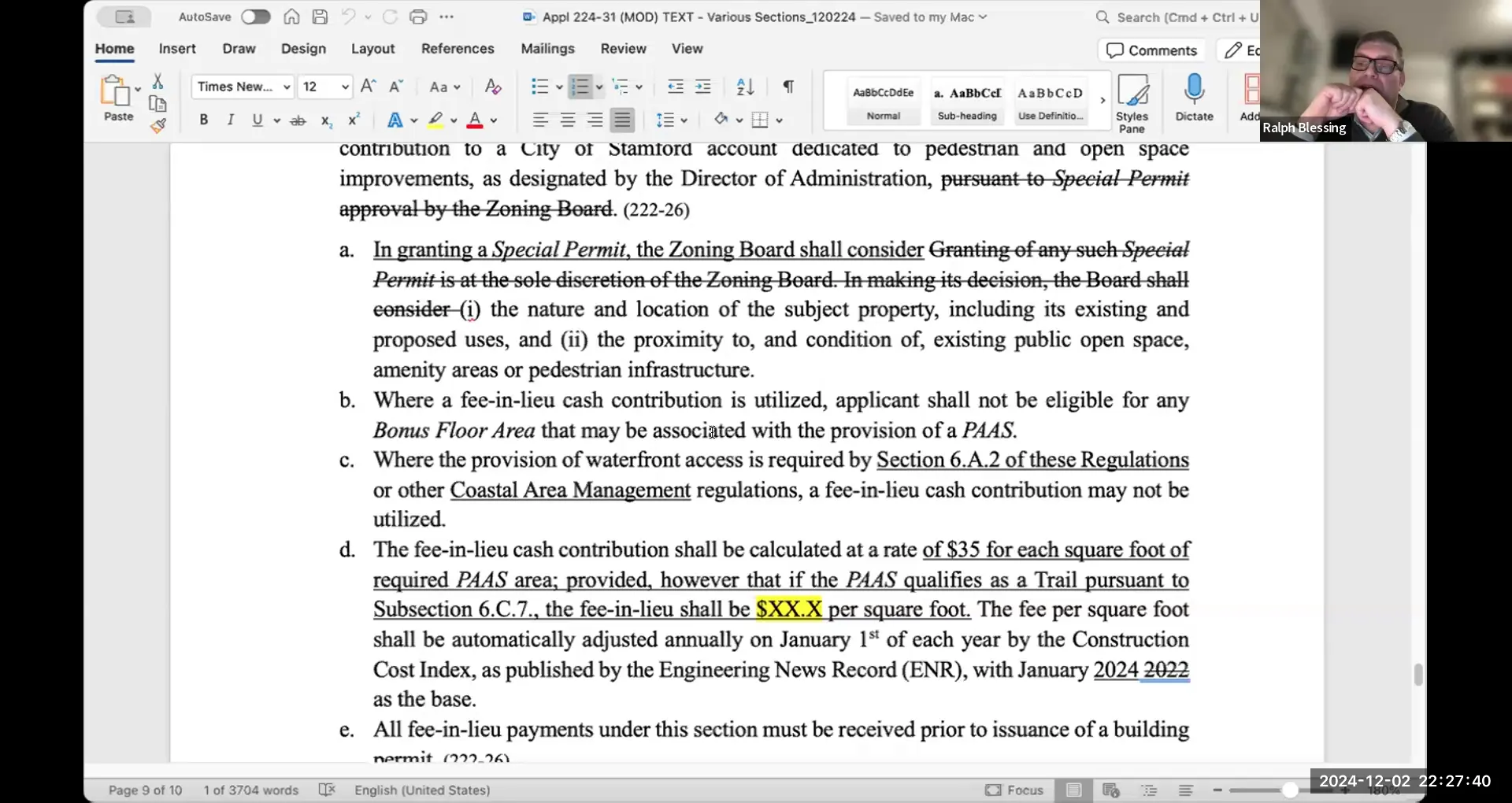
- Text Change (Application 224-31 mod): Ralph, a staff planner, presented proposed amendments to zoning regulations, including updates to references, removal of contradictions, and a new option for a lesser fee in lieu for trails ($15 per square foot) for large properties. Board members debated whether a lower fee would incentivize developers to pay instead of building trails. After discussion, the board decided to keep the fee in lieu for trails at $35 per square foot, deleting the proposed lower amount. The amendment passed unanimously.
- Administrative Review (Application 213-14, Edge Hill Property Corp): The applicant requested a minor modification to add 12 independent living units to the existing senior housing complex at 122 Palmer's Hill Road. Vanita, staff planner, presented conditions including a BMR fee in lieu, tree planting, bike parking, and sustainability scorecard. The board approved 4-0.
- Large-Scale Development (Application 224-32, 74 Broad Street LLC): The applicant sought special permits for a project with over 40,000 square feet of lot area, reduced setbacks, and density bonuses. The board discussed the handling of publicly accessible amenity space (PAS): the applicant will submit final PAS plans prior to certificate of occupancy, with the option to pay a fee in lieu if not met. Conditions also covered parking (316 spaces, including 32 EV), bike parking, transportation demand management, street trees, and easements. Approved 4-0.
- Litigation Transparency Discussion: Board member Jerry raised concerns about transparency regarding the 900 litigation settlement, suggesting a second public hearing for the public to see changes. Legal counsel noted that the public hearing was already closed and cannot be reopened; the board will follow up with the law department.
Key Outcomes
- Application 224-31 mod (Zoning Text Amendment): Approved unanimously. The fee in lieu for trails remains at $35 per square foot; the proposed lower fee was removed.
- Application 213-14 (Senior Housing Modification): Approved 4-0 with conditions including BMR fee in lieu, tree planting, and bike parking.
- Application 224-32 (74 Broad Street): Approved 4-0 with conditions on PAS, parking, bike parking, TDM, street trees, and easements.
- Minutes Approved: November 15, November 18, and November 22, 2024 meetings approved unanimously.
- Future Meetings: Special meeting scheduled for December 9, 2024; regular meeting on December 16, 2024.
Meeting Transcript
No, if they if they would be allowed to provide a trail, but want to make a fee and loo payment instead. Okay. I mean, if they would if they could meet all the requirements for providing a trail, but whatever reason. So you can only do a trail if your PAAS that is required is more than 30,000 square feet. So if it's less than 30,000 square feet, you cannot do a trail. You have to do one of the other types of PAS. So like a plaza, uh through block connection, and all the different types uh that are listed in section six. Um, but on particularly large properties, um, you are because the PAS requirement is 5%, all of a sudden you you have a very big PAS requirement. So that's where we introduced the option of a trail, but trails are obviously much cheaper to build uh than um uh a plaza, uh and they are also usually in areas of town um where the rents are lower, uh it's cheaper, so uh it's it's uh less feasible um to build an expensive PAS with the type of project that's being built there. But well, if we lower the PAAS, the pass B for um trails, aren't we incentivizing the property owner then not to put the trail in but to pay the fee and lo? Um I mean it's like the fee and loo for uh BMRs, it needs to be uh balanced. I mean, the idea of the fee and loo is um that uh you you create an out for situations where it's difficult to provide the amenity, or where uh it doesn't make a whole lot of sense uh to provide uh the amenity. So obviously, if we make it too cheap, then yes, people would go for the fee and loo um uh potentially, but what we also want to avoid is that people build PASs just because they have to, and those PASs don't make um a whole lot of sense. Okay, like um, I mean, in downtown, if you have two PASs right next to each other, that might not make uh a whole lot of sense uh in the context. While you could use the fee and loo to upgrade um uh nearby uh city park or or plant uh street trees uh uh in the public right of way or something like that, but usually obviously PAS um approvals come to you, and uh you have discretion if you if you approve the the fee and loo or or you don't. Got it. Okay. And then um there's a couple of um really small changes. So we uh propose to delete a footnote uh that literally says the same thing uh as a stated in the district regulations. Um because we have uh reorganized the zoning resolutions, uh there is some uh references in there to section 7K, which doesn't exist anymore. Uh the regulation has gone to a different place, so that's just updating uh the reference. The same is true for section 7R that was moved to the appendix. So we just want to make sure that in the regulations it doesn't say 7R, but it refers to the appendix where it's what's now located. Um also um we wanted to clarify that a simulated golf course uh is considered an amusement indoor. So uh one of the issues we have run into is that someone actually wanted to open a simulated golf facility in downtown. And uh we told them that sounds like a great idea. Um we think it could be considered an amusement indoor, but then it turned out that simulated golf course is actually a use that's defined in the zoning regulations, and it's only allowed by special permit in one district, which uh didn't seem to make a whole lot of sense. So uh I mean it's a little bit uh if you remember uh uh a while back we had a definition, a use definition for domestic veterinarians, domestic cats only. Uh it's really sort of cleaning up and and making the use where certain uses are allowed um more rational. Um then uh the next one uh in the PAS section. Um there were just two different uh pieces of information. So in one section it said that you can have a PA, you can have trails as a PAS if the required PAS is uh more than 30,000, and in a different section it says if it's more than one acre. So um to to get rid of that contradiction, we propose to reduce uh it to uh uniformly to 30,000 um square feet, and then uh lastly, and that's actually uh the thing that uh was new in the text uh version that I sent to you today was that the parking requirement and contractors material storage yard uh referred to the wrong uh parking requirement in section uh 12. So this is just correcting uh an error that that was in the regulations, and I believe um that's uh pretty much it. So in summary, I really think most of the stuff is uh uh upgrades and corrections and not anything of of any major significance, but it will clarify uh uh uh a couple of things that we've been struggling with. Um, and and makes it easier for both applicants and the zoning board to apply the regulations. Okay. That's very good. Okay, uh any questions from board members before we go to the public. Thank you, Mr. Chairman. Oh, I'm sorry, Rosan. Go ahead. No, no, Raquel, go ahead. Um, I just wanted um I just wanted Ralph to just um go over the last slide regarding the RM1 and the other zones, just not yeah, run that by a second. Uh you mean slowly, yes. So uh there was an old section 7R that allowed uh special development standards in the RM1R5 and RMF um for for public housing or publicly supported uh housing for affordable housing. Uh so 7R had been around forever. Um what we did was um when we reorganized everything, uh we moved 7R into a footnote in the appendix. We didn't change a thing, we just instead of having a separate section in the zoning regulations, we put a footnote next to RM1, R5, and RMF that basically said exactly the same thing that was uh in section 7R.
openpublica.com