Stamford Zoning Board Meeting: TDR Amendments and 900 Hope Street Approval (June 10, 2025)
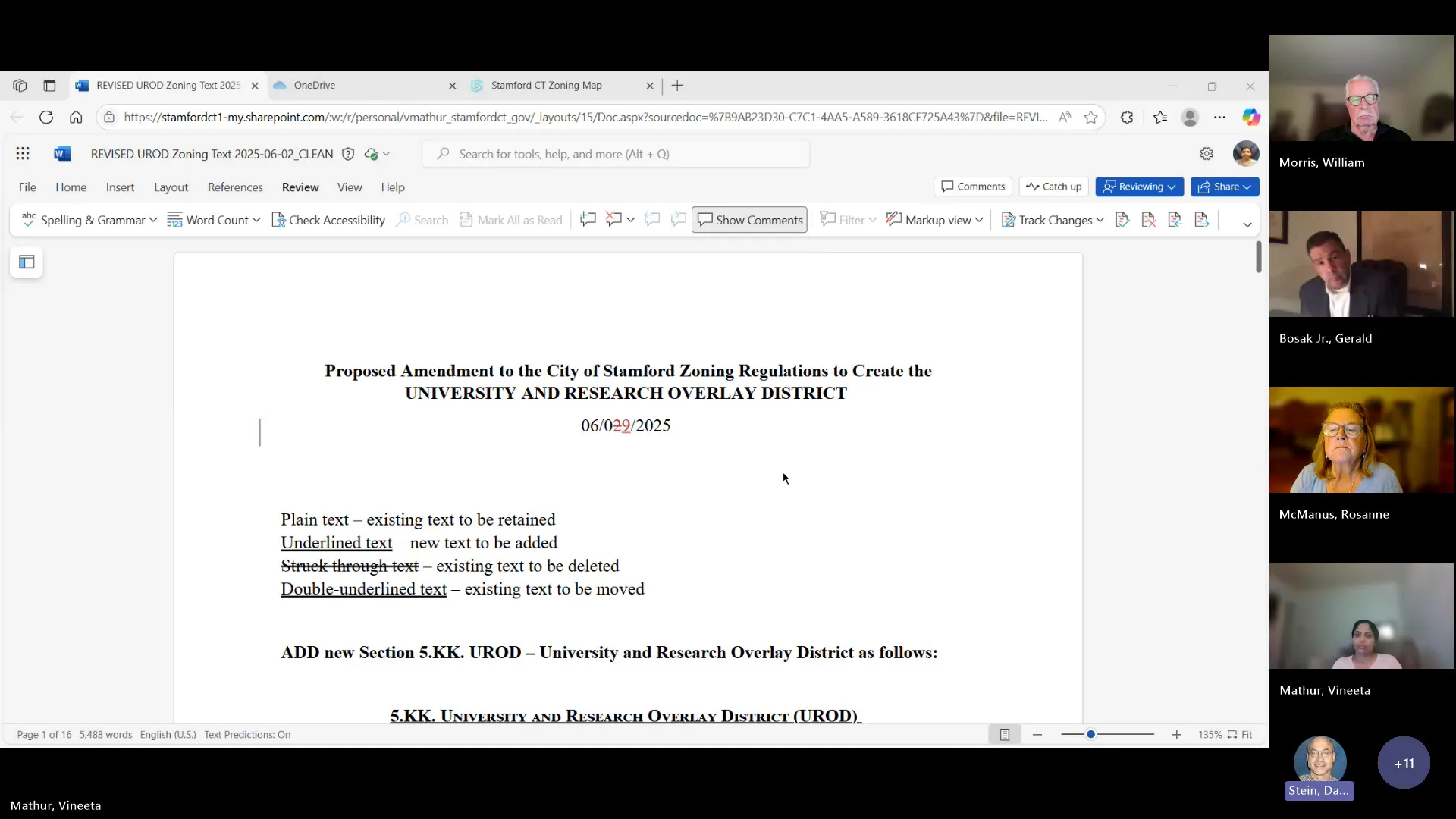
STREAMING COPY IN PREPARATION — RECORDING AVAILABLE FROM THE ORIGINAL SOURCE
Stamford Zoning Board Meeting: Transfer of Development Rights Amendments and 900 Hope Street Administrative Review (June 10, 2025)
The Stamford Zoning Board met on June 10, 2025, to consider zoning text and map amendments creating a new Transfer of Development Rights (TDR) program for cultural and university uses, and to review an administrative application for converting office space to residential units at 900 Hope Street. The board approved both the text and map changes (3-1 each) and granted administrative approval for the conversion (4-0).
Discussion Items
- Transfer of Development Rights (TDR) Program: The board reviewed detailed provisions for a new TDR program allowing transfer of development rights from eligible uses (cultural institutions, universities) within the University-Related Overlay District (UROD) and citywide for historic properties and land donated to the city. Key discussions included:
- Limitations on receiving sites, including height, lot coverage, and building coverage requirements.
- The use of "neighborhood character" language: The board debated whether to retain the term "character" due to precedent elsewhere, eventually substituting "neighborhood traits" to maintain intent.
- BMR (Below Market Rate) requirements: For TDR transfers, the board clarified that the BMR requirement would be the greater of the originating or receiving site's underlying zoning, applicable only to the transferred rights.
- Filing requirements: The agreement containing the TDR must be filed on land records.
- Historic property TDR: Discussion centered on whether to allow transfer of the historic preservation bonus. The board decided to allow it, but added a condition requiring site plan approval for the restoration of the historic property to ensure preservation.
- City-acquired land: TDR for land acquired by the city for a nominal amount was debated; the board agreed to allow transfer of development rights for such acquisitions.
- Receiving sites: The board excluded single-family and low-density multifamily districts from receiving TDRs citywide, but agreed to remove higher-density multifamily districts from the exclusion for historic properties.
- Definitions and Standards: The board reviewed new definitions for development rights, transfer of development rights, and eligible uses (e.g., innovation center, laboratory analytical, university affiliation). Standards for calculation of TDRs were detailed, including adjustments for lot size and vacant sites.
- 900 Hope Street Administrative Review: The applicant proposed converting 1,850 square feet of first-floor office space into four residential units in an existing 21-unit mixed-use building. The applicant requested waivers for light and air reduction, ground floor residence elevation, and usable open space. The board discussed whether the conversion triggered BMR requirements; the language in the regulations was deemed unclear, and the board decided not to require BMR for these four units. Conditions included a landscape plan, facade maintenance, and a term of approval.
Key Outcomes
- Text Amendment (Application 22509): Approved 3-1. The zoning text for the UROD was amended to include the TDR program as presented with modifications (e.g., "neighborhood traits" language, historic preservation condition, city-acquired land TDR for nominal amount).
- Map Amendment (Application 22510): Approved 3-1. The UROD boundary was revised to exclude the Boat Yard site and other areas, as previously discussed.
- Administrative Approval (900 Hope Street): Approved 4-0. The conversion of office space to four residential units was granted, subject to conditions including a landscape plan, hedge trimming, facade maintenance, and a term of approval.
- Next Meeting: Scheduled for June 30, 2025, with items including BMR text amendments, 68 Leonard Street, and potentially 30 Commerce Road.
Meeting Transcript
Are you all seeing the text? Yep. Yes. Yes. So here we we did see, right? Yeah. Okay. Okay. So here are um limitations on the receiving site. That they can't take all of the uh development rights that get transferred to them and use them all automatically. And these are the same standards, I believe, as we had for the bonus, um the 25% bonus. That again, limitation on height, uh lot coverage, building coverage. Um Ralph, am I correct? They're all the same. Yes, they're the same. We didn't change any of them, did we on the uh no in the other one? No. And the last one, number five there, says that um where we allow the larger the use of the um uh development rights on the receiving site. Um you can't also combine that with um bonuses and premiums. Any questions or discussion on limitations for the receiving site? No. Nothing for me. Um D says that uh the approval of the transfer of development rights by the zoning board is discretionary, and um uh it's a special permit approval. We may deny the transfer for any reason, including but not limited to that it would allow development inconsistent with the master plan or create a significant adverse impact on neighboring properties or neighborhood character um as compared to an as-of-right development. Um this may be where we would get into um yeah, neighborhood character. That's uh you know um where we talked about a building towering over um South End residential properties. Um this may be a clause we would look at to see if adding the additional height or um the additional density would create a significant adverse impact on those neighboring properties. Any discussion on this okay? Uh E says that the um do we want to use the word neighborhood character here? Yeah, I was just gonna um or should we just leave it at the significant adverse impact on neighbor on neighboring properties? Um elsewhere have you moved away from using the word character? Yes. It is um it is now a word that uh we try to avoid. Um I'm fine taking it out. Do you anyone think we're losing anything? We remove it. Uh I I do think we're losing a lot by removing it, but since that precedent was made on 900 and 800 long ridge road, I think we have to move it out. Well, we can use different words if they're what is it that we're that we're trying to get at? Um I I agree with your I I think your your your beginning point was spot on, but I can't use that term, you know. Right. I think just you know the first part covers, you know, gives us broad coverage. that we're trying to get at um I don't know I I agree with your I I think your your your beginning point was spot on but I can't use that term you know right I think just you know the first part covers you know gives us broad coverage um to deal with those situations without adding specifics here I mean yeah I think you're yeah go ahead I think you're right Benita I don't think we lose a whole lot by taking it out um so can I can I be devil's advocate what why did we have that in there in the beginning why was it ever written what was let's use another adjective uh you know at uh character or descriptor of character um i'm i'm okay with that if you just got their thesaurus handy i or they you want to say or then the neighborhood overall uh sure or the neighborhood traits i would love that um the quality of the neighborhood uh no that's the wrong yeah no i would say neighborhood traits i i like traits okay i'm good with that you okay okay neighborhood identity uh no that's wrong that's a little different yeah slippery slope neighborhood livability i'm sorry i i didn't realize i have my microphone off so i'm sorry the uh when we just redid the uh the purpose clause of our zoning regulations that issue came up what terminology do we use there he just took it off entirely i think i don't think we put another word in place of it so why do we want to add it in here i think you know we can put a synonym but i think it means the same thing so it might put back in the same position i i don't see a big difference between character and traits but then again that's not my uh uh so you're saying traits is a good a good substitute for character i don't know uh i think it i think the whole neighborhood traits or character should not be in there since we don't have it in our uh purpose for the zoning regulations but that's just opinion i'm not gonna make a big deal about it okay so why don't we stick with traits okay okay um next uh the originating and receiving site owners must jointly file an application for the special permit and the transfer development rights shall be filed on the record the land records of both the originating um Rob uh uh Ralph this is not exactly right um it's the transfer of development rights agreement um which is referenced down in G um is what gets filed um yes I mean you can't really file the rights yeah so I mean I guess the the point is yeah I I think it it should probably be the agreement but the point is that everyone should know okay this site the originating side has lost so and so many square feet of development rights and the receiving side gained so and so many square feet of development rights. um is what gets filed um yes i mean you can't really file the rights yeah so i mean i guess the the point is yeah i i think it it should probably be the agreement but the point is that everyone should know okay this site the originating site has lost so and so many square feet of development rights and the receiving side gained so and so many square feet of development rights yeah yes I mean you could see the document document or the agreement containing the the agreement containing the transfer of development rights no the CNG we already have it at we already have a name for it so just put the word agreement after rights and um and I think it'll yeah right um okay so FBMR requirements the the site where the uh rights are transferred to um is subject to all the BMR requirements and um the the requirements shall be the greater of the underlying zoning district of the originating site or the receiving site Ralph can you explain that to us I mean we we have um slightly different uh BMR requirements in uh different districts so um if you transfer development rights from uh a site that has 10% BMR requirement to a site that has 12% uh BMR requirements we want that the higher of the two numbers um uh is used to calculate the BMR requirement but wouldn't wouldn't the receiving site let's say the receiving site are we talking about the the development rights that are transferred or we're talking about the whole site i mean let's say the the originating site is 12 percent and the receiving site is eight percent and they do a transfer now we're saying that the receiving site now adopts the 12 percent i think it's only for the trans the the differential uh the the differential okay i don't yeah i don't think we made that clear um i think it it looks like it applies to everything the bm requirement for the transfer development rights the bm for the requirement for the development rights which are transferred yeah i think that that's clear yeah and then the the last sentence just says you you all of the um you look at the total density um including the rights that have been transferred when you calculate the bmr requirement okay transfer oh and the okay so g is where we get into the agreement that the parties have to um sign and um file file on the land records this is fairly similar to if you remember when we did a uh zoning lot development agreement where we said you could transfer rights on one zoning lot between buildings um and we so we took that as a guide here um so the they've got to come to the zoning board with an agreement and that's subject to part of the special permit approval by the the zoning board uh also has to be approved by the law department um there is a definition transfer of development rights which has been added to section three b the um definitions and it has to comply with that and i think that's that's later on isn't it rap yeah yep actually could i go with that yeah let's just take a quick look at that is it under development rights uh the sort it's in section three so it's before all the use definitions okay yeah i think that's that's it yeah no no that's no no it's yeah yeah it is okay it's after it's after that uh so there's transfer of development rights and then there's transfer of development rights agreement should be the next definition no i think it's above that isn't it uh let's see might be right off It's after it's after that. Uh so there's transfer of development rights and then there's transfer of development rights agreement, should be the next definition. No, I think it's above that, isn't it? Uh let's see. There it is. Yeah, okay. So this is the definition and the the agreement has to comply with this definition.
openpublica.com