OPENPUBLICA · PUBLIC MEETING RECORD
Record of Proceedings
St. Pete Beach City Commission Budget Workshop Summary: May 12, 2026
City Commission — Tuesday, May 12, 2026
BodySt Pete Beach, Florida
SessionCity Commission
DateTuesday, May 12, 2026
StatusFILED
Video Record
STREAMING COPY IN PREPARATION — RECORDING AVAILABLE FROM THE ORIGINAL SOURCE
Transcript — Verbatim
Speaker numbers apply only to this recording.
Discussion Breakdown — Share of Meeting
Capital Improvement Plan29%
Fiscal Sustainability15%
Fee Analysis11%
Water And Wastewater Management11%
Infrastructure8%
Budget Equity Analysis7%
Grant Funding3%
Revenue Generation Ideas3%
Procedural2%
Summary of Proceedings
St. Pete Beach City Commission Budget Workshop Summary: May 12, 2026
This budget workshop focused on two primary areas: a detailed overview of potential revenue generation strategies to address a projected $218 million infrastructure need over five years, and a preliminary prioritization of the city's capital improvement projects (CIP). Commissioners debated whether to set revenue priorities before or after fully vetting and possibly reducing the capital needs list, ultimately deferring major revenue decisions. Staff was directed to refine the capital project list by priority rating and explore specific asset sales and existing fund optimization before pursuing broad-based new revenue sources or resident assessments.
Discussion Items
-
Budget Workshop Context and Revenue Generation Strategies: Finance Director Devin Schmidt presented revenue options developed by a working group. Key proposals included a fire assessment fee ($2-3M/year), adjustments to enterprise fund fees (reclaimed water, stormwater, wastewater), a resiliency fee ($7/ERU, ~$840k/year), bond financing (various scenarios), a community redevelopment area (CRA) TIF, and public-private partnerships. Staff noted limited local control over taxes like the bed tax and sales tax, and a 1% grant eligibility rate for operating needs. A $12.5 million subsidy of enterprise funds over the past five years was highlighted as an unsustainable practice.
-
Finance Budget Review Committee Recommendations: The committee recommended staff pursue fire assessments, parking fee optimization, and enterprise fund adjustments. Road tolls were recommended against pursuit. Philanthropic fundraising and public-private partnerships were considered lower priority.
-
Commissioner Philosophical Debate on Revenue vs. Spending: Commissioners broadly agreed on the need to clarify the scope and urgency of the $218 million in capital needs before deciding on specific revenue tools. Mayor Tate argued the city was "putting the cart before the hearse" (a malapropism of "cart before the horse"), preferring to finalize spending priorities before determining revenue needs. He suggested exploring selling city assets like the sewer system to the county. Commissioner Causing echoed this, stating residents would need a clear "why" for fee increases related to specific critical failures. Commissioner Maldonado advocated for a flexible approach, noting infrastructure planning is a "moving scale."
-
Specific Revenue Feedback from Commissioners: Road tolls faced universal opposition. The fire assessment fee, though capable of generating $2-3M annually, was noted to require 24 months to implement and would apply to all properties. Regarding the CRA, Commissioner Robinson noted challenging feedback from Pinellas County, but staff recommended continuing the process. On bond financing, interest was expressed in revenue-backed bonds (e.g., against parking revenues) over general obligation bonds. Commissioner Robinson requested staff research business license/registration fees for short-term rentals, and asked about trademarking the city name for licensing opportunities. Philanthropic fundraising and a "round up" program were not considered a priority.
-
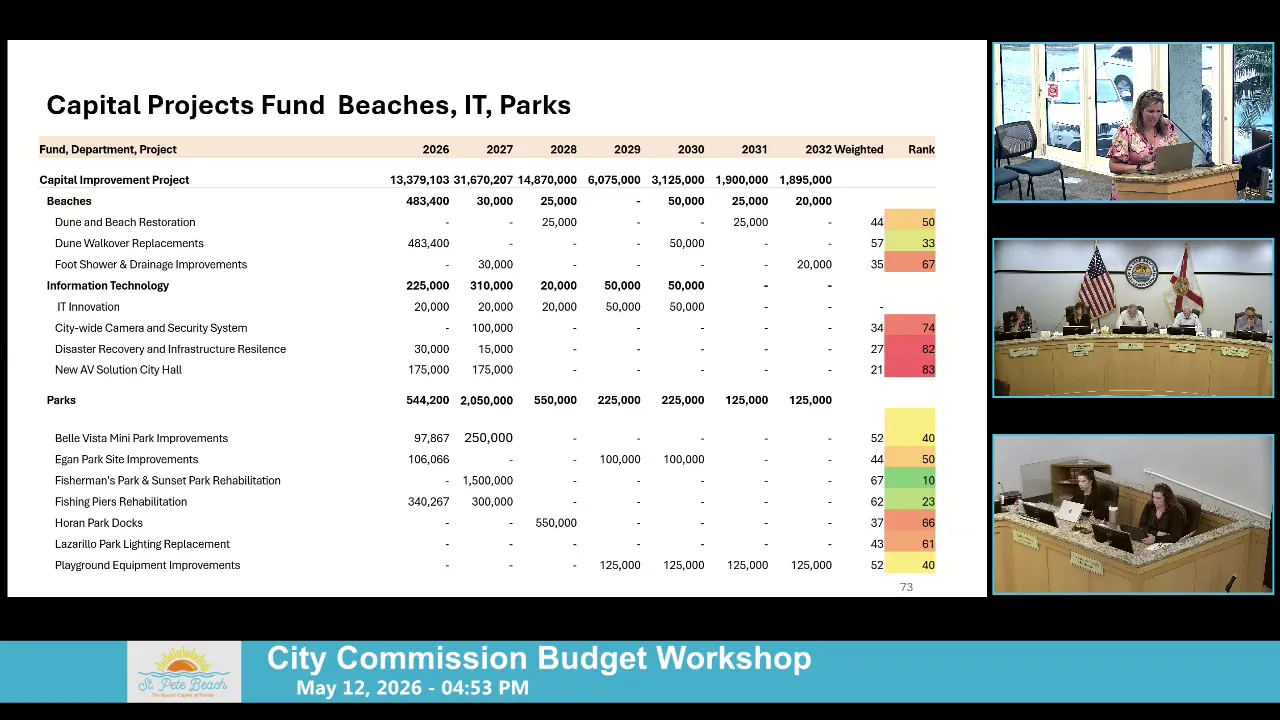
Preliminary Capital Improvement Plan (CIP) Prioritization: Devin Schmidt and Public Services Director Camden Mills presented a priority matrix ranking all 84 capital projects. Projects were scored on health/safety, regulatory mandate, asset condition, and bundling opportunities, resulting in "Green" (must proceed), "Yellow" (possible to proceed), and "Red" (consider defer) ratings. Staff modeled that without new revenue, the general fund, resiliency fund, and utility funds would run negative balances by 2027. The parking fund, buoyed by recent fee changes, was projected to have a positive ending balance.
-
Capital Priorities Discussion and Further Direction: Commissioners requested a refined breakdown of the CIP investments. Mayor Tate asked staff to draw a "strike line" to exclude red-rated projects, calculate the total cost of only green and yellow projects, and specifically identify the 2027 fiscal year cost for these priority items. Commissioner Marriott asked for an analysis of the fiscal picture if enterprise funds were to become fully self-sustaining, freeing up general fund money for capital.
Key Outcomes
- No Formal Votes: The workshop resulted in no formal votes but provided clear philosophical and directional guidance to staff for the next budget workshop on June 9th.
- Staff Direction on Capital Projects: Staff will re-present the CIP aggregated by priority color (Green, Yellow, Red), showing the total five-year cost and the specific 2027 impact for each tier.
- Staff Direction on Revenue Exploration: Staff is directed to continue researching specific near-term items (short-term rental fees, sewer system sale feasibility, TDT funding opportunities for the pier) but to defer significant new work on broad revenue generation strategies (rate adjustment public hearings, bond structuring, fire assessment studies) until the refined capital needs are reviewed and a clearer scope of critical funding is established.
- Commissioner Consensus: A predominant consensus emerged to minimize the financial burden on residents by first seeking efficiencies, exploring asset sales, leveraging state and county funds, and right-sizing the capital plan before resorting to new broad-based assessments or major rate increases for essential infrastructure.
Meeting Transcript
Uh good afternoon. Call together this meeting of the budget workshop. Today is Tuesday, May twelfth, and it is three o'clock PM. Please stand in rise for the pleasure leaders. Undergished liberty and justice for all. Commissioner Maldonado. Here. And Mayor Tate. Here. We have a quorum. Thank you. So I'm a little more adept at the uh at the commission meetings, but uh, I see we've got a presentation to start out workshop uh for a revenue on audited reserve preliminary capital projects improvement plan and priorities. Hi, how are you, Devin? Yes, hi, good afternoon, Mayor and Commission, Devin Schmidt. I'm the finance director for the record, and I will be taking you through um quite a few um slides as it relates to some of our revenue ideas that we've come up with. Um, we'll talk through the preliminary capital projects improvements and plans and priorities, and um, in between revenues and capital, I'll ask you guys to take an opportunity to help us rank and determine um what direction we need for staff to move forward on our revenue um generation ideas and where we should focus our efforts. And then I'll take you through the capital projects preliminary prioritization. So kicking off, we're gonna walk through some revenue generation strategies. So kind of setting the stage is why we're here. Looking at the total cost of the city and the total cost to run the city. Our city manager is always asking that question what does it look like? So our infrastructure needs are in the amount of 218 million over the next five years, which does some of those projects predate the storms. We do have some ad valorum changes and house bills that may eliminate at the worst case scenario, around 4 million in ad valorum. And then we have a pretty aggressive capital improvement five-year need. And then we also, as the commission is aware, have some enterprise funds that are not operating like a business unit and sustaining revenues where they're requiring offsets and transfers from our general fund or our parking fund. So as we walk through this presentation, at the end, we'll be looking for direction on where we should focus our efforts on our revenue generation strategies. So to kick off, this is a very high level forecast for us. If we're looking at the next five years estimated revenues and expenses, looking at kind of our operating expenses there, we have that just running at a 3.3% when the last time I pulled CPI was. We have revenue growing around 3%, and this is based on our 26 fiscal year budget. Our assumptions would be looking at removing any of those other revenue sources and any of the internal transfers between other funds. So this also does have a 25% reserve. While we know today, our our enterprise funds do not all have a reserve policy, but our general fund does. So we just wanted to kind of show what is that overall gap in funding that we're looking at to date based on our forecast. So when we're looking at building out our capital projects and all of our budgetary figures, we're trying to align with the commission in the sense that we're looking at our strategic plan roadmap that we had put together with you all. As you can see by the bar chart as well as the pie chart, our primary focus is on recovery resiliency and sustainability, followed by reliable infrastructure. So we just wanted to provide what categories these projects track in as far as what we're looking for over the next five years. So I wanted to share a little bit of context about how this revenue generation working group came together. So we launched in December and we had a couple meetings that as a lot of folks in this room. So thank you for all your efforts, helping us come up with some ideas. We tried to leave really no stone left unturned. We looked at all of what we could legally do, what we legally cannot do, what are some creative ideas that we could come up with. And so then after that, we started looking at more of the analysis and some of the vetting. So coming up with ideas where we have opportunities, whether it's statutory, um, and then going through and doing a refinement and a prioritization, which I'll take you through as we get later in the presentation. And then we're here today for direction on where we should continue putting those efforts forward. So to set the stage a little bit further, I wanted to give the commission just a reminder and an update kind of where we've come and where we've been at with our current revenue streams.
SUMMARIZED BY OPENPUBLICA AI
TRANSCRIPT VIA PUBLIC VIDEO
openpublica.com
openpublica.com