Tacoma City Council Study Session: Alternative Response and Historic District Moratorium - March 19, 2024
STREAMING COPY IN PREPARATION — RECORDING AVAILABLE FROM THE ORIGINAL SOURCE
Tacoma City Council Study Session: Alternative Response and Historic District Moratorium - March 19, 2024
The Tacoma City Council held a study session on March 19, 2024, at 12:00 PM in the Council Chambers. The meeting focused on two major briefing items: a quarterly update on the city's alternative response programs (including HEAL, HOPE, Community Service Officers, and a new library pilot) and a debrief on the public hearing regarding a proposed moratorium on new local historic districts. Additionally, the council received a weekly report and set the agenda for the evening's regular meeting.
Alternative Response Quarterly Update
The City Manager, Elizabeth Pauli, opened by reiterating the goal of enhancing public safety by connecting people with the right resources at the right time, grounded in community feedback and prior studies. Updates were provided by several departments.
Homeless Outreach (HEAL Team)
- Director Alison Griffith reported that the HEAL team is now fully staffed and focusing on proactive outreach. As of March 1, 2024, there were 181 open requests regarding homelessness in the Tacoma 311 system, a 93% decrease since January 1, 2023. Year-to-date, the team made 361 connections, with 179 clients accepting services and 41 individuals placed in temporary shelter. Response time averages 72 hours from complaint to initial site visit, with a 74% on-time completion rate.
- The team acquired two new Ford F-150 hybrid trucks with Tommy lifts and expanded storage capacity, enabling better transport of supplies and multiple clients simultaneously. The team also stores belongings for approximately 25 individuals at any given time, with a minimum 60-day storage policy. A new public dashboard is in development, with a target launch by the end of the next quarter (Q2 2024).
Behavioral Health Response (HOPE Team)
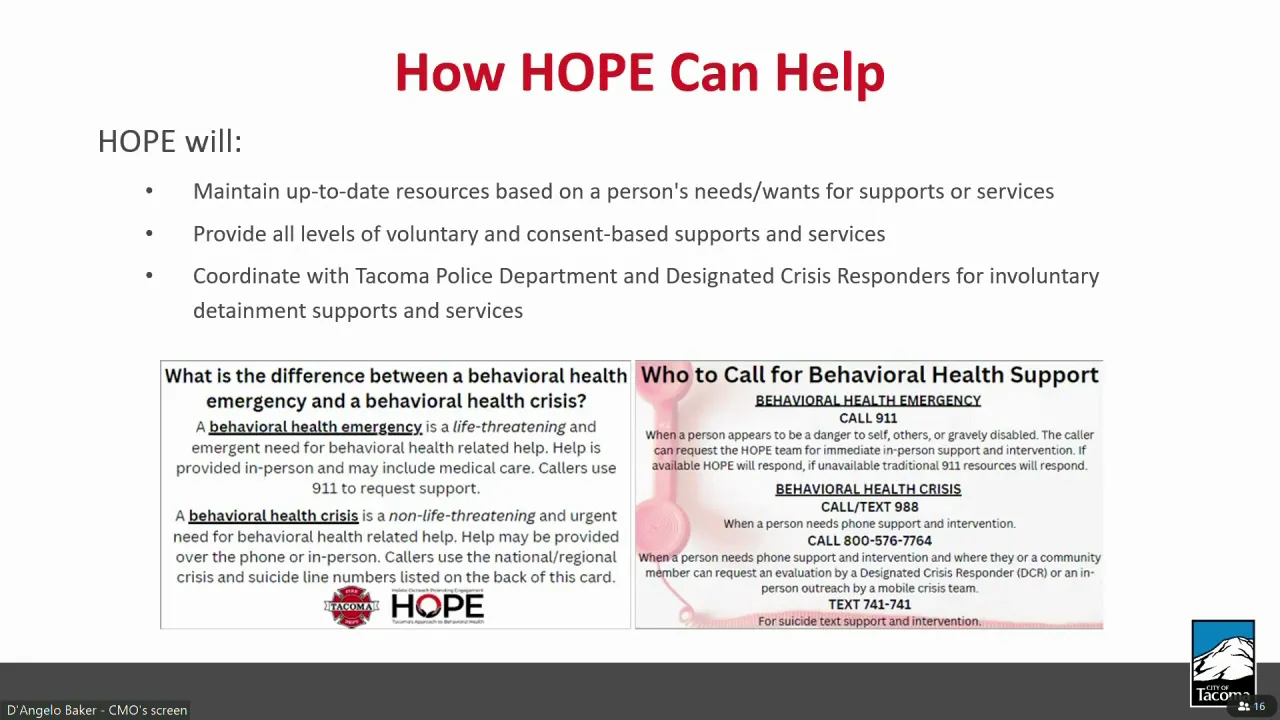
- Co-managers Alice Morales and Cassie Hallstone presented the HOPE team's progress. Since launching on September 6, 2023, through March 6, 2024, the team has completed 236 in-field responses (180 with Tacoma Fire Department, 56 with Tacoma Police Department). The case manager has 73 individuals enrolled and 126 on a waitlist, with 199 total referrals.
- Key outcomes include diversion from jail (18 individuals) and from hospital (more than 18). Average on-scene time ranges from 30 minutes to over an hour, with the team now able to transport clients directly to stabilization services. The team continues to hire for an advanced registered nurse practitioner and a certified peer specialist, citing compensation challenges for the ARNP position.
- Partnerships include local health authorities, 988 crisis line, and community organizations. Data collection aligns with state and county behavioral health requirements.
Community Service Officers (CSO Program)
- Deputy Chief Paul Younger provided an update on the new CSO program, part of TPD's 12-point plan for accountability and transparency. The first round of CSOs will handle non-emergent, nonviolent calls to free up commissioned officers. After interviewing 57 applicants, 10 candidates have advanced to background checks; two have completed all phases and received offer letters. The goal is to have CSOs on duty by May 2024, working 7:00 AM to 9:00 PM, split into two shifts, covering 5–7 days per week. The first academy is scheduled for April 2024 (4 weeks classroom, 20 days field training).
Library Patron Crisis & De-escalation Pilot
- Amita Lunill, Deputy Director of Tacoma Public Libraries, reported that a Library Social Worker and a Safety & Security Coordinator were hired on January 2, 2024. The social worker provides direct service at five of eight library locations; 65% of engagements are patron-initiated. Examples include connecting a domestic violence survivor to shelter the same evening, assisting a patron living in a car to complete a coordinated entry assessment, and navigating a five-hour crisis intervention for a patron threatening self-harm.
The City Manager announced recent funding successes: $1 million in the state operating budget for Tacoma's street medicine expansion (part of $3.7 million statewide) and a $963,000 federal earmark for the CSO program and designated responder programs.
Historic District Moratorium Public Hearing Debrief
- Principal Planner Reuben McKnight presented a recap of the March 5 public hearing on a proposed one-year moratorium on the creation of new local historic districts. The moratorium would not affect individual historic listings, existing districts, national register nominations, or other preservation regulations. Its purpose is to allow the 2024 Comprehensive Plan amendment process to update the code.
- The public hearing received 37 comments (34 written, 3 in-person). The most common themes were that the moratorium is not necessary (citing the discretionary process and infrequency of district creation) and that it is inequitable (potentially denying underserved areas access to tax incentives and chilling future efforts). However, staff clarified that individual property tax incentives remain available, and no current initiatives for new districts are underway in underserved areas.
- The Planning Commission and Landmarks Commission both recommended the moratorium be tied to the comprehensive plan update or one year, whichever comes first. Council discussion considered possible exemptions for the downtown regional growth center to avoid harming economic development, as well as clarifying that the moratorium could sunset earlier if code changes are adopted before the year ends. Councilmember Rumba expressed strong support for historic preservation and for using the pause to make the process more equitable citywide.
Committee Reports & Agenda Review
- No committee reports were given. The City Manager noted two opportunities for public comment during the evening's regular meeting and confirmed the agenda includes introduction of the 2024 Daffodil Festival Royal Court.
Key Outcomes
- The council received the alternative response quarterly update and expressed appreciation for progress, no formal vote was taken.
- For the historic district moratorium, the council will consider a first reading on April 16, 2024, and a second reading on April 23, 2024. Council members expressed interest in tying the moratorium's expiration to the adoption of updated code (not to exceed one year) and in potentially excluding the downtown regional growth center. Final language will be drafted based on direction received.
- The council adjourned the study session at approximately 1:30 PM.
Meeting Transcript
I would like to call to order the city council study session of March 19th, 2024. Clerk, will you please call the roll? Councilmember Bushnell. Present. Councilmember Daniels. Here. Councilmember Diaz. Here. Deputy Mayor Hines. Here. Councilmember Rumba. Here. Councilmember Scott. Here. Councilmember Eshka. Absent. Councilmember Walker. Here. Mayor Woodards. Here. Mayor and Council members of study session materials sent to you at 11. All right. Thank you very much. We are going to move on to our first agenda item, which is the alternative response quarterly update. One of my favorite times here at the city. So I'd like to call on City Manager Polly to begin the presentation in person. Thank you, Mayor. Mayor and Council. I'm going to open our conversation on our the city's alternative response efforts with a few remarks and then turn it over to the departments for you to hear directly about the status of their programs. So next slide, please, D'Angelo. As always, just beginning with a reminder that the programs that you're going to be hearing updates on today were founded in community feedback, council direction and the recommendations of studies conducted on policing and alternative response. And ultimately, this work is also grounded in our commitment to systems transformation captured in resolution 40622. For more background information, anyone interested can link to the studies and recommendations at our website at CityofTacoma.org/slash community safety. Next slide. So since the initial studies that we've continued to evolve our approach and our understanding of alternative response based on what we're learning through research and practical application and conversations with the community and the council. So as with any new and enhanced service, we're continuing to adapt and apply what we learn as we go. In short, the goal of the alternative response programs is to enhance public perception of safety by connecting more people with the right resources at the right time. We're doing this through innovating, expanding, and enhancing three city services and different different programs. And those are shown on the next slide. So those include expanding and enhancing our homeless outreach services, creating our dedicated behavioral health response team, and providing our unarmed community service officers within TPD. And you're you're going to hear about the progress that staff's making in each in each of these program areas in more detail today. And in a similar spirit, we're also going to you're also you will also get an update today about the patron crisis and deescalation team that's being piloted by Tacoma Public Library. So hear about that today. Next slide, please. As we implement this work, we've been using this slide to give an overview of the expanded response types and services that are capable of addressing a wider range of situations with more specialized resources to meet community needs. And these are not limited to 911 access services and range from proactive outreach to emergency response. Next slide, please. This is the um from you'll recall from prior presentations. This is just a standing remire reminder that our public safety response is designed to address situations along a broad spectrum of risk. Again, from community engagement events, low calls, low-call risk for service, low risk calls for service, like responding to car prowls when no suspect is present on the scene, all the way to higher risk situations where there is a threat to persons or property.
openpublica.com