Tacoma City Council Study Session - June 25, 2024
STREAMING COPY IN PREPARATION — RECORDING AVAILABLE FROM THE ORIGINAL SOURCE
Tacoma City Council Study Session - June 25, 2024
The Tacoma City Council held a study session on June 25, 2024, to discuss the citywide pavement condition rating, proposed charter amendments, the charter review timeline, and the Urban Development Action Grant (UDAG) program. The meeting included a brief recess due to a loss of quorum and concluded with preparations for the evening's regular meeting.
Discussion Items
-
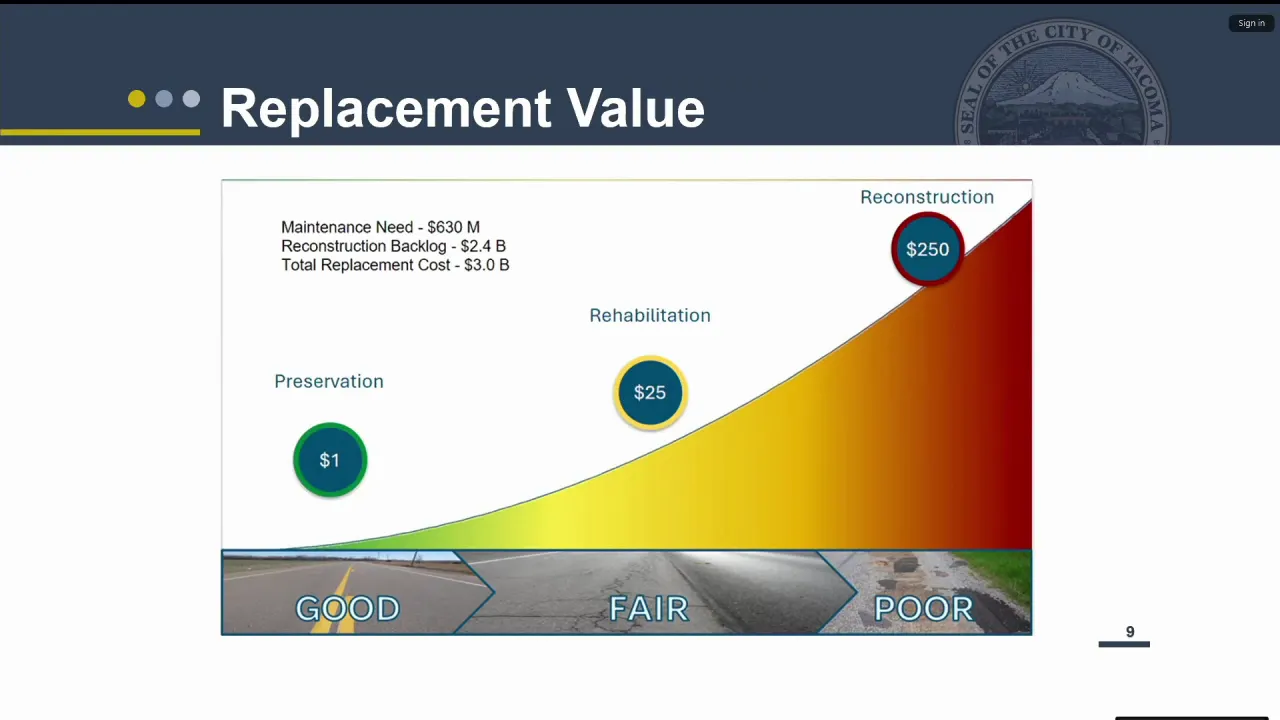
Citywide Pavement Condition Rating: Public Works Director Ramiro Chavez and Pavement Manager Eric Sloan presented the updated Pavement Condition Index (PCI). The city's network is approximately 60% arterial and 40% residential streets, primarily asphalt. The Streets Initiative (voter-approved) has improved residential PCI by 10% since 2015, but arterial conditions have declined significantly. The replacement value of the entire network is estimated at $3 billion, with $630 million needed for preservation and $2.4 billion for reconstruction of the 30% of streets in poor condition. Reconstructing all streets to complete street standards would cost an estimated $12.5 billion. Challenges include the reconstruction backlog, 50% of arterials in poor condition, and the high cost of upgrading gravel and brick streets (e.g., cobblestone reconstruction costs ~$400,000 per block vs. $100,000 for asphalt). Opportunities include leveraging the upcoming Streets Initiative Two and Transportation Master Plan to refocus efforts. Council members inquired about equity indexing, striping programs, and communication of pavement conditions to the public. No votes were taken.
-
Proposed Charter Amendments Review: City Manager Elizabeth Pauli introduced two amendments: C4 (waterfront property disposition) and 24C (an updated version of 24B). C4 (sponsored by Councilmember Rambah) was confirmed as unchanged. 24C incorporates five changes from the previous week, including: (1) adopting CRC 7 language on full-time council status and interaction with the mayor's staff; (2) adding council confirmation for the mayoral appointment of the city attorney (CRC 13); (3) revising the planning commission composition (CRC 14B); (4) retaining the current charter language on the Tacoma Humane Society; and (5) fixing a scrivener's error regarding the landmarks preservation commission. Councilmember Diaz proposed removing the last sentence of section 2.05 regarding council direction to mayor's subordinates, but after clarification from the city attorney, considered leaving it. Councilmembers discussed the implications of a mayor-council form of government, including council authority over settlements, resolutions, and budget. No formal action was taken.
-
Charter Review Timeline: City Manager Pauli presented an updated timeline. The Pierce County Auditor may be available to meet with the council on July 2, 2024, earlier than originally scheduled. Staff proposed a July 2 study session starting with an executive session on council candidate qualifications, followed by the auditor discussion at 3:00 PM. The calendar also includes dates for committee letters and resolution appointing for-and-against committees. Councilmember Walker noted she would be out on July 16. No formal action was taken.
-
Urban Development Action Grant Program: Finance Director Andy Cherullo and Chief Deputy City Attorney Steve Victor provided an overview of the UDAG program, a federal revolving loan fund from the 1970s. The city received an initial grant of approximately $1.5 billion (federal), and the remaining funds revolve through loans. Current outstanding loans include a $3 million loan for Valhalla Hall (issued 2018, due 2046), approximately $470,000 in COVID-era small business loans (21 still outstanding), and a $1.7 million investment in the former attempt site on 69th & Proctor (expecting repayment upon land sale). The current cash balance is about $5 million, but this does not account for pending repayments or expenditures. The fund has historically leveraged city investments 10 to 20 times through private investment. Councilmembers discussed default protections, the decline of the fund over time, and the lack of post-investment analysis. The fund will continue to be managed by the Community and Economic Development department, with council approval required for new allocations.
Key Outcomes
- No formal votes were taken during the study session.
- The council will receive further updates on the Streets Initiative Two planning, using the new pavement condition data as a baseline.
- The charter amendments (C4 and 24C) will be revised based on council feedback, with a final version to be presented for possible ballot placement.
- The July 2 study session will include the Pierce County Auditor and an executive session on council candidate qualifications.
- The UDAG fund will continue to be used for economic development projects that meet eligibility criteria and leverage private investment, with staff to provide more detailed loan histories to council.
- The evening's regular meeting will include a ceremonial recognition of the Tacoma Stars Reserves indoor soccer team, which won the National Amateur National Championship in April.
Meeting Transcript
All right. I'd like to call to order the city council study session of June 25th, 2024. Clerk, will you please call the role? Council Member Bushell. Council Member Daniels. Council Member Diaz. Here. Deputy Mayor. Here. Council Member. Here. Council Member Saw. Absolutely. Council Member Walker. Here. Mayor orders. Absolutely. All right. Thank you. Our first agenda item is the citywide pavement condition rating. I'd like to call on public works director Ramiro Chavez to begin the presentation. And he is joining us in person with Eric Sloan from Public Works. Welcome, gentlemen. Good afternoon, Deputy Mayor, Council members. Today we have for you a uh very technical presentation related to the payment condition rating. Uh the city utilizes this is a uh an assessment of uh uh of that we've just gone through in the last few months, updating the condition rating, what we call is the payment condition index. And um in this is an industry standard uh they all the jurisdiction uses to assess the conditions of the streets, give us the opportunity to assess what the life cycle of those uh pieces of infrastructure are, and also give us uh an indication of what uh management and what uh activities they will need to do to prolong if that is an option, the life expectancy of uh of uh of the street. So with me, I have uh Eric Sloan, he's the pro uh the payment manager for the city, and he will kick off this um presentation. Thank you. Um so uh as Ramiro said, my name is Eric Sloan. I'm the city's pavement manager. Uh thanks for having me here during this uh busy time. Um and I'm just here to discuss that uh pavement condition assessment. Uh next slide, please. So before I get into uh the the details here, I'm gonna go over a little bit of background on pavement management uh and take us into the network composition and conditions before uh talking about how those come together uh into maintenance categories and uh then help us uh come up with a uh replacement value, which uh then will lead us to the opportunities and challenges that we face as a result of this data. Next slide, please. So uh I want to take just a minute to define pavement management and to give you an idea of what we're trying to accomplish uh through this philosophy. So basically, we're trying to attain optimal street conditions at the lowest lowest possible life cycle cost. Uh so if you uh look at the red line on the diagram here, if you uh construct a street uh right off the bat uh and and don't do anything to it for 20 years, it's likely that you're gonna have to reconstruct that again at that point, and that's quite expensive. Uh so if you uh if you follow the the blue line, uh the philosophy on the blue line there, um, and perform maintenance at regular intervals. Uh you avoid that costly reconstruction and extend that life cycle out uh you know, three to even four times that length. So uh it's a lot uh it's a very cost-effective way to do things. Next slide, please. So to be effective at managing the network through this philosophy, we need information. We need to know where our streets are, what they're made of, uh, what they're used for, and what kind of shape they're in. Uh the chart on the right here uh shows the process of gathering that data. Basically, we start with a map of our network, uh, add in some of the details that we know about, uh, like the pavement types and things like that, and then pass it off to a consultant who drives a fancy van around town like the one you see on the screen. And uh, we have them collect as much data as they can about as many aspects as they can gather so that we have uh as much data as we can possibly take in order to help make more effective decisions about how we do things. Next slide. So that background on pavement management out of the way.
openpublica.com