Tacoma City Council Study Session: Smelter Plume and Equity Index Updates - July 23, 2024
STREAMING COPY IN PREPARATION — RECORDING AVAILABLE FROM THE ORIGINAL SOURCE
Tacoma City Council Study Session: Smelter Plume and Equity Index Updates - July 23, 2024
The Tacoma City Council held a study session on July 23, 2024, at 12:00 PM. The meeting covered updates on the Tacoma Smelter Plume cleanup and the Equity Index, as well as administrative items. Council members engaged in extensive discussion on both topics, emphasizing data-driven decision-making and equitable resource allocation. No public comments were received, but opportunities for public input during the regular meeting were announced.
Tacoma Smelter Plume Update
- Presenters: Dana de Leon (Assistant Division Manager, Environmental Services) introduced representatives from the Washington State Department of Ecology: Marian Abbett (Project Manager), Justin Zakoren (Remediation Manager), and Sarah Miller (Outreach Coordinator). They provided their 11th annual update on the Tacoma Smelter Plume cleanup.
- Background: The smelter operated for nearly 100 years, emitting arsenic and lead over approximately 1,000 square miles across three counties. The cleanup is funded by $94.5 million from the Asarco bankruptcy settlement, held in an interest-bearing account with slightly over half spent to date.
- Cleanup Progress: The Yard Program has cleaned up 359 properties since 2013, including 46 in 2024. There are 1,147 qualifying properties remaining in Tacoma (including the EPA study area). The program also cleaned up three child cares in 2024. Soil replacement takes about a year from planning to construction, with a group of 25 properties taking roughly 280 days.
- Outreach and Education: The Tacoma-Pierce County Health Department leads outreach, including the “Get Covered” campaign providing free toolkits and play chips (49 responses, 47 fulfilled in 2024). Education signs have been placed at 23 community gardens. Annual mailers go to 12,000 residents. The Dirt Alert Map receives about 1,000 users per month.
- Budget: Of the $94.5 million, $78 million is allocated for cleanup (yards, child cares, schools, parks), $13 million for education/outreach, and $3 million for administration. Funding is expected to run out around the 2029-31 biennium; the state legislature has been notified of the need for additional funds.
- Technical Assistance: Ecology works with developers on SEPA-triggered projects. To date, 261 acres sampled, 146 required cleanup, 87 acres cleaned up.
- Future Sustainability: Ecology is exploring options to inform new homeowners before purchase, such as training realtors, improving Form 17 (disclosure), and potentially adding notices on title. The EPA survey showed high awareness among long-term residents but lower awareness among recent buyers.
- Council Questions: Councilmembers asked about contracting equity (lowest qualified bid process, state bidding system), soil disposal (most goes to LRI in Graham, WA; higher contamination goes to Oregon), animal safety (dog parks not systematically sampled, concern noted), inclusion of business outreach, and opportunities to use Form 17 updates at the state level. Councilmember Daniels inquired about contractor diversity; Councilmember Rumba emphasized pre-purchase notification. Deputy Mayor Hines noted that funding has been on the legislative agenda and suggested adding Form 17 updates.
Equity Index Update
- Presenter: Jacques Colon (Chief Strategy Officer) led the presentation, with Rebecca Salverson (Public Art Program Manager) and Liz Castor (Active Transportation Coordinator) providing case studies.
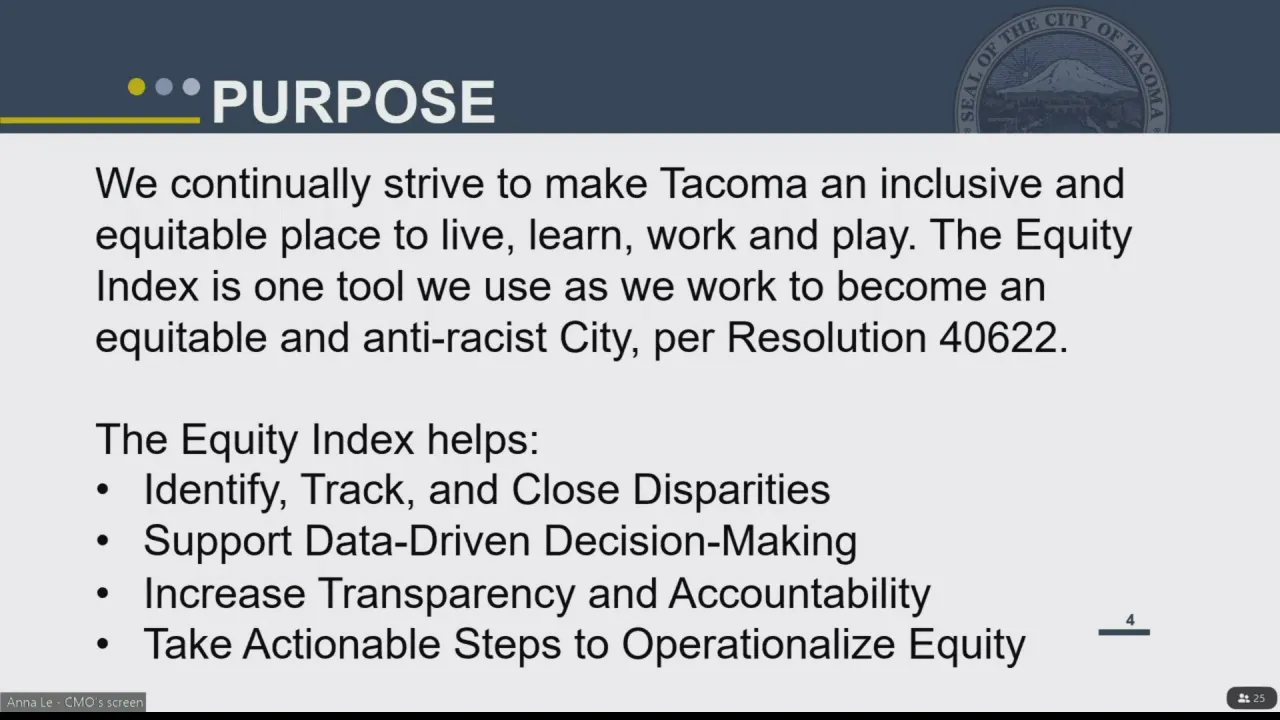
- Overview: The Equity Index is a tool comprising 29 indicators reflecting Tacoma 2025 strategic plan themes, used to identify, track, and close disparities. It supports data-driven decision-making and operationalizes equity per Resolution 40622. The index is publicly accessible and has been updated with new data (American Community Survey, environmental health indicators). Internal staff use DART maps; TPU has integrated it into their web apps.
- Award: The Equity Index received the Luminary Award from the New Growth Innovation Network at its Cityscape Summit, recognizing its impact on decision-making and inclusive economic growth.
- Case Studies: The presentation highlighted seven sections: overlaying data (Workforce Central, housing repair, digital equity), resource prioritization (streetlights, CED loan scoring, TPU advanced metering, Tacoma Creates grants), outreach and engagement (TFD cardiac arrest training, Solid Waste recycling reset, neighborhood planning, fair housing bus shelter wraps), policy development (MFTE affordability requirements), partner spotlight (Workforce Central), and continuous uses (hazardous tree assistance, historic preservation, language access, grant applications like Metro Parks’ feasibility studies).
- Vision Zero Example: Liz Castor noted that 75% of highest crash corridors are in low-opportunity areas. The Vision Zero Action Plan used the Equity Index to prioritize projects, leading to successful grants: $2.1 million for Portland Avenue improvements and nearly $1 million for South 38th & Cedar (both ranked first regionally).
- Future Plans: Staff workshops, community-based organization workshops, and continued partnership with Pierce County and other entities. The story map and case studies are available online.
- Council Questions: Councilmembers asked about data update frequency (every two years, with off-cycle updates), ability to overlay additional data (yes), expansion of art wraps (exploring possibilities), use by transit agencies (Pierce Transit using it for bus stop placement), and the importance of community-level outcomes versus program outputs. Councilmember Bushnell praised the tool’s role in equitable investment, while Councilmember Sidalgay encouraged championing the tool in the community and ensuring accessibility (noting it is already public and exportable). Mayor Woodards inquired about the next 10 years; Jacques Colon responded that continued building on current work, listening to community and staff, and applying quantitative equations to various processes are key.
Other Items of Interest
- Acting City Manager Hyun Kim announced two proclamations: July 31 – August 5 as Power Paddle to Puyallup Youth Canoe Journey Week, and July 2024 as Disability Pride Month.
- No changes to the agenda for the evening meeting.
Key Outcomes
- The council received updates on the Tacoma Smelter Plume and Equity Index, with no formal votes required.
- Councilmembers expressed support for both programs and suggested potential legislative action on Form 17 disclosure and continued funding for smelter cleanup.
- The Equity Index team will continue workshops and outreach; council members were encouraged to share the case studies and promote the tool.
- The meeting adjourned at approximately 2:00 PM, with the regular council meeting scheduled for 5:00 PM.
Meeting Transcript
I would like to call to order the city council study session of July 23rd, 2024. Clerk, you please call the roll. Councilmember Bushnell. Present. Councilmember Daniels. Councilmember Diaz. Deputy Mayor Hines. Here. Councilmember Rumba. Here. Councilmember Sidolgay. Here. Councilmember Scott. Here. Councilmember Walker. Here. Mayor Woodards, absent. Deputy Mayor and Council members, the study session material was sent to you at 1057. All right, thank you. Our first gender item is the Tacoma Smelter Plume Update. So if you are here to do that presentation, I'd invite you to come forward and you can join one of the five seats here in front. And it looks like I'll be calling on Environmental Services Assistant Division Manager Daniel De Leon Da Lyon to provide an introduction and begin the presentation. Okay. Thank you. Good afternoon, Deputy Mayor Hines and City Council members. I'm here to introduce Department of Ecology to talk about the Tacoma Smelter Plume Project. We have Justin Zacharin, Mary and Abbott from Washington State Department of Ecology, and there to give their 11th annual update of the project. The Tacoma Smelter Plume team has been working to address soil contamination from the former psycho smelter since 2006. The program started addressing areas where children play most, such as schools, child cares, and parks. Now the program is mainly addressed, is mainly focused on rising awareness about the Tacoma Smelter Plume, sharing information on individual actions that each of us can do to reduce our exposure to arsenic and lead in the soil. And residential soil replacement, removing and replacing soil in the most contaminated areas of North Tacoma and the Vash on Marie Island. Mary Am Abbott is the project manager for the Tacoma Smelter Plume Project. She has over 30 years experience with the cleanup and was part of the ecology group that negotiated the settlement with the Sarco. Her responsibilities including managing the budget and the overall team work. Justin Zakarin Zacharin is the remediation manager for the Tacoma Smelter Plume Project, and he is the point person for the team's sampling and soil replacement efforts. And in the audience with us too is Sarah Miller. She is the outreach coordinator for the Tacoma Smelter Plume Project, and she is responsible for outreach and communication with property owners and residents. Thank you. Thank you. Who am I turning it over to? Mary. And then you see it's right. Thank you, Deputy Mayor and Council members. We appreciate the opportunity to provide an update on the Tacoma Smelter Plume project. I'm going to give a little bit of an overview about the Tacoma Smelter Plume in case some folks aren't aware about the contamination from the old Asarco smelter. We'll also provide some updates on budget and then updates on our programs such as the Yard Program and Education and Outreach through the health departments to the communities. So there was a smelter that operated in North Tacoma for almost a hundred years. It started out as a lead smelter and then it switched over to be a copper smelter, specializing in ores that are very high in arsenic. And that smokestack was 571 feet tall. If you've been out to Point Reston, there's a restaurant called Stack 571, and that's to reflect the height of that stack.
openpublica.com