Tacoma City Council Study Session: 2024 Community Survey Results and Discussion on Tiny Home Village Letter - August 6, 2024
STREAMING COPY IN PREPARATION — RECORDING AVAILABLE FROM THE ORIGINAL SOURCE
Tacoma City Council Study Session - August 6, 2024
The Tacoma City Council held a study session on August 6, 2024, primarily to receive the results of the 2024 Community Survey conducted by ETC Institute. The survey provided a statistically significant snapshot of resident perceptions on safety, city services, trust in government, and priorities for the city. Council members also discussed a forthcoming letter to Pierce County advocating for tiny home villages in unincorporated areas, and Councilmember Stalgay announced a motion to add transparency language to a residential parking permit framework.
Discussion Items
2024 Community Survey Results Update
- Jacques Colon, Chief Strategy Officer, introduced the survey as a key listening tool conducted every two years. The survey was administered by ETC Institute, with 905 completed surveys from all council districts, providing a margin of error of ±3.25% at the 95% confidence level.
- Ryan Murray of ETC Institute presented findings. Key results:
- Overall perceptions: High ratings for quality of life, sense of belonging, and proximity to daily essentials. Low ratings for management of growth, value for taxes/fees, and trust in municipal government (only 24% excellent/good).
- Police services: Low satisfaction, with efforts to prevent crime, police patrol, and response time identified as top priorities. Perceptions of police fairness: only 41% agreed officers treat people fairly.
- Safety: 35% of respondents or a household member were crime victims in the past year. Feelings of safety in neighborhoods during the day were high, but only 24% felt safe in downtown areas.
- Top neighborhood priorities: Addressing homelessness (70%), housing affordability, community safety, and access to living wage jobs.
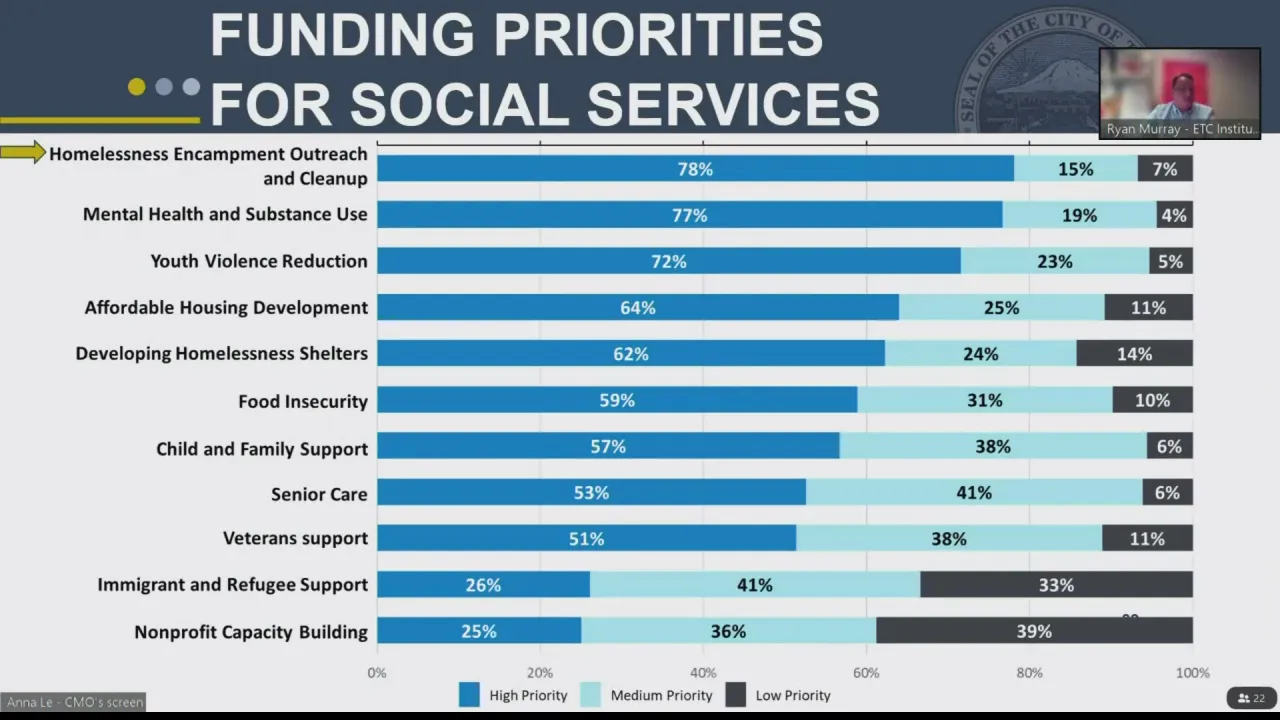
- Funding priorities: Homeless encampment outreach/cleanup, mental health/substance abuse, youth violence reduction, affordable housing.
- Communication: Low satisfaction with public involvement and information availability; most residents get information from friends/neighbors; city social media and newsletters are preferred.
- Customer service: 45% had contacted the city; among those, satisfaction with interactions was relatively high (60% treated courteously).
- Council questions and comments:
- Councilmember Stalgay noted an over-indexing of older respondents (45+) and asked about controls for demographic weighting. Staff confirmed results can be isolated by age group.
- Councilmember Bushnell inquired about non-English responses; 11 in Spanish, 1 in Russian, 1 in Ukrainian, 1 in Vietnamese.
- Councilmember Walker appreciated the timing before budget discussions and the walkability question.
- Deputy Mayor Hines asked about the relationship between overall police quality and specific sub-items. Staff explained that perceptions of crime prevention are tied to social investments, not just policing.
- Councilmember Diaz emphasized that root causes of homelessness are often state/federal issues, and the city should use its policy platform.
- Councilmember Daniels noted the need to crosswalk survey data with budget spending, and that increased funding may not always solve perceptions.
- Councilmember Bushnell asked about best practices from other cities; Ryan Murray offered to connect with other municipalities.
- Deputy Mayor Hines highlighted that shifting perceptions of safety may involve simple measures like street lighting.
- Next steps: Full report, GIS maps, and data tables to be posted on city website. Benchmarking report and trend analysis to follow.
Letter to Pierce County – Tiny Home Villages
- Councilmember Walker, on behalf of the Mayor, announced a letter to the Pierce County Council and County Executive supporting an ordinance to allow tiny home villages in unincorporated areas. The letter will highlight Tacoma's successes with non-congregate sheltering and urge county action to provide services countywide.
- Councilmember Diaz provided context: Pierce County allocated funds for a tiny home village but zoning did not permit it; the county council needs to change zoning policies.
- The letter will be presented for council support at the August 13 council meeting.
Other Items
- Councilmember Stalgay announced that at the upcoming council meeting, they will make a motion to add language to the modal traffic ordinance asking staff to present a framework for residential parking permits to the IPS committee for transparency and public feedback.
Key Outcomes
- The council received the 2024 Community Survey results and will use the data to inform the budget, strategic plan (Tacoma 2035), comprehensive plan, and community safety action strategy.
- A letter supporting tiny home villages in unincorporated Pierce County will be drafted and brought to the council for approval at the August 13, 2024 council meeting.
- Councilmember Stalgay will introduce a motion to add transparency language regarding residential parking permits to the modal traffic ordinance at the August 6 regular council meeting (tonight).
- The council moved into executive session for potential litigation after the study session.
Note: The agenda lists "Councilmember Stalgay" but the transcript sometimes refers to "Councilmember Sadalgay." The summary uses the official agenda name.
Meeting Transcript
I'd like to call the order of the government the City Council study session of August 6, 2024. Clerk, you please call the roll. Councilmember Bushnell. Councilmember Daniels. Absent. Councilmember Diaz. Deputy Mayor Hines. Councilmember Rumba. Absent. Councilmember Stalgay. Councilmember Scott. Councilmember Walker. Mayor. Mayor Woodards. Absent. Deputy Mayor and Councilmembers, the study session material was sent to you at 1103. Thank you, and apologize for the late start today to study session, but we are going to begin with our first agenda item, which is the 2024 Community Survey Results Update. Thank you, and good afternoon, Deputy Mayor, members of council. I'm Jacques Cologne, Chief Strategy Officer, and very excited to bring you our update on the 2024 Tacoma Community Survey today. And so really when you think about it, listening itself is a key strategy for us in how we do our work. We listen to the community in a number of different ways, recognizing the importance of hearing many diverse voices in the places that they want to connect with us and not assuming that we will get the engagement that we need in a set location or at a set time. So because we need to make sure that we're getting those voices in many different ways, we conduct workshops, we do surveys, we table at events, we do a lot of other things as well. One of the things that we do is every two years, we give a statistically significant survey that then allows us to ask key questions, for example, like what is your perception of safety in Tacoma, and then break that down by a number of different demographics, which you'll hear more about as we go through the presentation. We take the results of what we hear from community and we use those results to inform all that we do, including strategic initiatives such as our strategic plan Tacoma 2025 and our next strategic plan Tacoma 2035, which you'll hear more about in the coming months. The community safety action strategy, which you'll hear more about next week, and our comprehensive plan, just to name a few. But ultimately, what I want to make sure that we are starting with as a framing for this is that in order to accomplish our strategy as a city, we first have to understand what the vision of the community is. Once we can reflect that vision clearly, and then show folks that we are not just understanding but acting upon that vision in effective ways, that is how we build belief and trust in the community. Um you see the results of this survey, you know this is a point-in-time snapshot. So while there are things that we can glean from looking back, it is it is a reflection of a moment in time, and there's a lot of different factors that contribute to those feelings. So as with all of the data sources that we look at, it's important to look at the story that's being told by this data, but also important to recognize that there are many other pieces of data that help fill out what the what the real story is on the ground. Um I also wanted to mention that with surveys like this, you'll often see benchmarks or comparisons with other communities, and that can be useful, but it's also important to take those with a grain of salt. And the reason why as a parent, I think about this in terms of I tell my son in particular, comparison is not the route that we want to go, right? Like our goal is to be the best version of ourselves, and I think the same thing is true of cities that is as it is of people. Our goal is not to compare ourselves necessarily to similarly sized cities, but it is to be the best version of Tacoma possible. So as we think about the benchmarks, recognize that we have unique things happening in our community. Not every community that is the same size as us is dealing with economic issues that we're dealing with, or um regional homelessness issues, for example, that we know have a big impact on people's perceptions. So with that, um, I'm gonna pass it to Ted, who has been our project lead on this, and let Ted take it away. So next slide, please. So thank you, Jacques. Uh, for the record, my name is Ted Richardson. I work in the Office of Strategy, and we are joined today by Ryan Murray of the ETC Institute, who we hired to conduct the survey. Uh so like Jacques said, the city conducts a statistically significant survey every two years. So we've done it consistently consistently since 2018, and then also did it in 2010 and 2014. The prior one was completed in February of 2022. Uh, for this one, we contracted with ETC Institute. The surveyed uh instrument was finalized in late spring of this year, and then the survey was conducted in June and July. So you're seeing very fresh results. Um is a tool that should be paired with our other recent engagement efforts. It is the one that is statistically significant across geography and key demographic groups. Um, but it should be it should be informing those further outreach efforts.
openpublica.com