Tacoma City Council Study Session Summary - September 17, 2024
STREAMING COPY IN PREPARATION — RECORDING AVAILABLE FROM THE ORIGINAL SOURCE
Tacoma City Council Study Session Summary - September 17, 2024
The Tacoma City Council held a study session on September 17, 2024, at 12:00 PM in the Council Chambers. The meeting covered two major briefing items: the preliminary results of the 2024 Economic Disparity Study and the quarterly update on Alternative Response programs. Additionally, Council Member Walker introduced a Council Consideration Request for a resolution opposing Initiative 2117. The session concluded with an executive session for pending litigation and labor strategy.
Briefing Items
1. 2024 Economic Disparity Study Preliminary Results
Kacee Woods, Equity in Contracting and Workforce Programs Manager, presented alongside consultants from Keen Independent Research (Dave Keen, Janine Kyritsis, Manuel Perez, Blanca Monter). The study analyzed city contracting data from January 1, 2017, to December 31, 2022, covering $784 million in contract elements (3,200 prime contracts and subcontracts). Key findings include:
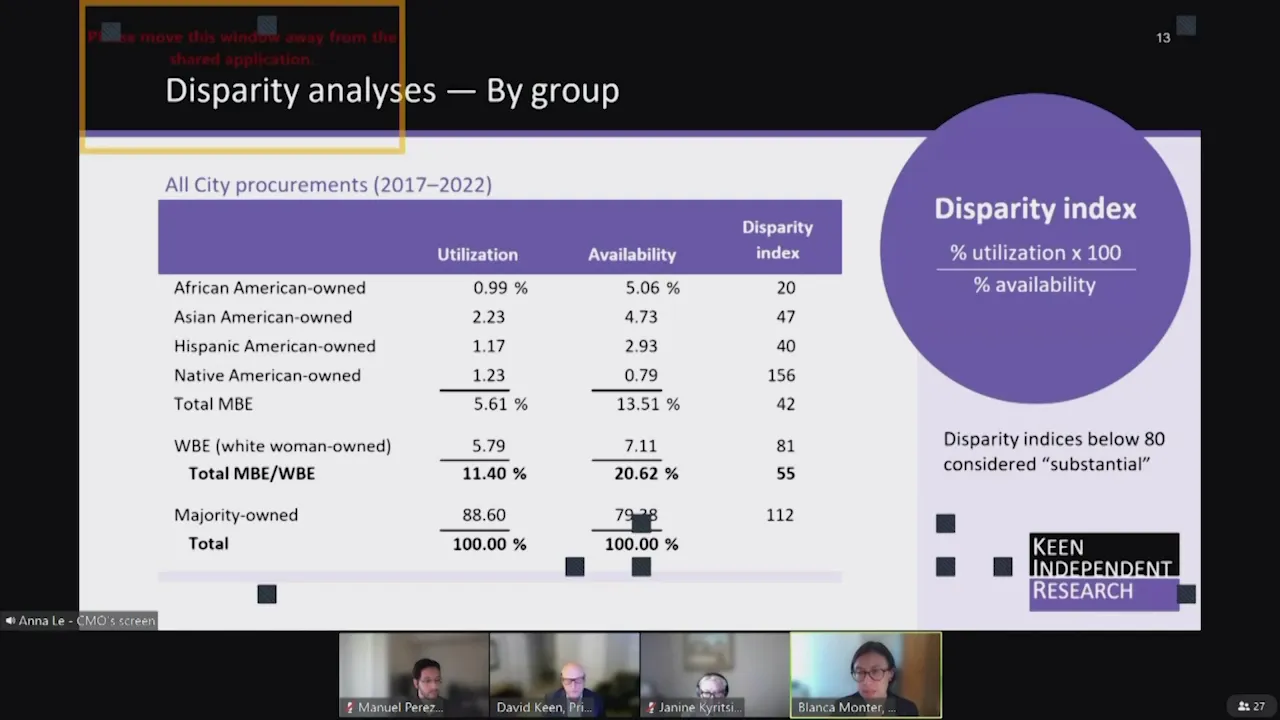
- Overall, 5.6% of contract dollars went to minority-owned firms and 5.8% to women-owned firms (11.4% total), compared to a weighted availability benchmark of 20.62%, yielding a disparity index of 55 (substantial disparity).
- Substantial disparities were found for African American, Asian American, and Hispanic American-owned firms; white women-owned firms showed a non-substantial disparity; Native American-owned firms had availability exceeding utilization.
- During the Equity in Contracting (EIC) program period (May 2020 – December 2022), the disparity narrowed: 14.6% utilization vs. 16.5% availability (non-substantial disparity overall), but substantial disparities persisted for African American and Asian American-owned firms.
- Qualitative data from over 300 business owners and stakeholders identified barriers including access to capital/bonding, closed networks, discrimination, and lack of communication about opportunities.
- Recommendations include: refining overall aspirational MWBE goal, expanding contract goals to professional services, SBE evaluation points and price preferences (where legally permissible), further developing the small contracts program, enhanced outreach, relationship building, regional capacity building, and ensuring sufficient staff resources.
- Next steps: Final report expected mid- to late October 2024; an external stakeholder meeting is scheduled for September 30, 2024.
Council members discussed the data and asked about program definitions (SBE vs. EIC), the impact of the pandemic, coordination with the Minority Business Development Agency, and efforts to track business owner experiences over time.
2. Alternative Response Quarterly Update
City Manager Elizabeth Pauli introduced the update, followed by presentations from multiple departments:
HEAL Team (Homeless Outreach and Engagement) – Presented by Alison Griffith, Director of Neighborhood and Community Services, and Javon Carlyle. Key data as of August 31, 2024:
- 146 open requests in 311 (down 19% since Q1 but up from last quarter, partly due to warmer weather and neighboring jurisdictions’ camping bans).
- 2,207 connections with new and repeat clients; 967 individuals accepted services; 172 placed in temporary shelter; 12 entered detox; 5 connected to HOPE team.
- A new HEAL dashboard has been soft-launched, providing data on outreach contacts, 311 requests, and emergency service calls, with briefings to council in the coming weeks.
HOPE Team (Behavioral Health Crisis Response) – Presented by co-managers Alicia Morales and Cassie Hallstone, under Chief Siana Stallings-Ala'ilima. Program launched one year ago (September 6, 2024). Key data:
- Total incidents dispatched: 613; on-scene: 427; 498 unduplicated individuals served (1,298 total contacts); 90% engagement rate (10% refusal).
- Primary presenting problems: mental health, co-occurring disorder, substance use; top interventions: referral to case manager, connection to outpatient resources, transportation assistance.
- Staffing model: two teams of two (mental health professional + registered nurse), 7-day coverage but not 24/7. Working toward behavioral health agency licensure to enable billing and expand capacity.
- Received $200,000 UW CODA grant for toolkit development and crisis intervention training for fire/EMS.
Community Service Officers (CSOs) – Presented by Deputy Chief Paul Younger and Lieutenant Meyer. Five CSOs hired (budgeted for ten); training completed for three, two nearing completion. Since June 17, 2024:
- 558 hours on calls; 330 dispatches; 220 reports taken; 80 calls at substations; provided traffic control and non-emergency response, freeing sworn officers for priority calls.
- CSOs are unarmed, civilian positions focusing on low-risk, non-emergent calls. Hailing process ongoing for remaining five positions.
- Councilmember Bushnell and others expressed appreciation; CSO Carlton Chambers ("CC") shared a positive day-in-the-life example.
Tacoma Public Library Pilot – Presented by Deputy Director Amita Lonial. Program started January 2, 2024, with a safety/security coordinator and a social worker. Key updates:
- 70% of staff trained in Crisis Prevention Institute curriculum (16-hour training).
- Social worker made 70 interactions June–August; top needs: housing, shelter, behavioral health.
- Success stories: connected unhoused patron with housing, helped a stranded immigrant return home.
- Building partnerships (e.g., Tacoma Needle Exchange, Schoolie Foundation). Preparing for main library reopening soon.
- Street medicine: exploring how to activate $1 million state allocation.
Council members asked about coordination between programs, data tracking, service gaps (e.g., detox capacity, neurocognitive decline in older adults), and plans for 24/7 HOPE coverage. The importance of communicating these efforts to the public was emphasized.
Other Items of Interest
3. Council Consideration Request – Resolution Opposing Initiative 2117
Council Member Walker presented a request to bring forward a resolution opposing Washington State Initiative 2117, which would repeal the Climate Commitment Act (cap-and-trade program). Key points:
- The Act generated $2.1 billion in 2023 for climate projects, including decarbonization and environmental justice programs that fund city climate action.
- The resolution would be considered at the September 24 council meeting; compliance with PDC rules was noted.
- Co-sponsors: Council Members Hines and Diaz; Mayor Woodards expressed support.
No questions or opposition were raised.
Key Outcomes
- No formal votes were taken during the study session; decisions are expected at future meetings.
- The resolution opposing Initiative 2117 will be voted on at the September 24, 2024 regular council meeting.
- Final Economic Disparity Study report to be released mid- to late October 2024.
- HEAL dashboard soft-launched; council briefings scheduled.
- HOPE team continues progress toward behavioral health agency licensure and 24/7 staffing.
- CSO program to hire remaining five officers; performance evaluation metrics (e.g., response times, community surveys) under development.
- Executive session held for pending litigation and labor strategy; meeting adjourned thereafter.
Meeting Transcript
I'd like to call to order the city council study session of September 17th, 2024. Clerk, will you please call the roll? Council Member Bushnell. Present. Councilmember Daniels, absent. Councilmember Diaz. Absent. Deputy Mayor Hines. Here. Councilmember Rumba. Here. Councilmember Sidalgay. Here. Councilmember Scott. Here. Councilmember Walker. Here. Mayor Woodards. Here. Mayor and Council members to study session material sent to 1115. Thank you. All right. We have two changes to today's agenda. Potential litigation, potential, potential litigation has been added to the executive session. And immediately following the executive session, we will enter into a closed session to discuss labor strategy. Our first agenda item is the 2024 economic disparity study preliminary results. And I'd like to call on community and economic development, equity and contracting and workforce programs manager. Casey, we're gonna have to get you a much shorter title. Um Casey Woods to begin the presentation. So Casey, we'll turn it over to you. Good afternoon, Mayor Woodards, Deputy Mayor Hines, members of the council. My name is Casey Woods, and I am the Equity and Contracting and Workforce Programs Manager for the City of Tacoma, housed in the community and economic development department. I am joined here today with consultants from Keen Independent Research to present the findings of the 2024 economic disparity study. In the fall of 2023, through competitive solicitation, the City of Tacoma engaged Keen Independent Research to gather data about marketplace conditions and to identify if there are any disparities in the use of minority and women-owned firms in city contracting. The study is based on five years of historical data from January 1, 2017 to December 31st, 2022, plus data from the post-December 2019 time period measuring the impacts of COVID-19. Results will help the city to assess whether there is a level playing field for these businesses in the local marketplace. And recommendations will include policy and programmatic direction for the city to foster equity and contracting and development of local minority and women-owned businesses. For your awareness, disparity studies are recommended to be undertaken every five to seven years, and the city has decided to undertake such a study every five years. Well, thank you very much. And thank you for making time for us. So if you hold on just a second, can we can we get that volume a little bit higher? So we can hear them. Okay, great. Let's try it again. Hi. So let me start start with a sound check. Is this better? Way better. Okay, that's great. Well, thank you for having us on your agenda today.
openpublica.com