Tacoma City Council Study Session: Zoning, Strategic Plans, and Community Initiatives – Sept 24, 2024
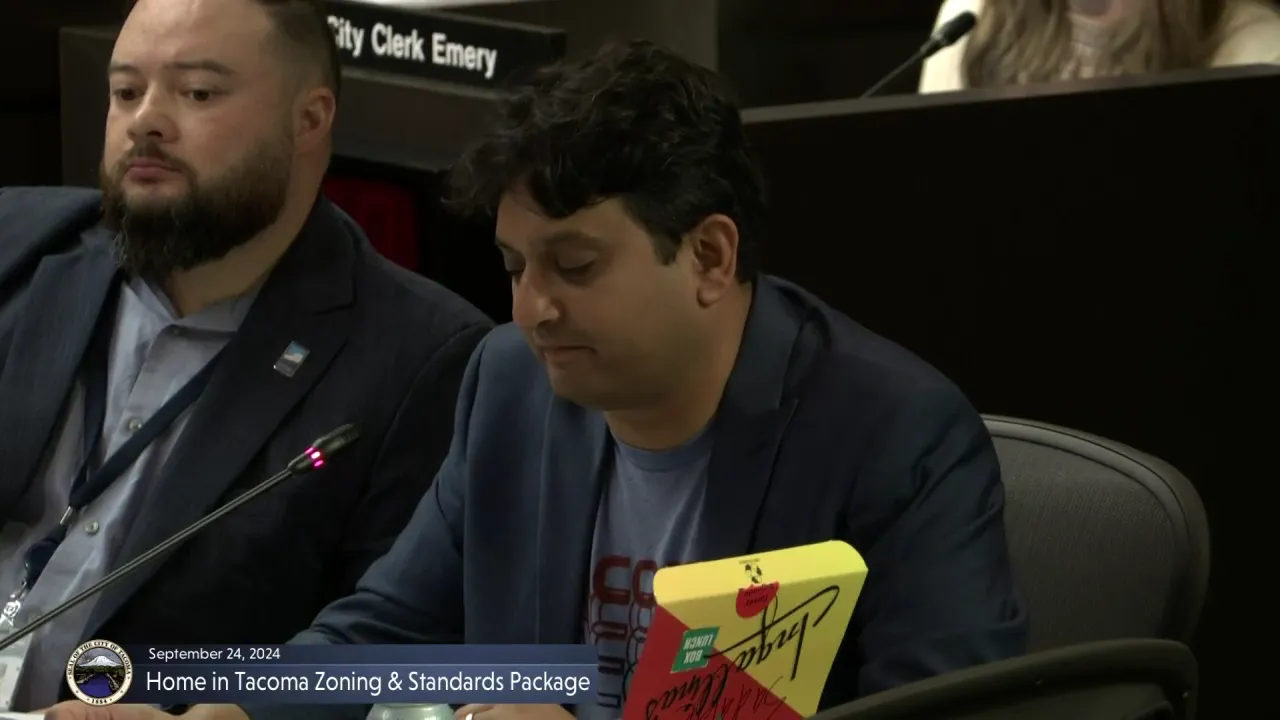
STREAMING COPY IN PREPARATION — RECORDING AVAILABLE FROM THE ORIGINAL SOURCE
Tacoma City Council Study Session Summary
On September 24, 2024, the Tacoma City Council held a study session beginning at 12:00 PM to discuss the Home in Tacoma zoning and standards package ahead of a public hearing that evening, receive a progress update on the Tacoma 2025 strategic plan and initiation of the Tacoma 2035 process, and consider three council funding requests. The meeting concluded with committee reports, the city manager’s weekly update, and a closed session on labor strategy.
Home in Tacoma Zoning and Standards Package – Public Hearing Preparation
Planning Division Manager Brian Boudet presented an overview of Phase 2 of the Home in Tacoma initiative, which rezones more than half the city from exclusively single-family zoning to zones allowing a greater variety of housing types. Key elements include new urban residential zones (UR1, UR2, UR3), reduced parking requirements, tree and landscaping standards, an affordability bonus system with 50-year deed-restricted units at 80% AMI, and strategies to encourage homeownership (e.g., unit lot subdivisions). Boudet noted that over 120 written comments had been received, and two informational events drew about 60 attendees. Council next steps are: a public hearing that evening (September 24), a study session on October 8 to debrief community input and discuss tree requirements, affordability, parking, and infrastructure coordination, followed by an amendment process on October 22 and a first reading of the ordinance on October 29, with final consideration on November 19.
Council Discussion: Councilmember Bushnell asked about the city’s growth allocation deficit; Boudet responded that Tacoma is about 50% behind its allocation target, partly due to historical restrictive zoning and market factors. Councilmember Daniels emphasized improving the permitting process alongside zoning changes. Councilmember Muroba stressed the need for livability elements (sidewalks, crosswalks) and impact fees. Councilmember Sadalge sought clarification on limiting factors (e.g., lot size, infrastructure, slopes) that prevent maximum density and highlighted the importance of the 50-year affordability bonus and the need for homeownership incentives. Deputy Mayor questioned the amendment timeline; Boudet clarified that amendments can be introduced at first reading to allow public comment.
Tacoma 2025 Progress Update and 2035 Development Plan
Chief Strategy Officer Jacques Colon presented an update on the city’s first 10-year strategic plan, Tacoma 2025, based on input from over 2,000 residents. He reviewed data on the six council priority indicators:
- Community Safety: Perception of safety declined (matching national trends); violent crime decreased.
- Housing & Homelessness: Units created through various programs; point-in-time homeless counts noted (2017-2019 countywide, 2022-2024 Tacoma-specific).
- Livable Wage Jobs: High school graduation rate improved; median household income rose from ~$52,000 (2014) to ~$80,000 (2022).
- Access & Transportation: Fatal and serious injury crashes increased from 72 (2016) to 131 (2023); Vision Zero initiatives underway.
- Human & Environmental Health: Over 25,000 trees planted since 2014; municipal GHG emission data included.
- Belief & Trust: Confidence in municipal government declined (national pattern); voter turnout data provided by Pierce County.
Colon proposed evolving to Tacoma 2035 with eight goal areas: (1) Community Safety, (2) Housing & Homelessness, (3) Economy & Livable Wage Jobs, (4) Access & Transportation, (5) Environment & Climate, (6) Human Health, (7) Education & Youth, and (8) Organizational Culture & Effectiveness. He emphasized clarifying the city’s role while maintaining a community vision and adding operational measures and checkpoints.
Council Discussion: Councilmember Bushnell appreciated the iterative approach and partnership focus. Councilmember Scott raised the potential impact of the upcoming World Cup. Councilmember Walker asked about the Tacoma 2025 steering committee (still active) and coordination with community-based organizations. Councilmember Daniels suggested a five-year update rather than a full 10-year cycle to adapt to rapid change. Deputy Mayor noted the tension between aspirational community metrics and city-controlled indicators, urging balance. Councilmember Muroba highlighted the importance of including plans from partner organizations.
Council Consideration Requests
Pride-Themed Decorative Crosswalk (Councilmember Diaz)
A $3,500 contingency fund request to install a permanent rainbow crosswalk on Broadway between 9th and 11th Streets downtown. Public Works estimated full costs between $21,000 (in-house) and $35,000 (contracted), pending material selection (paint vs. thermoplastic). Councilmember Walker co-sponsored; Councilmember Romba supported and asked about cost and potential for a future neighborhood program. The item will be voted on at the October 8 council meeting.
Historic McKinley District Halloween Parade (Councilmember Sadalge)
A $5,000 contingency fund request to sponsor the first Tacoma Halloween parade on October 19, 2024, in the McKinley Hill District. The event includes an afternoon street fair and an evening parade with over 40 participants. Co-sponsored by Councilmembers Diaz and Walker. Vote scheduled for October 1.
Alchemy Skateboarding Expansion Project and Youth Access Fund (Councilmember Walker)
Funding to support the expansion of Alchemy Skateboarding, the only public indoor skate park in Pierce County, which serves youth through skate-based curricula and partnerships with the juvenile court system. Co-sponsored by Councilmembers Daniels and Romba. Councilmember Romba noted a related participatory budgeting proposal for a permanent skate park in District 2.
Key Outcomes
- No formal votes were taken during the study session; advisory discussion was held on all items.
- The public hearing on Home in Tacoma Zoning and Standards Package occurred later that evening.
- The Pride crosswalk request will be voted on October 8; the Halloween parade request on October 1; the Alchemy Skateboarding request at a future meeting.
- The council will continue the Tacoma 2035 strategic planning process with further data collection and engagement, and a follow-up study session will be scheduled.
- The meeting adjourned after a closed session (labor strategy) with no return to open session.
Meeting Transcript
over uh the last few weeks as we've been preparing and talking to the community about the package as well as talk a little bit about the upcoming process post public hearing as the council will consider as the council will consider potential modifications to the package based on community input that you receive uh tonight and as part of the written record as well as any further analysis and discussion that the council has obviously so do we have the PowerPoint it's gonna make it tricky to look behind myself. Okay sorry go ahead to the next slide yeah keep going the next one so we've had quite a bit of discussion over um the last month or so with council so I'm not gonna go uh super into depth on background on on what the package is um go ahead to the next slide but just as a as a quick reminder you know this is phase two this is the zoning and standards update that implements the policies that council adopted in phase one uh now a couple of years ago hey Brian can we like a pause for a second and I think the presentation's up better thank you I uh Brian feel free to continue okay thanks go ahead uh phase two involves the zoning changes as well as all the development standards changes uh so this is the the phase in which the policies that the council adopted a couple years actually get essentially put on the ground uh so this is this involves rezoning a little more than half the city from um in many cases exclusively single family zoning into zones that allow for uh a more significant variety of housing types as you're as you're well aware so go ahead to the next slide uh we've done a lot of community input we went over this in more detail uh a few weeks ago and then uh throughout the process over not only this uh the second phase of home and Tacoma but as well through phase one in addition as you know the planning commission spent uh a significant amount of time taking public input and and going through all of that information and deliberating and providing the recommendation that you have before you uh which is which is the subject of your public hearing go ahead to the next slide uh the package includes new urban residential zones um in addition uh it includes new uh tree and landscaping requirements reduced parking requirements affordability and bonus retention or building retention bonus system to try to encourage those sorts of public benefits as well as a number of strategies to address and encourage home ownership um a topic that we've heard a lot about I know the council's heard a lot about the community has indicated a lot of interest in uh throughout the last couple of years of this process so that includes the the um unit lot subdivisions as well as a number of other um provisions go ahead to the next slide uh just a quick reminder of the map again oh more than half the city uh three zones the UR12 and three there's a hierarchy there obviously allowing for more density more intensity and more flexibility on uses as you go up in scale um the the the UR3 is directly related to the mid-scale designation that the council adopted when you put in place phase one and the UR1 and UR2 zones are uh within the low scale uh uh geographies that the council adopted in phase one so the difference being more units uh that you can get as you go up in size and as council knows in in coordination with your policy direction the higher intensity zones are generally coordinated around transit as well as other community amenities The UR3 is directly related to the mid-scale designation that the council adopted when you put in place phase one and the UR1 and UR2 zones are within the low scale of geographies that the council adopted in phase one. So the difference being more units that you can get as you go up in size, and as council knows, in coordination with your policy direction, the higher intensity zones are generally core located around transit as well as other community amenities like commercial areas, park schools, and things like that. Go ahead to the next slide. So as I mentioned, we held a couple of informational events over the last couple of weeks. Had pretty good attendance at those, probably 60 plus between the couple events. We did one in person here in the council chambers and one virtual meeting this last week. Just I don't think there's going to be any huge surprises in the kinds of comments and questions that we heard as part of those meetings, still related to many of the hot topic areas that have been the case for a while now around affordability and density and parking and the permitting process. Certainly there is interest in how this gets implemented, how fast this will happen, how quickly change might be expected in communities. So, you know, no surprise, I think to council, but obviously just a reminder this is a change to the zoning allowances, which really just identifies what people can do with their property, not what they have to do with their property. And certainly single family is still remains to be allowed, will continue to be allowed, and and no doubt we expect to still be a very common home type for a long time in this community. Plenty of questions about the affordability, how the system works, what the uh the rent restricted units would be, how we track those, all of those kinds of things. Um, and I will say, in particular, at the in-person event, there was definitely a lot of concern in general, just uh amongst those that were there about the the realities of affordability in our community overall and the fact that we are continuing and uh to see really significant increases in housing prices as compared to incomes. You know, obviously a trend that's been going on for more than a decade, but is certainly coming to a real head. Um, and so a lot of interest not only in home and Tacoma and moving this forward, but also what other efforts that the city can take to help encourage more affordability in housing. Um the density side, lots of questions about um what the difference is between what the state is mandating and what uh the city here is considering, something I know that we have talked about a number of times as well. Uh questions associated with that regarding like what is the major transit stop, what are those, since that's one of the trigger points in the state law. Um we also hear questions about you know parking and loss of parking, and how is the city going to address the realities of more people, likely with more cars in areas where we are potentially requiring less parking. And as you know, there are some significant reductions in parking, not only based on the state mandates, but also beyond that in the planning commission's uh recommendation. Um the permitting side, we hear um certainly lots of interest from the development community about um wanting to get going essentially on this. You know, this has been a long conversation in the city about what home and Tacoma will allow and when certainly conversations going on about how people there's interest in people being uh guinea pigs, I guess, coming in and testing and and trying to do that as soon as possible so that they can sort of get get working even before the February 1st effective date to try to support and encourage this development to happen. Um let's see. Also, lots of questions about trees, no surprise there. That continues to be a really significant theme in the public comment. I'm sure will be also tonight during your public hearing. Um the questions about how the tree requirements work, how the fees work, how the credit system works, all those kinds of things continue to be big points of interest on the part of the community. Um go ahead to the next slide. So in preparation for tonight's hearing, uh lots of communications have been going out. I'm sure you've been seeing some of those, not only just the standard mailers, but lots of stuff out, news releases and social media and stuff like that. I think we are somewhere in the 120 plus written comment range, I think so far. So I think the clerk's office certainly putting all that information together and providing it to council. Go ahead to the next slide. So last piece is just to talk a little bit about next steps. So after we after the public hearing tonight, as you know, we're scheduled to come back on October 8th and sort of debrief the input that's received from the community. A couple things that I want to mention about that is I know coming out of the previous study sessions as well as other conversations we've had we've had with council members. There are a number of topics I think that council is also interested in, digging kind of one step deeper on, shall we say. The intent is to bring back a little bit more information and conversation about a few items like the tree and landscaping requirements, the affordability standards, the parking, as well as uh talk a little bit about infrastructure and service providers. I know that's another question that's come up from council members and community members about how we're coordinating with all the other components that need to fit on a site and need to be operational, you know, the garbage service and the water and the power and all those kinds of things, uh, as well as some discussion about um I mentioned the interest that we've heard uh regarding how we might be able to move things forward even prior to February 1st and support developers at least coming in for some sort of pre-application kind of testing process. So I think that's something also that we'll we'll bring back and talk about with council. Um the the last thing I was gonna mention is just um after we get into the debrief through the uh October 8th study session, obviously that's when we'll get into the conversation about amendments and the amendment process. So at this point, uh a little bit borrowing from uh the first phase, so those those of you that were around when we went through phase one uh will recall that there was at that time also a fairly significant conversation about potential amendments that council worked through. Um and so we want to mirror a little bit of that process to try to provide a little bit of structure. And part of this is just from uh a public communications perspective, um, because obviously there's a lot of community interest in what this package is, but also the reality that this is a very complicated package that comes forward for you. And so certainly important that as we are talking through amendments, that there's sufficient time and ability on the back side to make sure that everything actually works together as it comes forward for final adoption by council. So, in in preparation for what you see on the schedule there of that October 22nd um study session, where the intent is really to walk through potential amendments and really kind of at the at least at the concept level, shall we say. Um that hope the hope is that council members will be working through your council assistance between now and then because they can help coordinate obviously not only with planning staff but also legal staff and other groups that may be necessary, like I say, to make sure that uh amendments that come forward uh fit into the overall package and are functional. Um that the intent is really to try to have those all outlined by probably the the the week before October 22nd, so like October 15th, so that then we can walk through and talk about all those during that study session on October 22nd, with the idea then that that would set us up well for October 29th, that first reading of ordinance where all of those amendments, however many the council ultimately decides, obviously, to move forward uh could be formally introduced so that the public can see those and have that space between October 29th and November 19th to consider those and provide input as necessary as part of the council's sort of final consideration and vote in November. So with that, that's really all I had for this meeting. Again, obviously, this is uh we're really queuing up for tonight's public hearing, and we'll see what all of the community input is, uh, and then we'll be happy to to come back and debrief with council uh in October there.
openpublica.com