Tacoma City Council Study Session – March 4, 2025: ShotSpotter, Federal Agenda, and Transportation Oversight
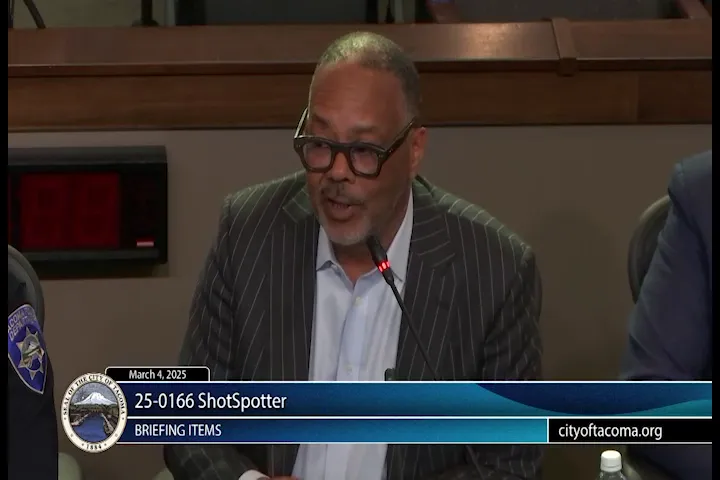
STREAMING COPY IN PREPARATION — RECORDING AVAILABLE FROM THE ORIGINAL SOURCE
Tacoma City Council Study Session – March 4, 2025
The Tacoma City Council held a study session on March 4, 2025, to discuss the deployment of ShotSpotter gunshot detection technology in the Hosmer corridor, the 2025 federal legislative agenda, a proposed ordinance for expenditure targets and reporting for Proposition 1 transportation revenue, and a resolution supporting good jobs. The meeting began with an executive session and included extensive deliberation and questions from all councilmembers. No formal votes were taken during the study session; the legislative agenda and ordinance were to be voted on at the evening regular meeting.
ShotSpotter Gunshot Detection Technology
- Presentation: Assistant Chief Christopher Karl, TPD, introduced the technology, noting it is part of a BJA SMART Policing Initiative grant. The grant covers ShotSpotter, Recover Lift fingerprint technology, and Faro 3D crime scene scanning. To date, TPD has used Recover Lift on over 600 shell casings and the Faro 3D scanner in 14 crime scenes (homicides and officer-involved shootings).
- Coverage: The technology will be deployed in a two-square-mile area along the Hosmer corridor (roughly 72nd to 96th Streets, Hosmer to approximately Tacoma Mall area).
- Statistics: Ralph Clark, CEO of ShotSpotter, stated that across 180 cities, 80–90% of criminal gunfire goes unreported. In Tacoma, 80% of gunfire incidents go unreported. The system uses about 20 sensors per square mile, capturing only pops, booms, and bangs, not conversations or faces.
- Independent Evaluation: Dr. Jesse Huff, University of Cincinnati, will provide bi-annual independent analysis of the grant, including false positives and unreported gunfire.
- Digital Trust Campaign: TPD outlined a public transparency plan including an external webpage, quarterly data updates, town halls, and policy publication. Councilmember Rumbaugh agreed to take the digital trust plan to the Committee on Community Safety (CVS) for further input.
- Councilmember Positions:
- Councilmember Bushnell (District 5) expressed support as a trial, noting community concerns but also a desire for more action on gun violence.
- Councilmember Diaz expressed deep concern that the technology could erode trust built by TPD, questioned its benefits, and worried about long-term reliance.
- Councilmember Hines asked for clear success metrics, emphasizing need to measure response time, evidence recovery, and community sentiment.
- Councilmember Walker asked how data would integrate with ongoing crime prevention and public health efforts.
- Councilmember Scott questioned whether the technology could lead to over-policing or resource shifting.
- Councilmember Daniels stressed that the technology is a response tool, not prevention, and urged a focus on upstream investments.
- Key Outcomes: The discussion concluded with agreement to continue community engagement, post FAQs, and provide quarterly updates. The digital trust plan will be reviewed by CVS. No formal council action was taken; the grant is already in place.
2025 Federal Legislative Agenda
- Presentation: Andrea Roper (Government Relations) and Lauren Adler (TPU Federal Affairs) presented the proposed federal legislative agenda. The agenda includes two documents: a comprehensive policy positions document and a short list of priorities.
- Key Priorities:
- Infrastructure – support for the Fishing Wars Memorial Bridge and Portland Avenue Freight and Access Improvement projects.
- Affordable Housing – advocate for preservation of LIHTC, housing vouchers, CDBG, and HOME programs.
- Community Safety – support for alternate response models (co-responders, community service officers) and fire/EMS funding (AFG, SAFER).
- Human Rights and Dignity – broad statement supporting all Tacomans.
- TPU priorities include tax-exempt financing, customer assistance, infrastructure funding, and PFAS liability protections (clarified that polluters should pay).
- Councilmember Input:
- Councilmember Rumbaugh raised concern about VOCA funding for victims of crime; staff agreed to provide talking points.
- Councilmember Bushnell asked about transformer supply chain issues; TPU said it remains a concern but not a top priority for this document.
- Councilmember Diaz requested regular updates on federal activity, especially from Congress, and noted the need for community communication.
- Councilmember Sidalgay appreciated the comprehensive document for setting priorities.
- Key Outcomes: The council will vote on the agenda at the evening meeting. The mayor and several councilmembers planned to attend the National League of Cities conference in Washington, D.C., later that week.
Ordinance on Proposition 1 Transportation Revenue Expenditure Targets
- Presentation: Mayor Woodards introduced a council action memorandum for an ordinance establishing expenditure targets and reporting requirements for revenues from Proposition 1 (streets initiative). The ordinance would require annual reports on spending in categories (arterials, streets, pedestrian/bicycle), five-year evaluations with forecasts, and a 14-year review allowing council adjustments. This is intended to ensure transparency and accountability if voters approve the proposition.
- Councilmember Walker confirmed that the ordinance adds to existing transparency efforts, not replaces them.
- Key Outcome: The ordinance will be voted on at the evening meeting.
Good Jobs Resolution
- Presentation: Mayor Woodards introduced a Council Consideration Request declaring support for good, quality jobs in Tacoma. The resolution is based on the “Good Jobs Great Cities” partnership with the U.S. Department of Labor and includes locally tailored Tacoma Good Jobs Principles.
- Action: The mayor requested delaying the resolution to April to allow the new Economic Development Director (starting March 24) to engage with the principles.
- Councilmember Walker supported the partnership with Workforce Central and suggested highlighting that in the language.
- Key Outcome: The resolution will be brought back for action in April.
Other Items
- The city manager noted two proclamations for the evening meeting: National 311 Day (March 11) and Municipal Court Appreciation Week (March 9–15).
- The meeting concluded with adjournment, with the next regular meeting at 5:00 PM.
Meeting Transcript
I'd like to call to order the City Council study session of March Fourth, twenty twenty-five. Clerk, will you please call the role? Councilmember Bushnell. Deputy Mayor Daniels. Councilmember Diaz. Councilmember Heinz. Council Member Rumba. Councilmember Sidalgay. Councilmember Scott. Councilmember Walker. Mayor Woodards. Here. Mayor and Councilmember's study session material sent you at eleven. Thank you very much. Um, we're going to change the order of some items today. We're going to begin with an executive session. So the presentations will be held until after the executive session concludes. So I will entertain a moment uh motion to convene to an executive session pursuant to RCW forty two dot three zero. All those in favor signify by saying I. All those opposed. The motion is declared adopted. We will go into recess and we'll be back in ten minutes. I'd like to call back to order the study session of March fourth. All right. Our first agenda item is shot spotter. And I'd like to call on Tacoma Police Department Assistant Chief Christopher Carl for introductions and to begin the presentations. Technology is great when it works. Rather than have people wait on online, I'm just going to call a quick five minute recess, and we'll we'll get we'll get this up and working, and then we'll be right back. We stand in recess for five minutes. I'd like to call back to order the City Council study session of March Fourth, and we now are techno we have our technology in order now. So I'm going to turn it back over to Chris Carl, who's going to uh introduce everybody at the table and begin the presentation. Thank you, Miss Mayor. I'd like to introduce Ralph Clark, the CEO of Shot Spotter. Al Lures to his left and Assistant Chief Crystal Haskins on the far end down there. In addition, I would like to announce Dr. Huff is online from the University of Cincinnati, who will be the independent academic reviewer of the technology grant and the data. Well, in essence, eighty percent of gunfire incidents go unreported. As part of that, um we have Shaw Spar because it saves lives. Both the recover lift uh fingerprint technology and the Faroe 3D scanner are currently being used by the Tacoma Police Department. In regards to the grant itself, it's uh a BGA grant under the SMART policing initiative. The Tacoma Police Department was one of 10 police departments in the United States that was issued this grant money. It is technology and evidence-based. What that means is that the grant tracks the gunfire incidents specifically in regard and we use the other two parts of that technology grant, the recover lift technology to process shell casings and the Faro 3D scanner to process crime scenes. To date, we've utilized the recovery lift technology in over 600 shell casings, and the Faroe 3D scanner we've used over uh 14 times in regards to homicide investigations and an officer-involved shooting again. What I talked about is the BGA grant is technology only. The shot spotter will give us the location. The Faro 3D scanner allows us to document that crime scene, and the recover lift technology allows us to process those shell casings. The SMART, the SBI, the SMART Policing Initiative is geared towards technology in regards to response, identification, and investigating crimes involving guns. Dr. Huff from the University of Cincinnati will be the independent academic reviewer of the grant.
openpublica.com