OPENPUBLICA · PUBLIC MEETING RECORD
Record of Proceedings
Tacoma City Council Study Session – Therapeutic Court, Budget Workshops, and Holiday Market – October 27, 2026
City Council Study Session — Tuesday, October 27, 2026
BodyTacoma, Washington
SessionCity Council Study Session
DateTuesday, October 27, 2026
StatusNEW · FILED
Video Record
STREAMING COPY IN PREPARATION — RECORDING AVAILABLE FROM THE ORIGINAL SOURCE
Transcript — Verbatim
Speaker numbers apply only to this recording.
Discussion Breakdown — Share of Meeting
Public Safety27%
Homelessness20%
Court Support Services15%
Community Engagement9%
Fire Department Operations6%
Economic Development5%
Affordable Housing4%
Public Finance3%
City Council Proceedings3%
Summary of Proceedings
Tacoma City Council Study Session – Therapeutic Court, Budget Workshops, and Holiday Market – October 27, 2026
The Tacoma City Council met in study session on October 27, 2026, beginning at 12:00 PM, with Mayor Ibsen presiding and Deputy Mayor Bushnell and Councilmembers Diaz, Heinz, Palmer, Rumbaugh, Sadalgay, Scott, and Walker present. The session covered the Municipal Court therapeutic approach request, the 2027-28 budget workshop for community safety and housing/homelessness, a downtown Tacoma holiday market sponsorship request, and the City Manager's weekly report. No formal action was taken on agenda items; the council adjourned by voice vote after a motion and second.
Therapeutic Court Approach Model
- Municipal Court Judges Steve Krupa and Sergio Flores, joined by Judge G. Sontag, presented their prioritized staffing needs for Tacoma's therapeutic approach to criminal justice.
- They said all four requested positions are still needed, but their top priorities are a court support services supervision specialist and a court information technology/data analyst.
- The supervision specialist would provide pretrial and post-trial case management, risk and needs assessments, and connections to housing, treatment, and other services. Judge Krupa said the intent is to reduce unnecessary detention and improve individual outcomes, not simply save money.
- Judge Krupa noted the total requested funding is $533,000 and is not currently in the budget, as confirmed by Councilmember Walker.
- He explained that Tacoma once contracted with the county for probation, but a mid-to-late-1990s budget crisis shifted the city to bench probation, leaving Tacoma with no dedicated supervision staff. A comparison slide showing municipal courts such as Fife, Lakewood, and Puyallup with supervision staff was described as the 'shame slide.'
- The data analyst position would support data-driven decisions, grant competitiveness, evidence-based programs, and accountability, including work connected to the mayor's Bloomberg project.
- Councilmembers generally supported the request. Councilmember Hines asked how Tacoma ended up with zero supervision; Councilmember Walker asked how the supervision specialist would work day to day; Councilmember Sadalgay asked whether the positions serve the whole municipal court, not only therapeutic courts; and Councilmember Palmer raised potential jail-cost savings and asked whether the county could provide the service. The judges said contracting with the county was explored but was not affordable and did not align with Tacoma's therapeutic approach.
- Judge Sontag echoed support for the presentation and asked the council to fund the positions.
Budget Workshop: Community Safety
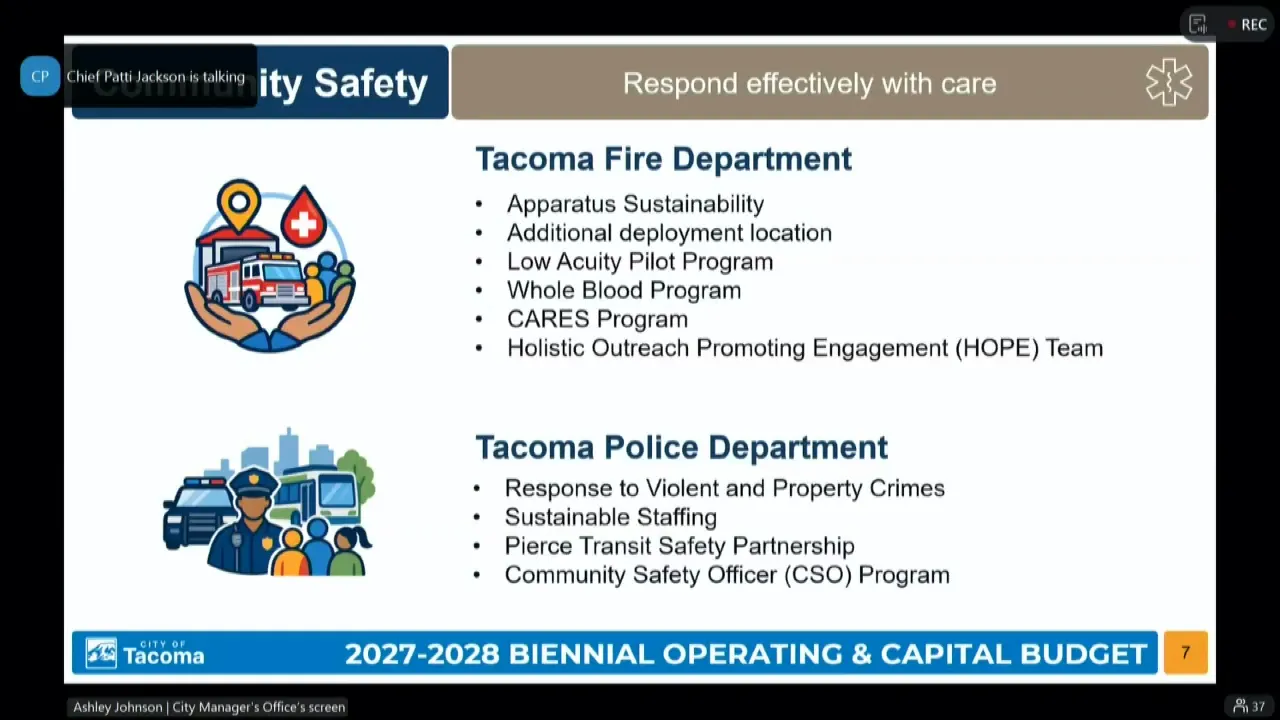
- Fire Chief Sionna Stallings-Ala'ilima, Police Chief Patti Jackson (remote), and Neighborhood and Community Services Director Toni Esparza presented the community safety portions of the proposed 2027-28 budget.
- They reported more than $557 million in all funds is invested citywide in community safety, with approximately 86 percent in police and fire.
- TPD has eight Community Liaison Officers with a plan to add at least four more, and has a state grant to add 12 entry-level officers. Chief Jackson said the 12 officers would be used for primary response, additional CLOs, and investigations.
- Chief Jackson discussed the Community Safety Officer (CSO) pilot, saying it showed limitations in scope and staffing. Councilmember Sadalgay said the proposal she had been told about would reduce CSO staffing by 40 percent, and she questioned why CSOs responded to only 17 percent of about 28,000 eligible calls over two years, with District 4 having the lowest call response. She said District 4 residents have trust concerns with uniformed response. Chief Jackson responded that CSO capacity, shift availability, and some tasks requiring certified peace officers explain some limits, and she welcomed further expert review of alternative response.
- TFD reported it trained 2,100 community members in CPR in 2025, conducted more than 6,000 fire and safety inspections, and processed nearly 8,000 fire protection compliance reports.
- The whole blood program launched as a county effort with Central Pierce and TFD carrying blood; 105 patients received whole blood countywide in 2025, 72 by TFD, and year-to-date numbers are 30 percent above last year.
- The CARES program served over 1,200 individuals in 2025 and 800 in the first quarter of 2026. The HOPE team has responded to more than 760 calls year-to-date, but staffing challenges remain, and Chief Stallings-Ala'ilima said 99 percent of HOPE responses are co-responses. She suggested HOPE may be more effective in a social services environment, with potential future billing and 988 dispatch pathways.
- NCS reported HEAL engaged 506 prohibited encampments in 2025 and 409 through September 2026, coordinating removal of more than 1.7 million pounds of waste in 2025 and approximately 1.3 million in 2026. HEAL offers 90-day belongings storage.
- Other community safety investments include BRAVE serving almost 2,400 youth in 2025 and 2,200 this year; domestic violence services supporting more than 1,000 residents in 2025 and almost 800 through September; designated crisis responders serving almost 800 in 2025 and more than 600 through September; and community trauma response responding to 22 incidents in 2025 and 16 through September, with a proposed $100,000 reduction.
Budget Workshop: Housing and Homelessness
- Director Esparza presented the housing and homelessness portion of the proposed budget, with over $90 million dedicated to this goal area: over half in NCS and just under half in Planning and Development Services.
- The city is working with Pierce County governments on an interlocal agreement, standardizing HMIS use, and standardizing inclement weather protocols. New 2026 investments include a 100-bed Tacoma Rescue Mission expansion, an emergency hotel expansion with St. Vincent de Paul, and a medical/social service shuttle.
- HEAL outreach served more than 1,800 individuals in 2025 and more than 1,500 through September 2026; more than 1,100 accepted services in 2025 and 900 this year; and 418 people were placed into shelter in 2025 and 188 through September.
- City-funded shelter investments supported more than 5,000 individuals in 2025 and approximately 4,500 through September. Known transitions into housing were 838 in 2025 and 528 this year.
- The proposed budget anticipates 518 shelter beds. Of those, 378 are funded for the full biennium, while 140 rely on state commerce funding that ends in June 2027 and are at risk without renewal or replacement funding.
- Thames 3, the temporary emergency micro-shelter for families, is relocating near 69th and Proctor, with a community meeting scheduled for that week and an expected opening by mid-November. The stability site with 58 micro-shelters must move from a floodplain; $850,000 in congressional appropriation funding is on the council agenda for that relocation.
- The budget includes approximately $31.6 million in human services contract funding, an approximate $1 million reduction, including reducing Tacoma-Pierce County Health Department funding to the amount identified in the interlocal agreement.
- Affordable housing work includes the MFTE program approving 725 new homes this biennium, including 144 affordable to households earning 70 percent of area median income. Four city-supported developments placed 138 affordable homes into service in 2025 and 227 through September 2026; five under-construction projects are expected to deliver 311 homes; the city has invested more than $23 million in these projects.
- Homeownership support helped 25 Tacoma residents with down payment assistance. Home repair investments funded seven major rehabilitations and 60 minor repairs.
- Eviction/instability prevention includes a landlord-tenant program completing more than 1,000 intakes in 2025 and 881 through September; legal assistance for more than 280 residents in 2025 and 150 through September; and nearly $740,000 in rent/financial assistance in the recent biennium, with approximately $900,000 proposed for 2027-28.
- Councilmembers expressed support for continued state advocacy and for the human services needs assessment. Councilmember Rumbaugh asked about right-of-way housing referrals and the 140 commerce-funded shelter beds; Councilmember Palmer asked about grant-seeking capacity; and Councilmember Heinz noted the city funds 518 shelter beds and wants to keep working with state legislators.
Downtown Tacoma Holiday Market Sponsorship
- Councilmember Rumbaugh requested $30,000 in council contingency funds for Downtown for the Holidays, co-sponsored by Councilmembers Heinz and Walker.
- The 2025 Downtown for the Holidays Market received $35,000 in contingency funds and was a single-day, free family event on December 13 from 1 to 6 p.m. at Theater Square, with 25 vendors and more than 1,000 attendees. The request would expand the market to two days.
- Funding would support approximately $10,000 for tented vendor booths, heaters, and a covered gathering area; holiday decor such as window paintings and lights; and event production, permits, insurance, marketing, signage, entertainment, and family activities.
- JD Elk, Director of Placemaking and Experience for the Downtown Tacoma Partnership, said the event cost about $45,000 overall last year, and the organization is moving toward a sponsorship-funded model. He said the goal is to make the event self-funding and not return with a similar request next year.
- Councilmember Scott questioned whether the city should provide such a large share of the event budget and whether contingency fund practices should be reviewed. Councilmember Sadalgay noted the council generally does not provide year-over-year event funding through contingency requests and said many District 4 events did not receive such requests. Councilmember Diaz asked about including businesses outside the DTP footprint and suggested seeking sponsors such as UW Tacoma.
Committee Reports and City Manager's Weekly Report
- No committee reports were given.
- City Manager Hyun Kim reported two proclamations for that evening: October 28, 2026 as National Immigrants Day and October 2026 as National Co-op Month.
- He noted a staff-recommended agenda modification to move the city manager report earlier in the evening, a presentation by Tacoma Public Schools Superintendent Dr. Garcia on Beyond the Bell and youth programming, public comment periods, a public hearing on the proposed 2027-28 operating and capital budgets, and a special Transportation Benefit District governing board meeting immediately after the council meeting.
Key Outcomes
- No formal votes were taken on the briefing items; the requests remain under council consideration during the budget process.
- The therapeutic court request is prioritized around the supervision specialist and data analyst, with the $533,000 ask not currently in the proposed budget.
- The CSO program reduction and future of alternative response remain open policy questions, with Chief Jackson saying TPD would welcome further expert review.
- The holiday market resolution is expected to be voted on November 10, 2026.
- The meeting adjourned by voice vote on a motion and second.
Meeting Transcript
I'd like to call to order the city council study session of October 27th, 2026. Clerk, please call roll. Deputy Mayor Bushnell. Councilmember Diaz? Councilmember Heinz. Here. Councilmember Palmer. Councilmember Rumbach? Here. Councilmember Sadalgay? Here. Councilmember Scott? Here. Councilmember Walker? Here. And Mayor Ibsen. Here. Our first agenda item is the therapeutic court approach model. For this, I would like to call on municipal court judges Steve Krupa and Sergio Flores to begin the presentation. And I see G Sontag here too. You're also welcome if you like. I guess not. All the judiciary is welcome if you like, or you can stay there. Your choice. Um, yes. Okay, over here. Okay, do I need to turn anything on? Yes, please. Okay. No one. All right. So let's wait for Judge Flores. But good afternoon, everybody. Okay, so the reason we're here is because we've had some questions from you. I know uh it says on the uh paperwork, the therapeutic approach uh to justice and our therapeutic courts, but we've talked with you about that, and what we're here for today really is to kind of answer your questions and see if you have uh if you have further questions. And um, I think some of what we were hearing from you folks after our last presentation was hey uh you've asked for a lot. Can you kind of prioritize that and can you give us a little more of an explanation about what you hope to achieve here? So that's what we tried to do uh with this slide deck. Um, hence prioritize critical needs on the cover sheet. Anyway, it's I think it's worth uh next slide, please. I think it's worth just repeating what our approach is at at Tacoma. And again, we call it the therapeutic approach uh to uh criminal justice. Uh and what we're trying to do, of course, is address the root causes of criminal behavior, and most importantly, in doing that is connecting people with the services they need to change their lives. And as we've told you uh before in our last presentation, ultimately this is gonna make the city safer, it's gonna make it a better city for for all of our residents. So, do I st do we still want all four of those positions filled?
SUMMARIZED BY OPENPUBLICA AI
TRANSCRIPT VIA PUBLIC VIDEO
openpublica.com
openpublica.com