City Council Joint Work Session on Title 16 Subdivision Code Revision - May 7, 2025
STREAMING COPY IN PREPARATION — RECORDING AVAILABLE FROM THE ORIGINAL SOURCE
City Council Joint Work Session on Title 16 Subdivision Code Revision - May 7, 2025
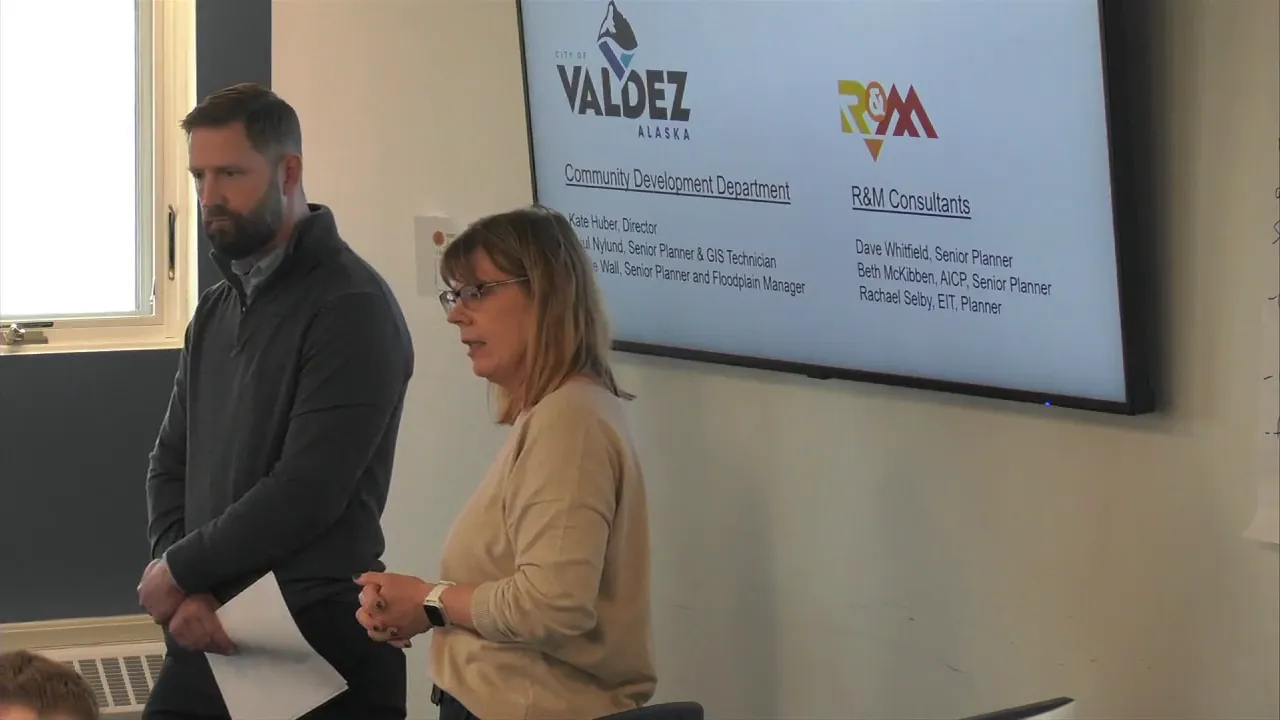
The Valdez City Council and Planning & Zoning Commission held a joint work session on May 7, 2025, at 5:30 PM to begin the process of revising Title 16 (Subdivision Code). The session was led by Community Development Director Kate Huber, Senior Planner Paul Nyland, and consultants Dave Whitfield and Beth McKibben of RM Consultants. The goal is to align Title 16 with the 2021 Comprehensive Plan and the recently updated Title 17 (Zoning Code). The project timeline targets a draft ordinance for Planning & Zoning Commission recommendation and City Council adoption by the end of 2025.
Public Comments & Testimony
- Alan Minish (surveyor, Wrangle Mountain Technical Services) expressed support for creating an administrative plat process for simple lot line adjustments, noting that the current requirement to go before the Planning & Zoning Commission adds unnecessary cost and delay. He cautioned that any new requirements (e.g., snow storage, improvements) increase costs to developers and ultimately to homebuyers, potentially hindering housing development. He urged the city to establish clear criteria for Planned Unit Developments (PUDs), citing the St. Patrick's subdivision process as a costly and contentious experience due to a lack of guidelines. He also requested that right-of-way setbacks be considered as part of snow storage calculations and that standard deed forms for snow storage track dedication be created.
Discussion Items
- Formal Criteria for Variances/Waivers – The current code gives the Planning Commission power to waive provisions without criteria. The team proposed adding clear, consistent standards (like those in Title 17) to ensure defensible, non-arbitrary decisions. Planning Commission members and council expressed strong support, noting that guidelines would benefit both applicants and decision-makers.
- Minor vs. Major Subdivisions – The code defines minor subdivisions (4 lots or fewer) but lacks a separate process. The team suggested creating an administrative review process for minor subdivisions to expedite approvals, especially given Valdez’s short building season. Council and commission discussed appropriate notification (e.g., mailed letters to nearby property owners) and the need to consider density, not just lot count, when defining thresholds.
- Snow Storage Areas and Lots – Title 16 requires dedication of snow storage to the city but lacks a clear process. The team proposed establishing a consistent mechanism (e.g., dedicating a tract vs. part of right-of-way) and clarifying off-season uses. Public Works Director Nate noted that the current formula (1 sq. ft. of snow storage per 1 sq. ft. of built road) works but does not account for snow from private driveways or equipment. Staff emphasized that Title 17 now requires new developments to show an on-site snow storage plan, and Title 16 should handle right-of-way snow storage.
- Vacations of Public Right-of-Way – The code currently has no process for vacating public rights-of-way. The team proposed establishing criteria to evaluate whether a right-of-way is no longer needed and is in the public interest. Council members noted that this issue arises occasionally and that a transparent process is important.
- Public Improvements – Title 16 lacks standards for required improvements (roads, sidewalks, streetlights, parks). The team suggested creating standards (with flexibility) to give developers certainty and prevent lowest-cost defaults. Discussion focused on scaling improvements by zone (urban vs. rural), density, or proximity to amenities. Council member Don DeCorso preferred to see a draft before specific comments, while others supported sidewalks and lighting in-town but not in rural areas.
- Alternative Subdivisions / Conservation Subdivisions – The team introduced the concept of allowing higher density in developable areas in exchange for setting aside hazard areas or sensitive lands (e.g., wetlands, steep slopes). Staff noted that a similar tool exists under Title 17 as a Planned Unit Development (PUD), and questioned whether a separate mechanism is needed. Council member Jimmy Devons cautioned about unintended consequences (e.g., zero-lot lines and snow shedding) but acknowledged potential benefits for preserving open space and recreation.
- Definitions – The team noted that several terms used in Title 16 are not defined, leading to ambiguity. Adding clear definitions would improve consistency, transparency, and reduce legal risks. No opposition was expressed.
- Final Plat Certifications – Staff requested review of the certification statements on final plats to align with common practices in other Alaska communities and clarify responsibilities. Support was noted.
Key Outcomes
- No formal votes were taken, as this was a work session. The following directions were established:
- Staff and consultants will incorporate feedback from the meeting into a draft ordinance.
- Continued outreach will be conducted with surveyors, utility companies, and other stakeholders.
- The draft ordinance is expected to go to the Planning & Zoning Commission for recommendation and then to City Council for adoption by the end of 2025.
- The team will analyze other Alaska communities’ approaches (e.g., Anchorage, Juneau) to inform standards for improvements, snow storage, and administrative processes.
Meeting Transcript
So we adopted the comp plan in 2021. And as you know, many of those high priority action items that we had in the comprehensive plan tied directly to the zoning code and Title 17. So the next step of that process was to revise the zoning code and to really bring it into alignment with the vision of the comprehensive plan, which was pretty drastically different than the previous comp plan. And so you you all went through that process with us or are very familiar with it. So we made a lot of really drastic changes to our land use regulations within the zoning code. And so now the natural next step that we need to do is to bring our subdivision code, which is related to you know how we subdivide land and uh how parcels are changed or modified in our community to make sure that it's in alignment with Title 17 and everything goes together, works together well. Um but also it's just another way that we are implementing our comprehensive plan. So I know our our team, our consultant team will talk more about that. Um but we've been really excited, we've been working together on this project. But this is really the formal kickoff. We've been doing a bit of work behind the scenes to analyze the existing code and to look at Title 17 and the comprehensive plan to outline the goals for this project. But this is really the beginning. So the purpose of the work session tonight is for us to try to bring everyone up to speed and just revisit what exactly Title 16 is and what the role of our planning and zoning commission is within Title 16, and also then the role of city council. Um, and then um and then we want to get feedback from you what what is working in the current code, what isn't working. We also, as you saw in the agenda packet with the attached memo, um, we've gone through, you know, from the staff perspective and the consultant perspective, identify the areas that we know we need to look at. So if you know if anyone um doesn't have a lot of feedback right off the bat, these are the topics that we're gonna walk through tonight and um ask for your opinions on. So um on I'll I'll just do kind of a general introduction of the team, everyone's names are up here, um, and then as presenters come up, I'll let you introduce introduce yourself. So on the city side, um, you all know me, Kate Huber, the community development director, um, and then our staff working on the project is Paul Nyland, senior planner, and Ruth Wall, senior planner, you know as well. Um, and then uh we're really excited to be working with RM consultants, um, an Alaskan firm that um you know we've wanted to work with for the our department for a long time, and this was a great fit for this project. Um so you'll meet Beth and Dave and Rachel, but I'll let you introduce yourselves more completely when you come up. Um so with that our uh the other thing I just wanted to mention, I'll um say generally what the timeline for this project is, and then let Dave build on that if he has any more specifics. Um but so tonight is kind of the initial public kickoff input gathering, um, and then we're gonna go back and start incorporating the feedback we receive and what we've been working on as staff into a draft. Um, and then ultimately our target is to look at bringing this to you to planning and zoning commission first for recommendation and then to city council for adoption before the end of this year. So it's pretty aggressive timeline. Um, as you you probably noticed in reviewing the code, Title 16 is not as extensive as Title 17. So this project is gonna take a little less time than Title 17, but it really is that important final step in implementing even Title 17. So with that, I would have Paul come up and talk a bit about the existing Title 16. Oh, just come on up, Paul. But did anyone have any questions about process or before we move on to the next topic? Okay, I think we'll try to kind of stop and take questions along the way, and then um we'll open it up for a broader discussion after Dave wraps up his part of the presentation. Thanks, Kate. Um, yeah, I think I know everybody here, but just a real quick Paul and Island. Um, been with the city now for 17 years and been with the community community development department for the last seven and been working really closely with Title 16. And um it works, it functions, but it could use uh an update. So I'm pretty excited about this because I do work with it closely. And I'm not gonna go through all the the specifics of the title. You can you have that paper copy and in your packet, but I would like to go through just sort of what our subdivision process is at the city, and just what I do when somebody comes up to me and say, Hey, I've got this piece of property on a subdivide, or I want to join these two lots or whatever. They they come in and they ask some questions, hopefully, and then I um just try to get an idea of what they want to do and just get a general impression. Then I give them a subdivision application, which um is technically not always accurate because it's subdividing is only if you're gonna cut one lot into smaller lots, right? So it's it should be a platting action application, which is part of this process. We might want to rename it, but um, and subdivision code as well, because it's not all subdivisions, it's platting actions. So I got a couple several checklists I follow. Um, this general staff checklist is just a guideline for me. So after that, that informal meeting, they start to fill out the application, and I go back and forth with the applicant, making sure everything is, you know, generally there's nothing glaring that's gonna cause them to you know for cause them to fail in their their attempt to do what they want to do. So we work the application, we get it down to ready to submit. Um, they usually hire a surveyor or they have to hire a surveyor, a stamp surveyor, and then part of the application process is them sort of signing off on me being able to work directly with the surveyor to bring their their project forward. Um, once we get a preliminary plat that's sort of you know good enough to start working with, I'll work with the surveyor, and we'll try to if we find any errors or issues beforehand before um set sending it to the commission, we'll we'll work those things out. And um during that time, once we get it get an accepted application, I'll send it off to Nicole Chase and in the community development. She does a zoning review, make sure there's nothing glaring. Um that's the subdivision's gonna create some sort of um code violation.
openpublica.com